Hidatsa Scalp Dance
Download
jpeg(87.25 kb)
For information on accessing a high resolution version of this image suitable for print reproduction please visit the Rights and Reproduction page.
Artist
Karl BodmerBirth and death dates
1809 - 1893Artist Nationality
SwissTitle
Hidatsa Scalp DanceDate
January 1834Dimensions
10 13/16 × 12 5/8 in. (27.5 × 32.1 cm)Medium
Watercolor and graphite on paperInstitution
Joslyn Art MuseumCredit Line
Gift of the Enron Art FoundationAccession Number
1986.49.279Rights (i.e. copyright information)
Joslyn Art MuseumPhotographer credit
Photograph © Bruce M. White, 2019Commentary
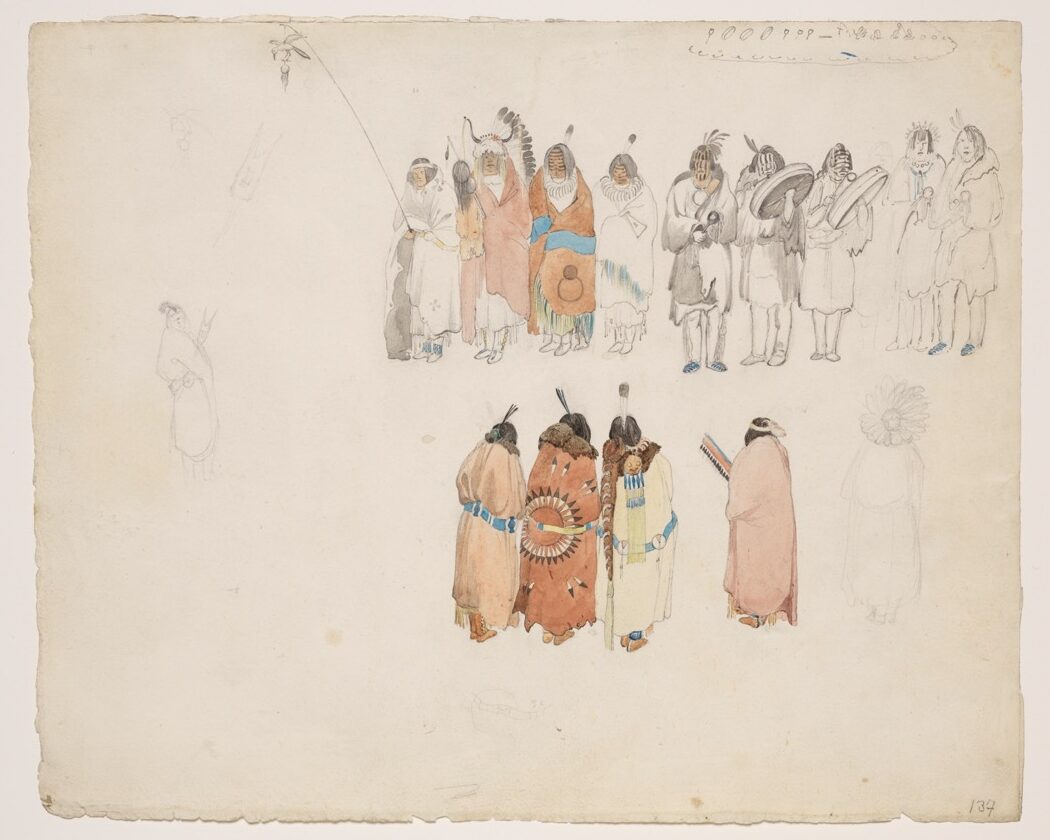
The Hidatsas came to Fort Clark to perform their scalp dance twice in 1834, once in February after a retaliatory raid on some horse-stealing Assiniboins, and again in April after a surprise attack on a Sioux camp. The women played a principal role in these victory dances. They donned military attire, painted their faces like warriors, carried weapons, and displayed scalp trophies. In this image several women wear coup feathers in their hair, and one has on the horned feather bonnet reserved for acknowledged war leaders. Another holds a long pole from which dangles a stuffed bird with a hoop-mounted scalp fastened to its claws. Musical accompaniment is being provided by the men at the right with drums and rattles. The small drawing in the upper right corner may be a diagram of the dance arrangement, with representations of rattles, drums, the bird and scalp, and other figures showing the positioning of the dancers. Each of these three works is apparently a preliminary drawing for Tableau 27, a vivid aquatint portrayal of a scalp dance with over three dozen participants and observers. However, the lone penciled figure at the left in this image is unrelated to the aquatint, as is the detail above of his mirror.
References in Journal
Remarks on the Indian Tribe of the MandansLabels:
studyApproximate Depicted Location:
Fort Clark, North Dakota