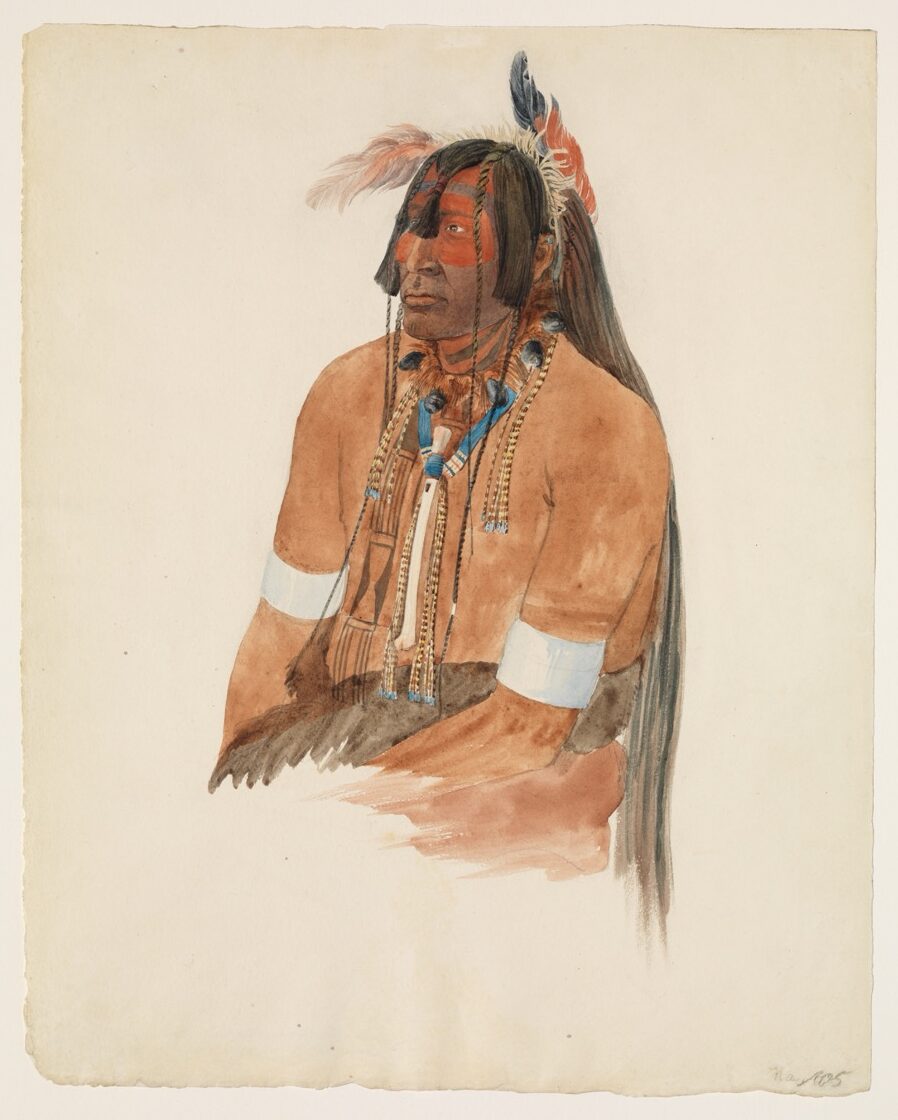
Possibly Ahschüpsa-Masihichsi, Hidatsa Man
Download
jpeg(95.61 kb)
For information on accessing a high resolution version of this image suitable for print reproduction please visit the Rights and Reproduction page.
Artist
Karl BodmerBirth and death dates
1809 - 1893Artist Nationality
SwissTitle
Possibly Ahschüpsa-Masihichsi, Hidatsa ManDimensions
12 1/2 × 10 in. (31.8 × 25.4 cm)Medium
Watercolor and graphite on paperInstitution
Joslyn Art MuseumCredit Line
Gift of the Enron Art FoundationAccession Number
1986.49.249Rights (i.e. copyright information)
Joslyn Art MuseumPhotographer credit
Photograph © Bruce M. White, 2019Commentary
An inscription on the reverse of this portrait refers to the subject as Ahschüpsa Masihichsi. A nearly identical inscription appears on the reverse of the portrait reproduced in Image 1986.49.389. From a statement in the German edition of Travels in the Interior of North America, Image 1986.49.389 definitely depicts Ahschüpsa Masihichsi, but there is no corroborating data for the inscription associated with this one and, while there is some likeness of facial features and dress, the two pictures may represent two different individuals. Given the similarity of hair, dress, clothing, and ornament between the two tribes, the subject here could be either Mandan or Hidatsa. Whistles made of the bones of large birds and worn around the neck were common among Plains peoples. They are frequently referred to as war whistles and were used in battle to signal attack. They also had strong ceremonial associations and were often among the insignia of men's societies. For example, various Mandan societies were distinguished by whistles made of goose, crane, or swan bones. However, whistles made of eagle bone were most prevalent overall. Whistles were often beautifully ornamented, and the ornamentation could be part of an identifying society insignia.
Labels:
genre, portraitApproximate Depicted Location:
Fort Clark, North Dakota