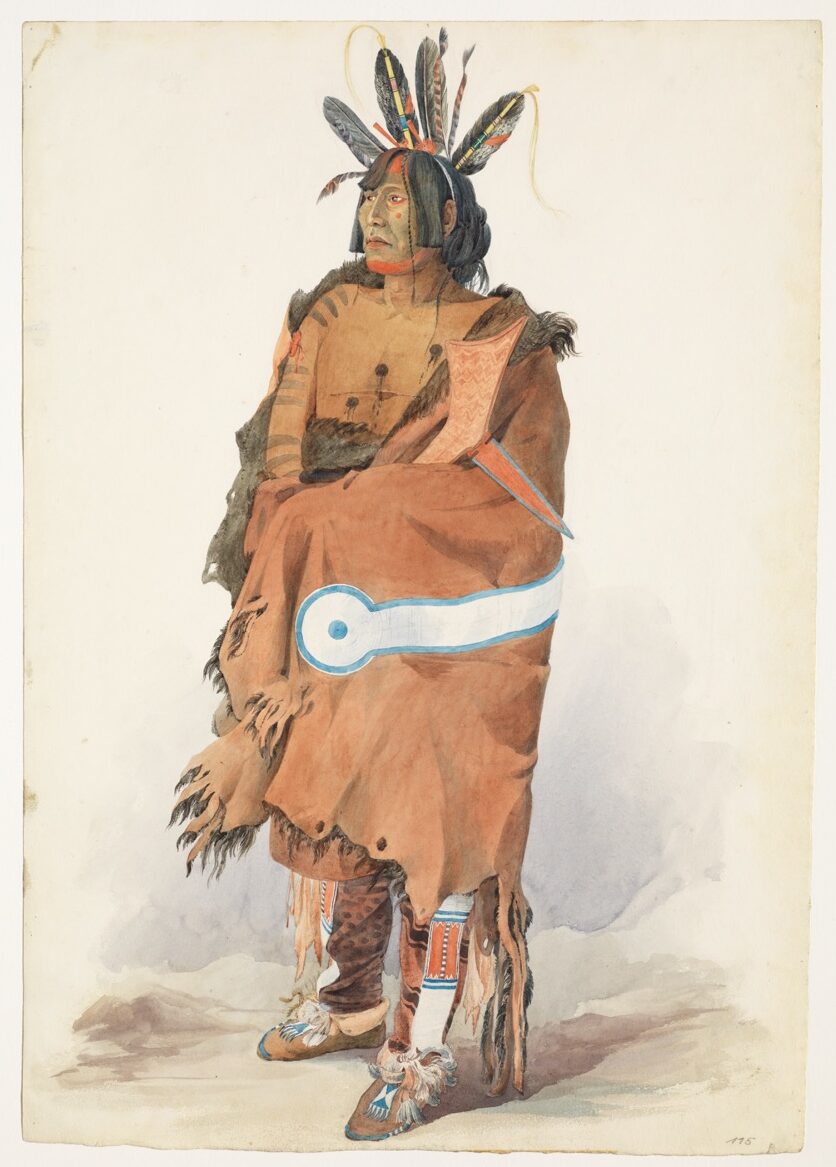
Pachtüwa-Chtä, Arikara Man
Download
jpeg(110.99 kb)
For information on accessing a high resolution version of this image suitable for print reproduction please visit the Rights and Reproduction page.
Artist
Karl BodmerBirth and death dates
1809 - 1893Artist Nationality
SwissTitle
Pachtüwa-Chtä, Arikara ManDate
March 6, 1834Dimensions
17 × 12 in. (43.2 × 30.5 cm)Medium
Watercolor and graphite on paperInstitution
Joslyn Art MuseumCredit Line
Gift of the Enron Art FoundationAccession Number
1986.49.258Rights (i.e. copyright information)
Joslyn Art MuseumPhotographer credit
Photograph © Bruce M. White, 2019Commentary
Maximilian and Bodmer met very few Arikaras on the expedition, but there is frequent mention of the Arikaras in the diaries usually in regard to their numerous hostile actions against the whites and other Indians. The man in this portrait, for example, was a member of a war party that attacked and killed three traders near the Heart River in 1830. His appearance is certainly that of a proud, successful warrior. He carries a gunstock club with a painted metal blade. His chest is embellished with marks that seem to represent gunshot and slash wounds and the ornaments in his hair, such as the cylindrical red sticks, probably commemorate other wounds and war deeds. Pachtüwa-Chtä was a friend of the Mandan chief Mató-Tópe, who introduced the Arikara to Maximilian and Bodmer in March of 1834 at Fort Clark. In return for posing for his portrait, Pachtüwa-Chtä asked for a picture of his own-a bear drawn by Maximilian against a forested background supplied by Bodmer. Since there are beaded representations of bear paws on Pachtüwa-Chtä's moccasins, his request for an image of a bear may have been related to his personal medicine, or power. This portrait was later reproduced as Vignette XXVII of the aquatint atlas.
References in Journal
March 6, 1834Labels:
genre, portraitApproximate Depicted Location:
Fort Clark, North Dakota