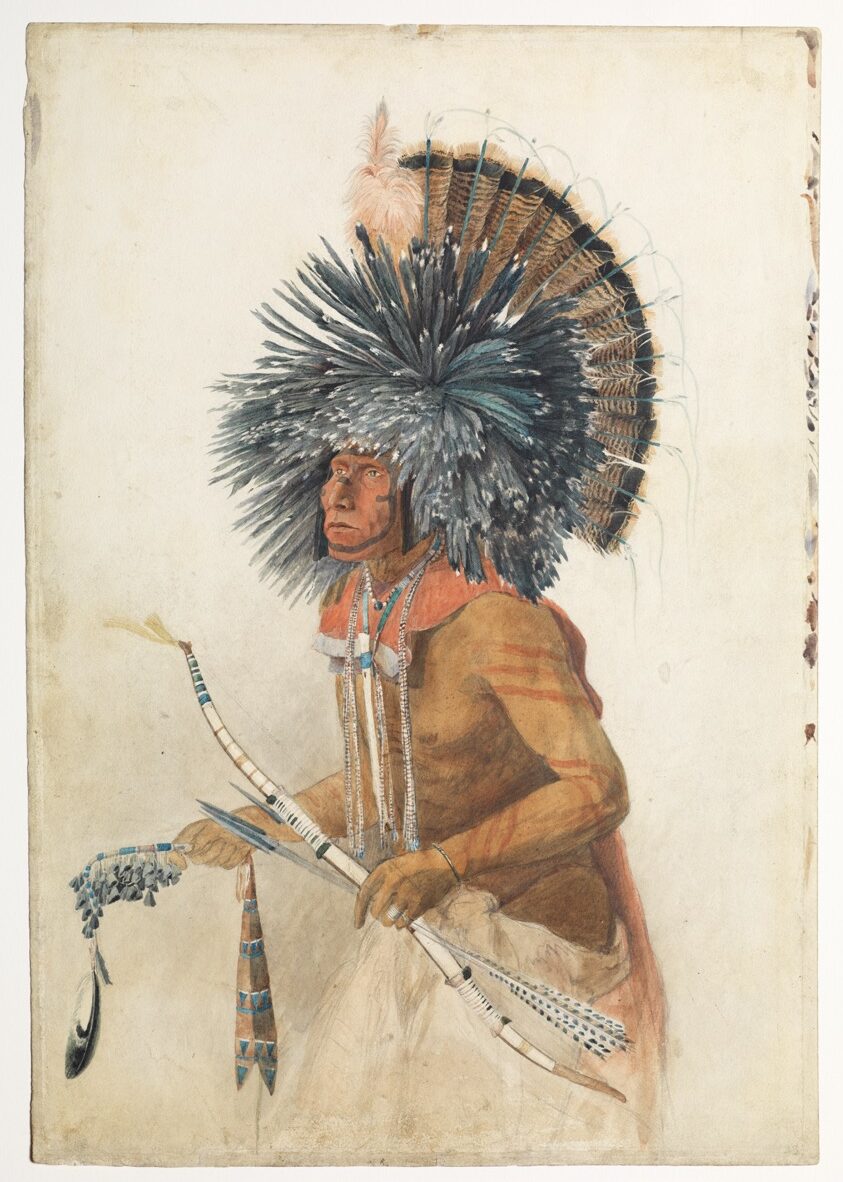
Péhriska-Rúhpa, Hidatsa Man
Download
jpeg(161.44 kb)
For information on accessing a high resolution version of this image suitable for print reproduction please visit the Rights and Reproduction page.
Artist
Karl BodmerBirth and death dates
1809 - 1893Artist Nationality
SwissTitle
Péhriska-Rúhpa, Hidatsa ManDate
March 12, 1834Dimensions
17 1/8 x 11 15/16 in. (43.5 x 30.3 cm)Medium
Watercolor and graphite on paperInstitution
Joslyn Art MuseumCredit Line
Gift of the Enron Art FoundationAccession Number
1986.49.275Rights (i.e. copyright information)
Joslyn Art MuseumPhotographer credit
Photograph © Bruce M. White, 2019Commentary
Péhriska-Rúhpa was a principal leader of the Dog Society of his village, and in March of 1834 he posed for a portrait dressed in his society regalia. According to Maximilian he was wearing at that time a large black cap made of magpie tail feathers with a wild turkey tail in the middle, a war whistle, and a long scarflike cloth trailer which was red over the left shoulder and blue over the right. The red and blue trailer appears on a portrait of Péhriska-Rúhpa by Maximilian and is mentioned in the diaries as part of Hidatsa Dog Society regalia. Bodmer, however, pictures the trailer here and in the corresponding aquatint as red, the color Maximilian ascribes to the trailer worn by Mandan Dog dancers. Although Maximilian states that Bodmer's depiction of Péhriska-Rúhpa is representative of both Mandan and Hidatsa Dog Society costumes, there were differences in insignia between the two tribes and probably between villages as well. The headdress is impressive. The white tips on the glossy black feathers indicate the attachment of a tiny down feather to the point of each plume, as Maximilian observed on the raven feather headdresses of Mandan Dog dancers at Fort Clark. The central, vertical plume is painted red. Dyed horsehair floats from colored sticks attached to the shafts of the turkey feathers. All of this was in constant motion as the dancer moved to the cadence of drum and rattle. The rattle, made of small hooves or dewclaws attached to a beaded stick, is also a society emblem. A magnificent, full-figure version of Péhriska-Rúhpa as a Dog dancer in Tableau 23 in the aquatint atlas presents him wearing the regalia shown here, a breechclout, and richly ornamented leggings and moccasins, in a dramatic pose evoking the action of the dance.
References in Journal
March 12, 1834Labels:
genre, portraitApproximate Depicted Location:
Fort Clark, North Dakota