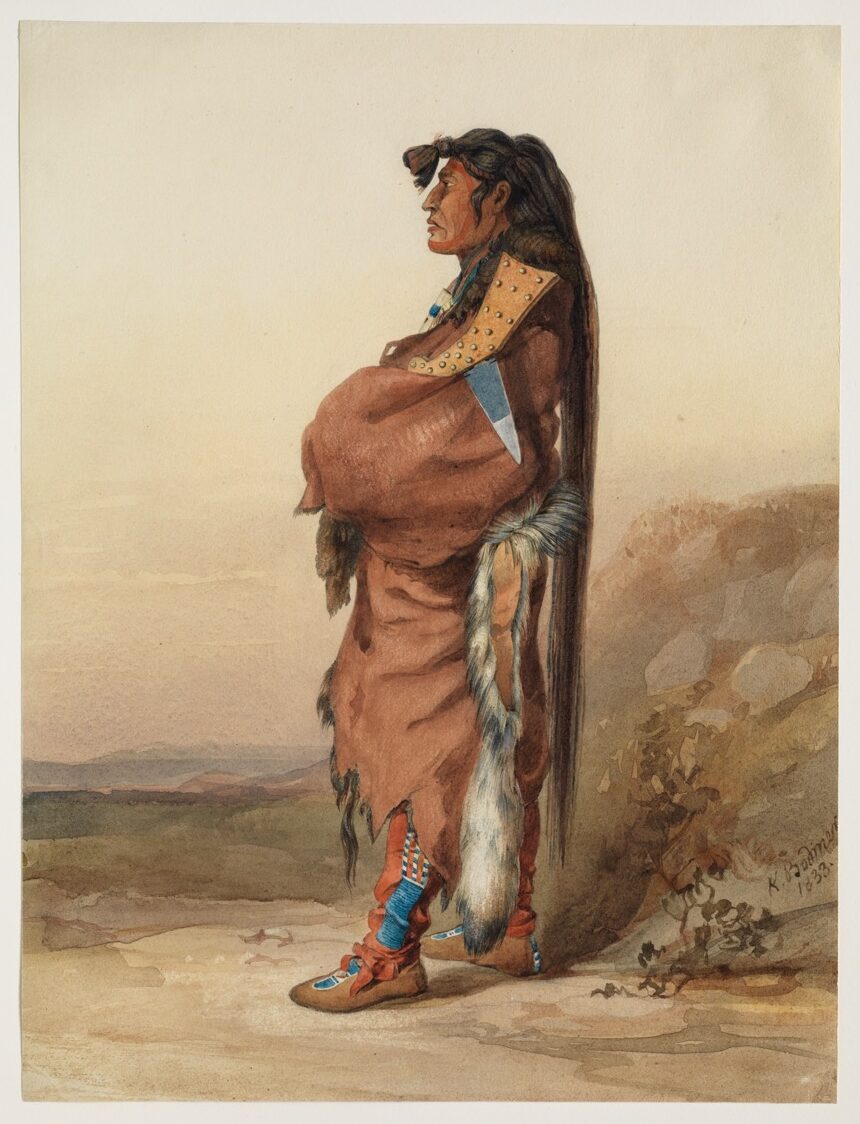
Ahschüpsa-Masihichsi, Hidatsa Man
Download
jpeg(136.38 kb)
For information on accessing a high resolution version of this image suitable for print reproduction please visit the Rights and Reproduction page.
Artist
Karl BodmerBirth and death dates
1809 - 1893Artist Nationality
SwissTitle
Ahschüpsa-Masihichsi, Hidatsa ManDate
February 28, 1834Dimensions
12 1/8 × 9 3/16 in. (30.8 × 23.3 cm)Medium
Watercolor and graphite on paperInstitution
Joslyn Art MuseumCredit Line
Gift of the Enron Art FoundationAccession Number
1986.49.389Rights (i.e. copyright information)
Joslyn Art MuseumPhotographer credit
Photograph © Bruce M. White, 2019Commentary
A portrait of Ahschüpsa-Masihichsi ("Chief of the Pointed Horn") was done on February 28, 1834, at Fort Clark. He objected to Bodmer's retaining the picture because he was about to leave on a military expedition and evidently feared that leaving his image with others might bring misfortune. When Bodmer refused to make a copy; Ahschüpsa-Masihichsi countered by drawing a picture of the artist-a very creditable likeness, according to Maximilian. The weapon Ahschüpsa-Masihichsi carries is a gunstock club, so named because the wooden handle was copied after the overall shape of a gun. This type of club was noted as early as the beginning of the seventeenth century and was most popular in the eastern woodlands area and on the upper Missouri. The blades, originally made of flaked stone, were later replaced by metal ones obtained from traders. As Maximilian notes in the German edition of Travels in the Interior of North America, Ahschüpsa-Masihichsi appears in Tableau 27 of the aquatints, the second figure from the left among the spectators at a scalp dance. He is pictured again among the Hidatsa men greeting Maximilian and Bodmer in Vignette XXVI.
References in Journal
February 28, 1834Approximate Depicted Location:
Fort Clark, North Dakota