Assiniboine Camp
Download
jpeg(141.59 kb)
For information on accessing a high resolution version of this image suitable for print reproduction please visit the Rights and Reproduction page.
Artist
Karl BodmerBirth and death dates
1809 - 1893Artist Nationality
SwissTitle
Assiniboine CampDate
June 30, 1833Dimensions
7 9/16 × 10 5/16 in. (19.2 × 26.2 cm)Medium
Watercolor on paperInstitution
Joslyn Art MuseumCredit Line
Gift of the Enron Art FoundationAccession Number
1986.49.379Rights (i.e. copyright information)
Joslyn Art MuseumPhotographer credit
Photograph © Bruce M. White, 2019Commentary
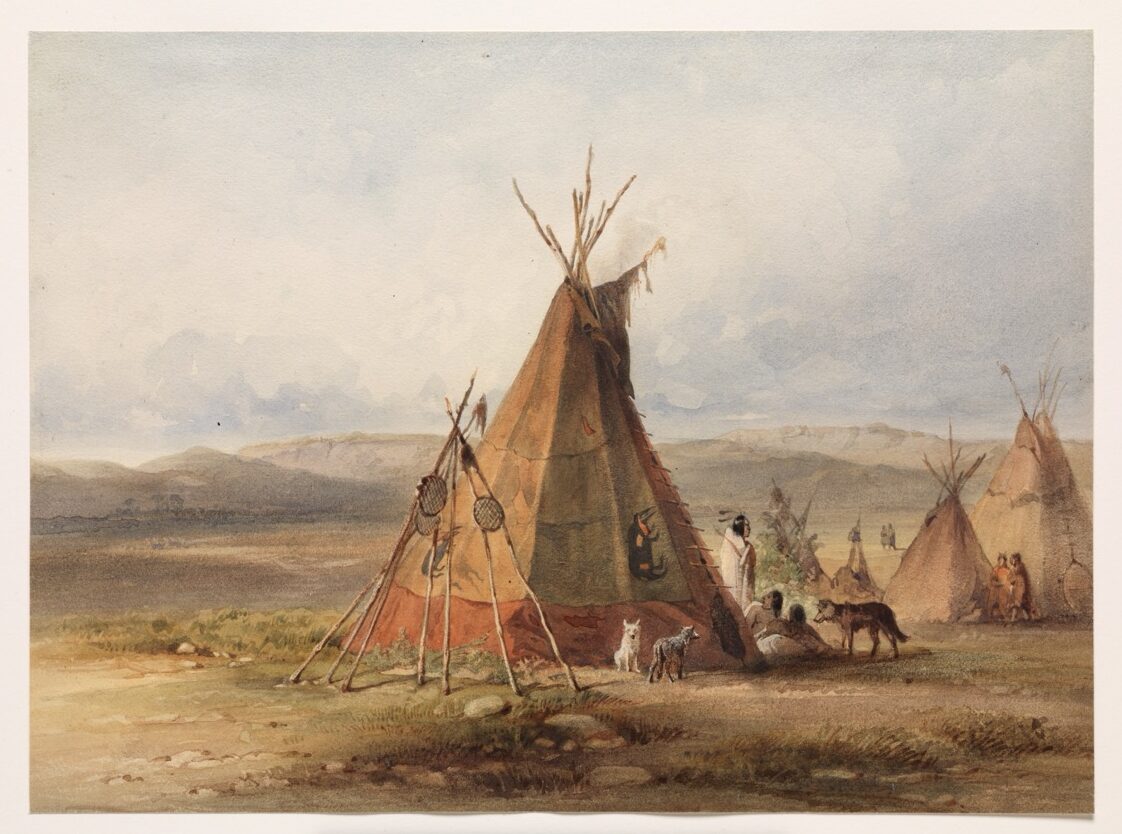
On June 30, a band of Assiniboines set up a camp of about twenty-five tipis at Fort Union. One of the tipis, the dwelling of a chief, was distinguished from the rest by the large bear figures painted on each of its sides. The bear was a symbol of strong supernatural power, a medicine sought after to insure success in battle or for aid in treating the sick. The man who owned this tipi presumably had obtained this special power. Three travois are propped together in front of the tipi, each consisting of a circular, netted platform attached to two long poles. The travois was used to transport baggage; bundles were strapped to the platform and the opposite ends of the poles were harnessed to an animal which dragged the load behind it. Dogs were used for this purpose long before the horse was introduced to the Plains, and continued to be so used long afterwards by groups who had relatively few horses, like the Assiniboine. The aquatint based on this watercolor (Vignette XVI) has an added detail showing a dog harnessed to a travois.
References in Journal
June 28, 1833Approximate Depicted Location:
Fort Union, North Dakota