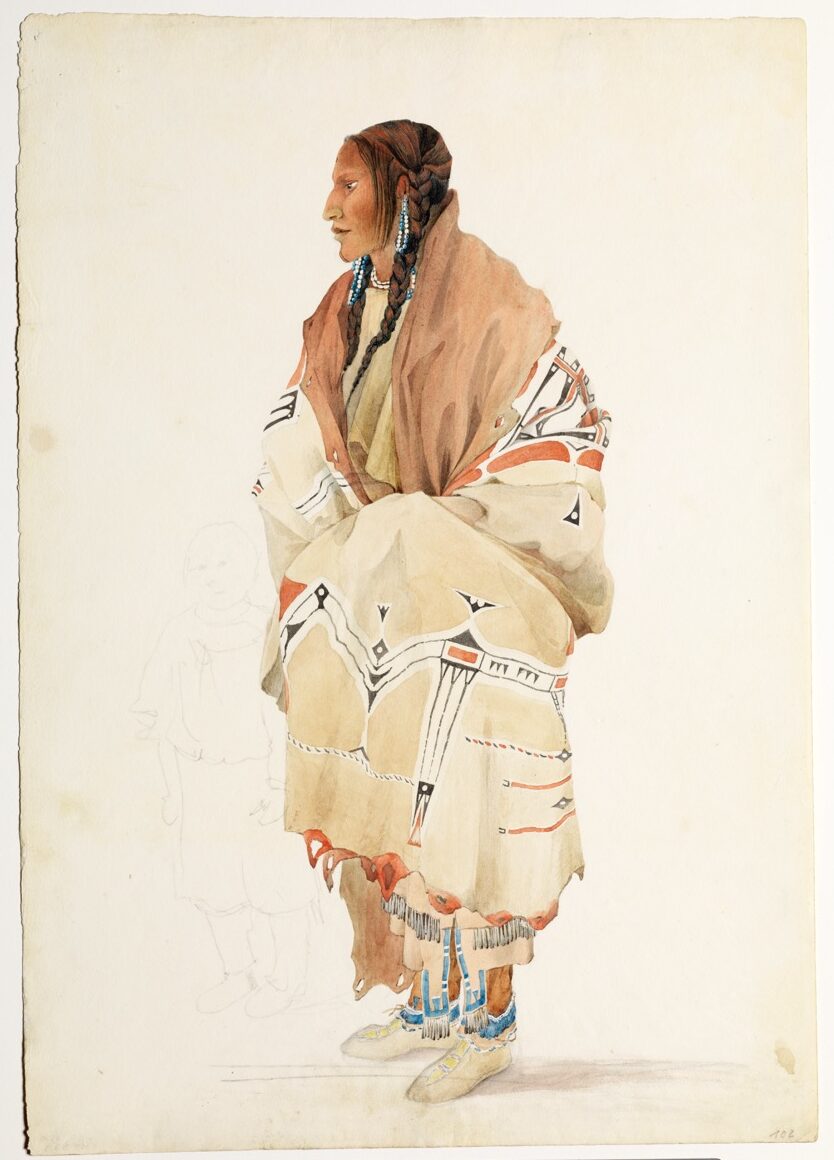
Chan-Chä-Uiá-Te-Üinn, Lakota Sioux Woman
Download
jpeg(94.37 kb)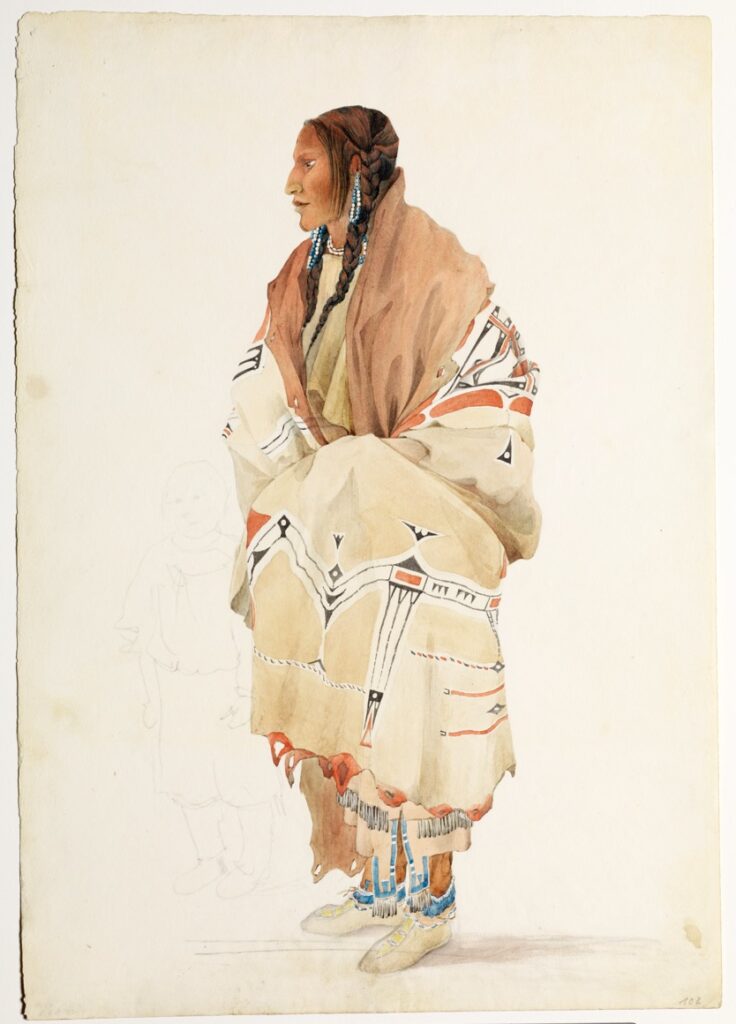
For information on accessing a high resolution version of this image suitable for print reproduction please visit the Rights and Reproduction page.
Artist
Karl BodmerBirth and death dates
1809 - 1893Artist Nationality
SwissTitle
Chan-Chä-Uiá-Te-Üinn, Lakota Sioux WomanDate
June 1, 1833Dimensions
17 1/8 x 11 7/8 in. (43.5 x 30.2 cm)Medium
Watercolor and graphite on paperInstitution
Joslyn Art MuseumCredit Line
Gift of the Enron Art FoundationAccession Number
1986.49.246Rights (i.e. copyright information)
Joslyn Art MuseumPhotographer credit
Photograph © Bruce M. White, 2019Commentary
The English meaning of the name of this Teton individual, "Woman of the Crow Nation," implies a former association or kinship with that tribe. Her portrait was painted at Fort Pierre on June 1. Chan-Chä-Uiá-Te-Üinn's dress is trimmed with blue and white beads and has a fringe of twisted metal cones at the hem. The cones or "tinklers" would make a musical sound as she walked. Over the dress she wears a painted summer robe, a buffalo hide with the hair removed to make it lighter in weight. The colorful pattern on the robe, an elaborate combination of geometric motifs, is called a box and border style. Box and border robes were popular on the central Plains, particularly among the Sioux. They are also frequently called "women's robes" and were indeed commonly worn by women. However, Bodmer depicted an Assiniboine man wearing a robe with a markedly similar design (Image 1986.49.257).
References in Journal
June 1, 1833Labels:
genre, portraitApproximate Depicted Location:
Fort Pierre, South Dakota