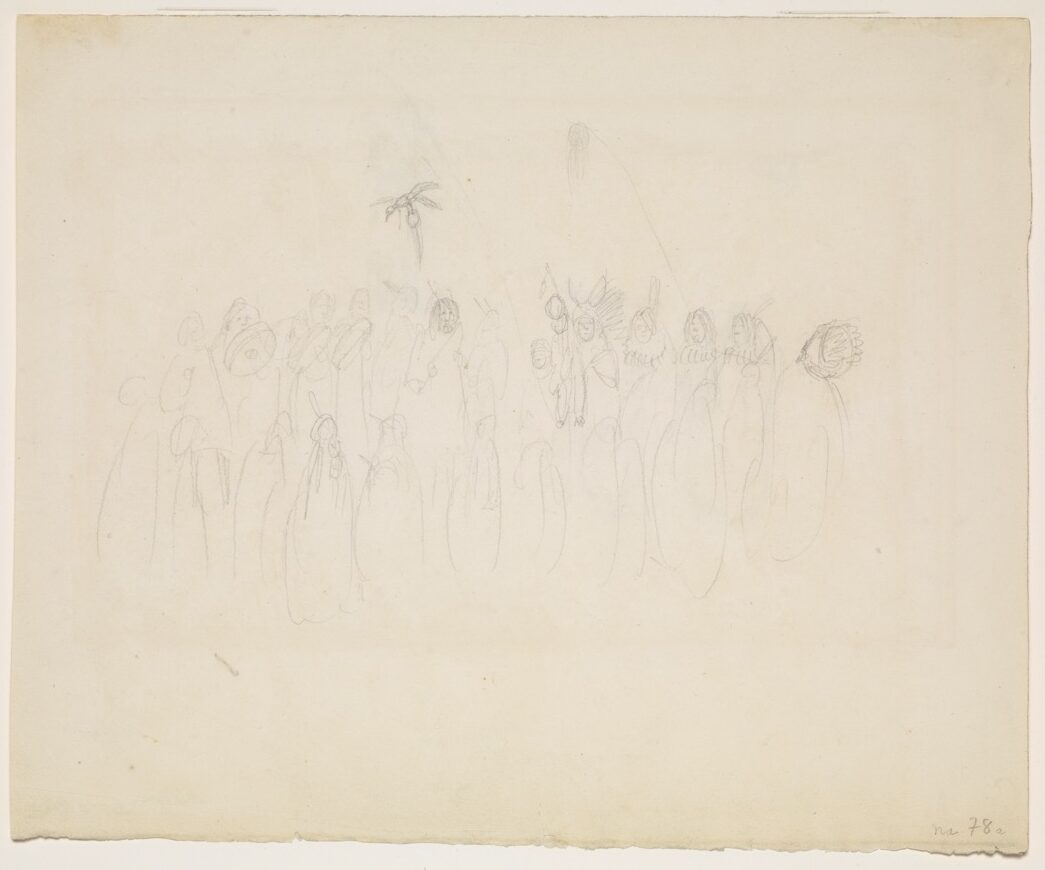
Hidatsa Scalp Dance
Download
jpeg(49.75 kb)
For information on accessing a high resolution version of this image suitable for print reproduction please visit the Rights and Reproduction page.
Artist
Karl BodmerBirth and death dates
1809 - 1893Artist Nationality
SwissTitle
Hidatsa Scalp DanceDate
November 1833Dimensions
10 x 12 1/4 cm. (25.4 x 31.12 cm.)Medium
Graphite on paperInstitution
Joslyn Art MuseumCredit Line
Gift of the Enron Art FoundationAccession Number
1986.49.223.ARights (i.e. copyright information)
Joslyn Art MuseumPhotographer credit
Photograph © Bruce M. White, 2019Commentary
In late November of 1833 Maximilian and Bodmer made a cold, tiring, nine-hour trek from Fort Clark to one of the Hidatsa winter villages to observe a ceremony. They stayed for several days, and this sketch may have been done at that time. Composed of about eighty households, the village is most probably Eláh-Sá, the largest of the Hidatsa settlements on the Knife River. Maximilian remarked on the dense arrangement of lodges in the winter villages, where the dwellings were of necessity packed closely together amid the thick, sheltering timber. A similar but more detailed scene appears as Tableau 26 in the aquatint atlas.
References in Journal
Short Description of Fort Clark and Its SurroundingsApproximate Depicted Location:
Eláh-Sá, Hidatsa Village