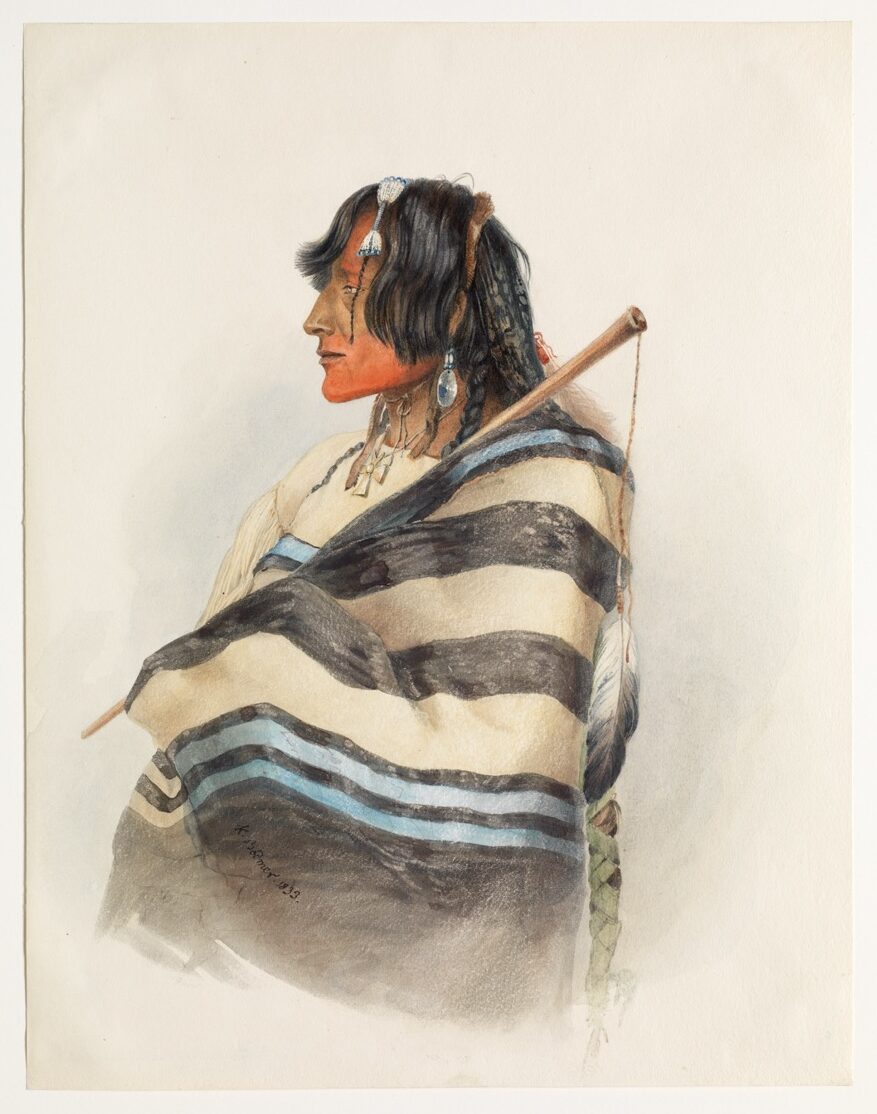
Kiäsax, Piegan Blackfoot Man
Download
jpeg(113.71 kb)
For information on accessing a high resolution version of this image suitable for print reproduction please visit the Rights and Reproduction page.
Artist
Karl BodmerBirth and death dates
1809 - 1893Artist Nationality
SwissTitle
Kiäsax, Piegan Blackfoot ManDate
June 19, 1833Dimensions
12 3/16 × 9 1/2 in. (31 × 24.1 cm)Medium
Watercolor and graphite on paperInstitution
Joslyn Art MuseumCredit Line
Gift of the Enron Art FoundationAccession Number
1986.49.395Rights (i.e. copyright information)
Joslyn Art MuseumPhotographer credit
Photograph © Bruce M. White, 2019Commentary
Kiäsax ("Bear on the Left") was married to a Hidatsa woman and was apparently living in one of their villages near Fort Clark. On June 19 he and Matsókuï, a young Blackfeet companion, joined Maximilian's party on the steamboat Assiniboine, intending to travel upstream to visit their relatives. Kiäsax's portrait was executed during the five-day journey to Fort Union. Uneasy about the numbers of unfriendly Indians encountered at that stop, Kiäsax changed his mind and returned to Fort Clark. His more impetuous friend remained behind, and was shot by a hostile Cree a few days later. Kiäsax wears a heavily fringed bighorn sheep skin shirt, and over this a blanket which Maximilian called Spanish. It is more likely Navajo, for the pattern of white, black, and indigo stripes is typical of an early Navajo style commonly called a First Phase chief blanket. The blanket and the metal cross around his neck are both evidence of trade between the Southwest and the Northern Plains. The beaded hairbow and the slender flute decorated with an eagle feather are more typical of the Upper Missouri tribes. Kiäsax's hair is smeared with clay and separated into tresses or plaits, including a long central braid bound in green cloth. Judging from its length, that braid may have incorporated an added switch of human or horse hair, a common Plains practice. This image of Kiäsax was incorporated into the crowds of figures in Tableau 43 of the aquatint rendition of the Piegan camp at Fort McKenzie.
References in Journal
June 21, 1833Approximate Depicted Location:
Between Fort Clark and Fort Union