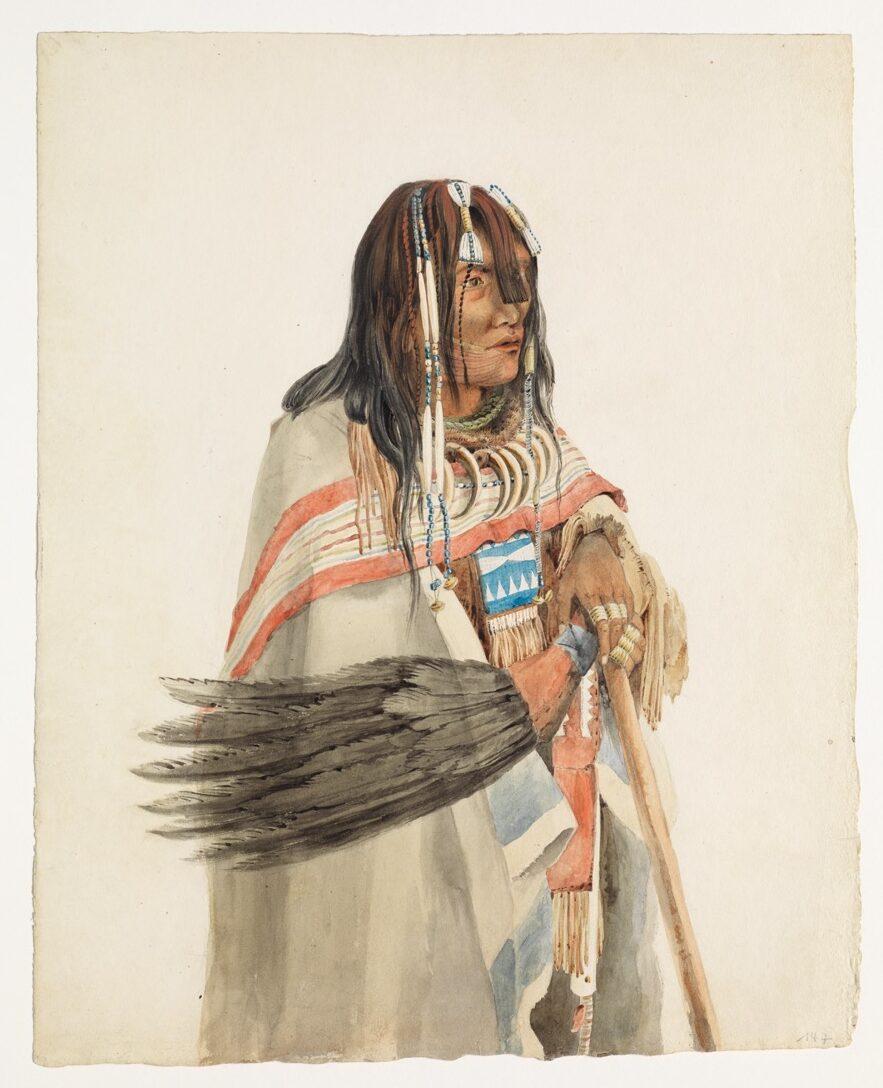
Makúie-Póka, Piegan Blackfeet Man
Download
jpeg(113.42 kb)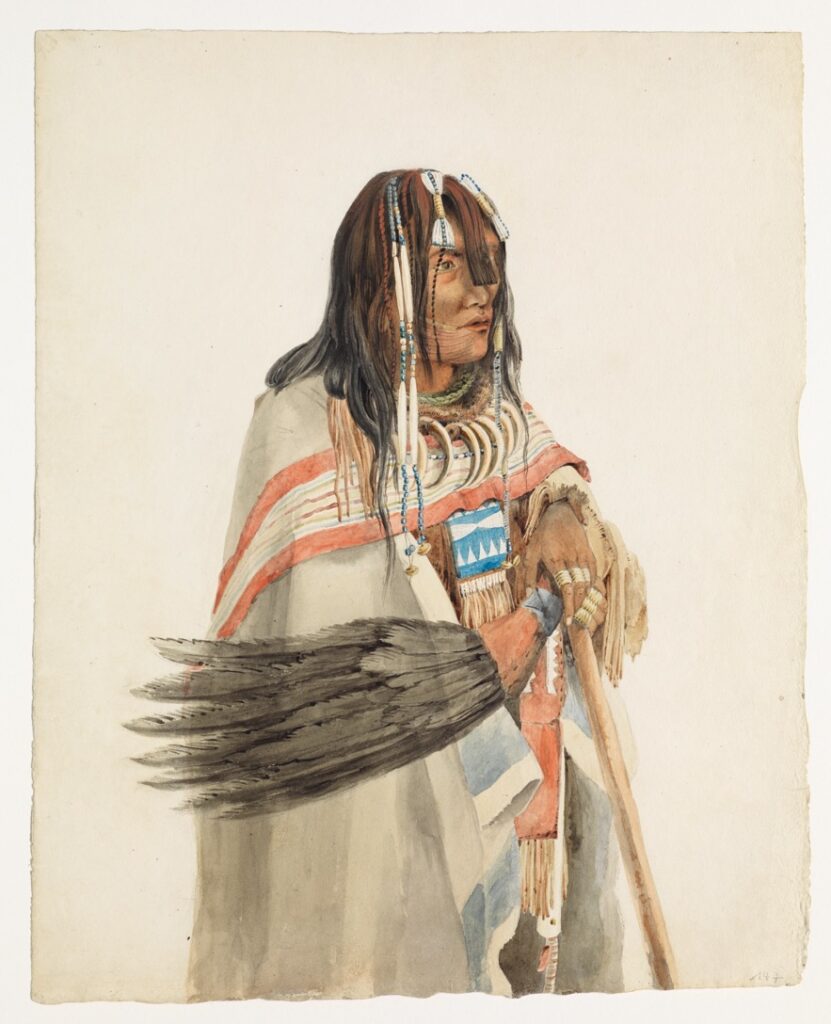
For information on accessing a high resolution version of this image suitable for print reproduction please visit the Rights and Reproduction page.
Artist
Karl BodmerBirth and death dates
1809 - 1893Artist Nationality
SwissTitle
Makúie-Póka, Piegan Blackfeet ManDate
August 19, 1833Dimensions
12 9/16 × 10 in. (31.9 × 25.4 cm)Medium
Watercolor and graphite on paperInstitution
Joslyn Art MuseumCredit Line
Gift of the Enron Art FoundationAccession Number
1986.49.289Rights (i.e. copyright information)
Joslyn Art MuseumPhotographer credit
Photograph © Bruce M. White, 2019Commentary
Makúie-Póka ("Child of the Wolf") was the son of a Blackfeet mother and a Kutenai who lived with the Blackfeet and had become one of their principal chiefs. Father and son were painted on the same day in mid-August at Fort McKenzie; see Image 1986.49.26 for a portrait of the father. Makúie-Póka is elaborately dressed in a striped blanket, a shirt with a rectangular beaded bib, and a wealth of ornaments. His fingers are covered with brass rings and he carries a large feather fan. Around his neck is an impressive bear claw necklace and above this a green, braided choker, probably made of sweet grass. In his hair he wears a pair of bows, brass-wrapped at the center and covered with beads and what appear to be dentalium shells. Dentalium shells were traded in from Pacific Coast tribes, whereas the long, white, tubular ornaments came from the West Indies via New Jersey and the fur traders. Called hair pipes, these tapered tubes were manufactured from the lip of a tropical conch shell as a New Jersey cottage industry. They were a popular trade item, used as ear pendants or, as shown here, part of long decorative strands attached to the hair.
References in Journal
August 19, 1833Labels:
genre, portraitApproximate Depicted Location:
Fort McKenzie, Montana