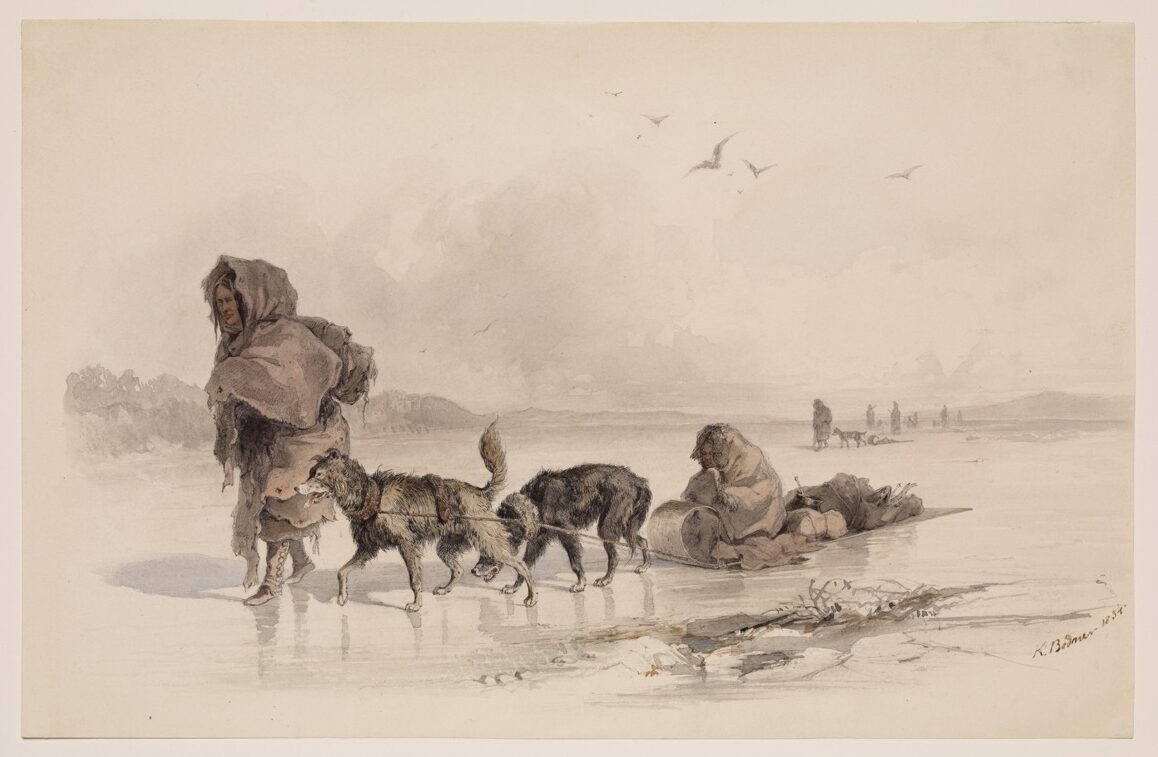
Mandan Dog Sled
Download
jpeg(89.38 kb)
For information on accessing a high resolution version of this image suitable for print reproduction please visit the Rights and Reproduction page.
Artist
Karl BodmerBirth and death dates
1809 - 1893Artist Nationality
SwissTitle
Mandan Dog SledDate
February 1834Dimensions
7 15/16 × 12 1/4 in. (20.2 × 31.1 cm)Medium
Watercolor on paperInstitution
Joslyn Art MuseumCredit Line
Gift of the Enron Art FoundationAccession Number
1986.49.387Rights (i.e. copyright information)
Joslyn Art MuseumPhotographer credit
Photograph © Bruce M. White, 2019Commentary
The sled in this scene appears to be loaded with household goods, including a globular pottery cooking vessel and a shallow wooden dish. Bodmer's signature is dated 1834, and the painting probably depicts a family moving back to the summer village from the winter one in February of that year. Maximilian described and illustrated the manufacture of Mandan sleds in his diary. Two long, flat boards were laced together lengthwise with thongs; four slender crossbars provided stability. The front end was bent upwards and anchored tohe body of the sled with stout leather cords to maintain the curvature. These cords can be seen in Bodmer's detailed rendering. Dogs were the preferred draft animals for sleds. Lighter in weight than horses, they could race over snow or ice without breaking the crust. They also had greater stamina. Maximilian was told that dogs could journey as long as eight days without food and, when fed, could travel thirty miles or more a day without tiring. This same scene appeared as Vignette XXIX in the atlas of aquatints.
References in Journal
December 9, 1833Labels:
zoological studyApproximate Depicted Location:
Fort Clark, North Dakota