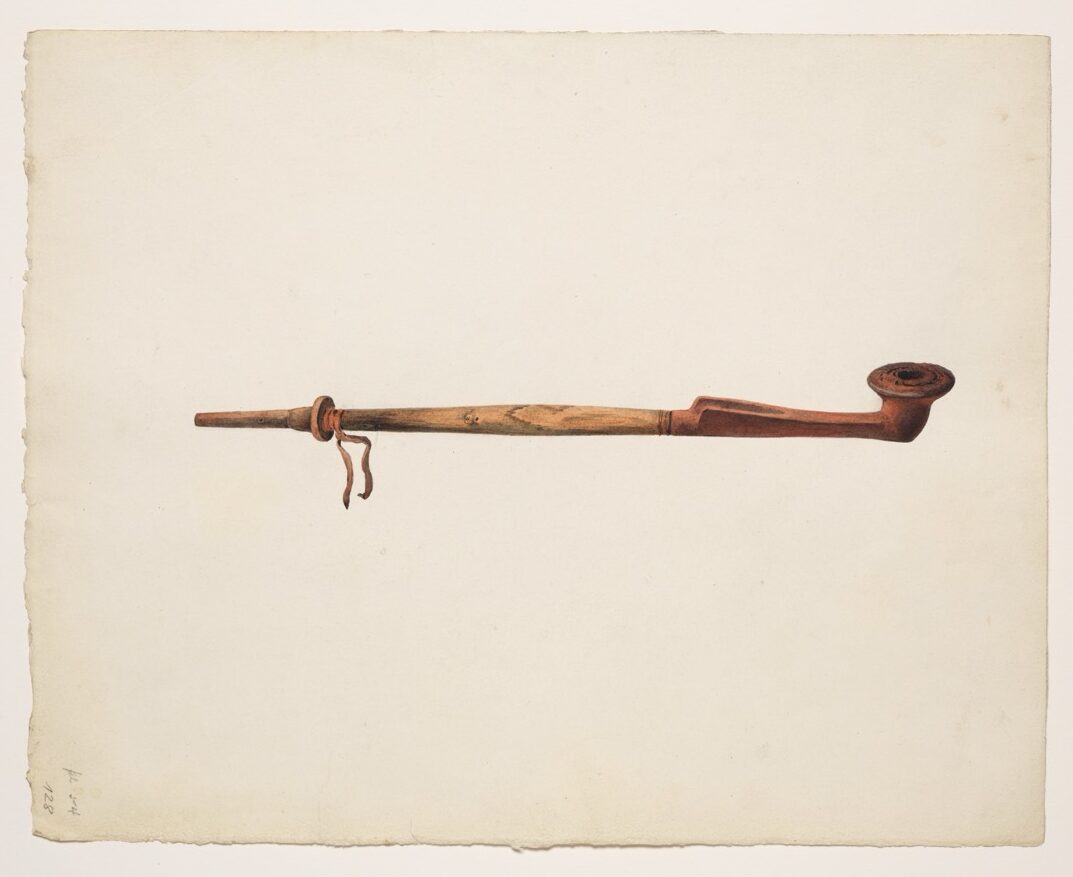
Mandan Pipe
Download
jpeg(48.48 kb)
For information on accessing a high resolution version of this image suitable for print reproduction please visit the Rights and Reproduction page.
Artist
Karl BodmerBirth and death dates
1809 - 1893Artist Nationality
SwissTitle
Mandan PipeDate
February 15, 1834Dimensions
10 1/16 × 12 11/16 in. (25.6 × 32.2 cm)Medium
Watercolor on paperInstitution
Joslyn Art MuseumCredit Line
Gift of the Enron Art FoundationAccession Number
1986.49.271Rights (i.e. copyright information)
Joslyn Art MuseumPhotographer credit
Photograph © Bruce M. White, 2019Commentary
Pipes and smoking were associated primarily with men's ritual activities. In speaking of the Mandans, Maximilian remarked that pipes were made of stone, clay, or wood and that many people fashioned their pipes "according to their own taste" to reflect a personal vision or supernatural belief. He cited the pipe of Dipäuch, illustrated here, as an example. Dipäuch was a respected man and apparently a religious leader well versed in the myths and sacred traditions of his people. The shape of his pipe was said to represent the Lord of Life in human form. The bowl symbolized the deity's head, the hollow area below his stomach, and the stem the legs and feet. The bowl of this pipe is red clay, and the stem is wood. Dipäuch used it to consecrate his arrows and invoked its power to protect him from enemy arrows. Dipäuch's pipe was among several artifacts pictured in Tableau 21 of the published aquatints.
References in Journal
February 15, 1834Labels:
studyApproximate Depicted Location:
Mih-Tutta-Hang-Kusch, Mandan Village