Mandan Shrine
Download
jpeg(141.78 kb)
For information on accessing a high resolution version of this image suitable for print reproduction please visit the Rights and Reproduction page.
Artist
Karl BodmerBirth and death dates
1809 - 1893Artist Nationality
SwissTitle
Mandan ShrineDate
November 1833Dimensions
10 1/8 × 7 7/8 in. (25.7 × 20 cm)Medium
Watercolor on paperInstitution
Joslyn Art MuseumCredit Line
Gift of the Enron Art FoundationAccession Number
1986.49.386Rights (i.e. copyright information)
Joslyn Art MuseumPhotographer credit
Photograph © Bruce M. White, 2019Commentary
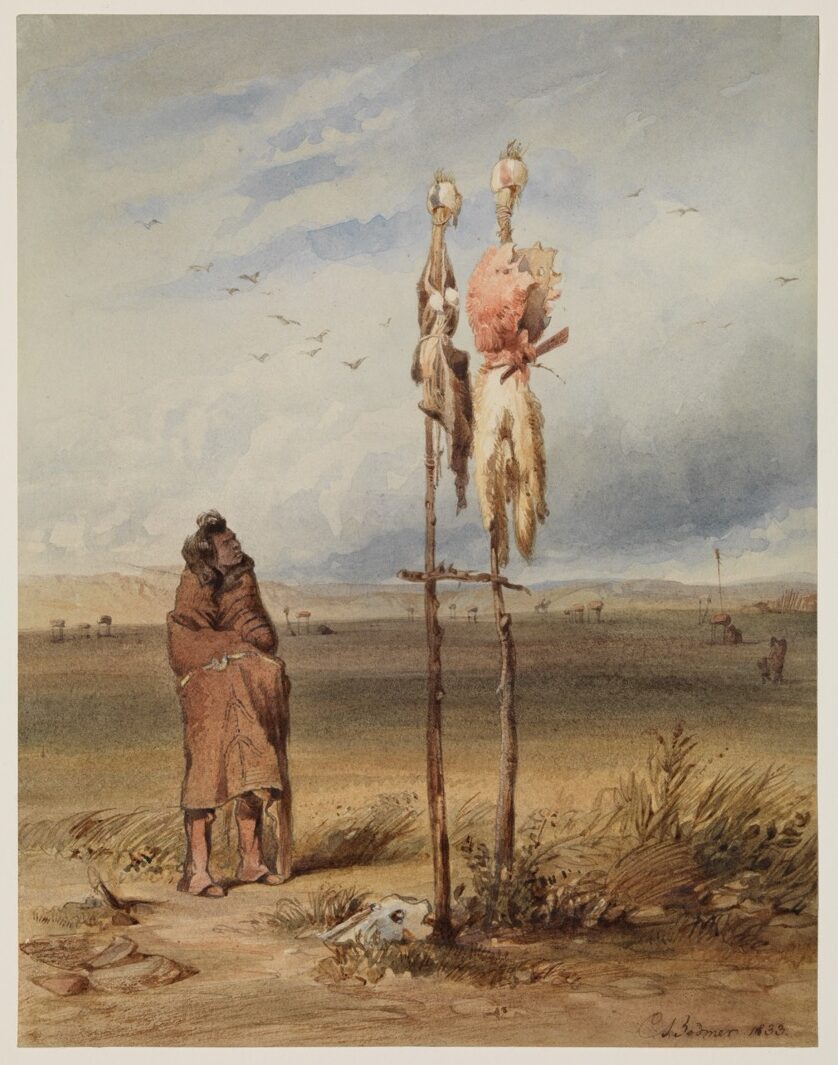
The hide-wrapped poles in this scene are effigies of the sun and the moon, which in turn symbolize two of the most powerful Mandan deities: the Lord of Life, creator of all things; and the Old Woman Who Never Dies, who was associated with corn and the buffalo. Religion permeated every aspect of Mandan life, and no major decision or undertaking was made without first seeking the help of a sacred being, as the Mandan standing before this shrine is presumably doing. Such supplications often involved fasting and sacrifice or offerings. In Tableau 25 1 the aquatint based on this watercolor, there are three knives and an ax at the foot of the poles, evidently gifts to the deities.
References in Journal
November 17, 1833Approximate Depicted Location:
Fort Clark, North Dakota