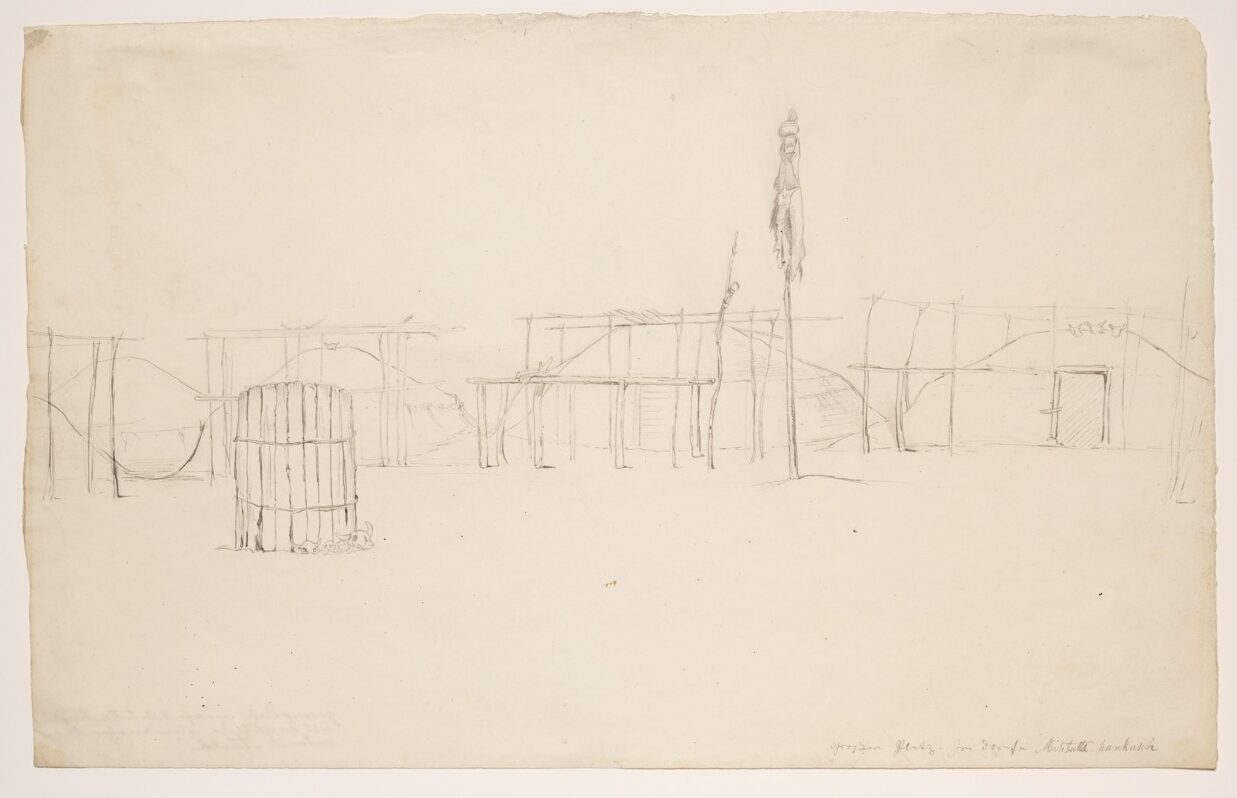
Mih-Tutta-Hangkusch, Mandan Village
Download
jpeg(63.57 kb)
For information on accessing a high resolution version of this image suitable for print reproduction please visit the Rights and Reproduction page.
Artist
Karl BodmerBirth and death dates
1809 - 1893Artist Nationality
SwissTitle
Mih-Tutta-Hangkusch, Mandan VillageDate
May 7, 1833Dimensions
10 7/8 × 17 1/8 in. (27.6 × 43.5 cm)Medium
Graphite and ink on paperInstitution
Joslyn Art MuseumCredit Line
Gift of the Enron Art FoundationAccession Number
1986.49.169Rights (i.e. copyright information)
Joslyn Art MuseumPhotographer credit
Photograph © Bruce M. White, 2019Commentary
In the center of every Mandan village there was a large open area or plaza on which stood the Ark of the First Man. According to myth, the First Man, a divine being created by the Lord of Life as a mediator between humans and the deities, once saved the people from a flood by showing them how to build a protective tower or "ark." The cylindrical plank structure in the plaza was a miniature replica of that extremely sacred symbol. From Maximilian's description, this view looks northward across the plaza past the ark to the medicine lodge, in which important rituals were held. In front of the medicine lodge is a tall fur and feather-wrapped pole with a black-painted wooden head. This represented Ochkíh-Haddä, a fearsome being who also figured importantly in Mandan mythology. Most major ceremonies and dances were held on the plaza. The drawing of the ark was reproduced as a woodcut in Travels in the Interior of North America.
References in Journal
May 7, 1833Labels:
Mih-Tutta-HangkuschApproximate Depicted Location:
Mih-Tutta-Hang-Kusch, Mandan Village