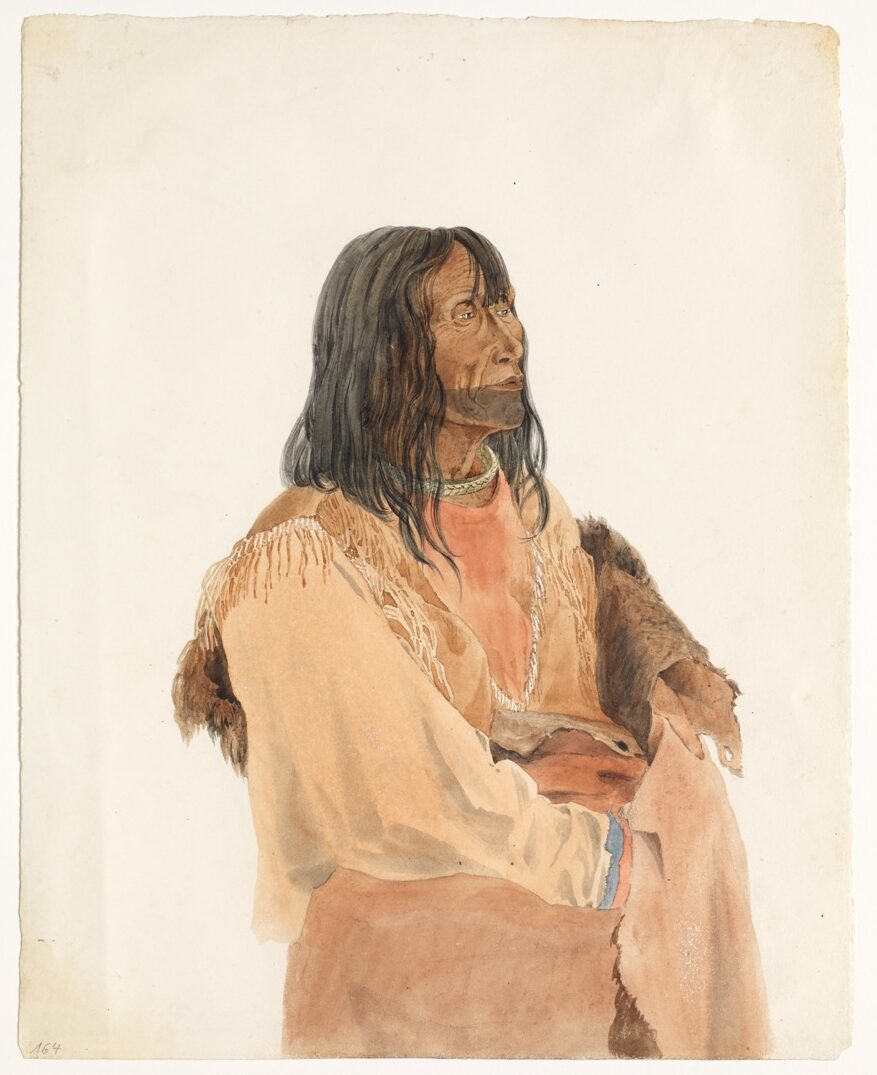
Hómach-Ksáchkum, Kootenai Man
Download
jpeg(94.45 kb)
For information on accessing a high resolution version of this image suitable for print reproduction please visit the Rights and Reproduction page.
Artist
Karl BodmerBirth and death dates
1809 - 1893Artist Nationality
SwissTitle
Hómach-Ksáchkum, Kootenai ManDate
August 19, 1833Dimensions
12 5/8 × 10 1/16 in. (32.1 × 25.6 cm)Medium
Watercolor and graphite on paperInstitution
Joslyn Art MuseumCredit Line
Gift of the Enron Art FoundationAccession Number
1986.49.306Rights (i.e. copyright information)
Joslyn Art MuseumPhotographer credit
Photograph © Bruce M. White, 2019Commentary
This Kootenai man had apparently made his home with the Piegans for some time and had become a respected leader. A friendly person, he and Maximilian talked at length about Kootenai customs and language. A fur company trading expedition to the Kootenai country far to the northwest of Fort McKenzie set out on August 30 with Hómach-Ksáchkum as a guide. The journey was never completed, for the party was attacked by Kainai and one of the company employees was killed. Hómach-Ksáchkum wears a fringed skin shirt and a buffalo robe. In contrast to his richly ornamented son in Image 1986.49.289, he wears only a braided choker, probably one made of sweet grass. Maximilian observed several such necklaces among the Blackfeet and tentatively identified the grass used as a species of Antboxantbum. More likely the grass was Hierochloe odorata, indigenous to the area and having a vanilla-like scent similar to that of the European Antboxanthum. Hómach-Ksáchkum portrait was included in Tableau 46 of the aquatint atlas.
References in Journal
August 19, 1833Labels:
genre, portraitApproximate Depicted Location:
Fort McKenzie, Montana