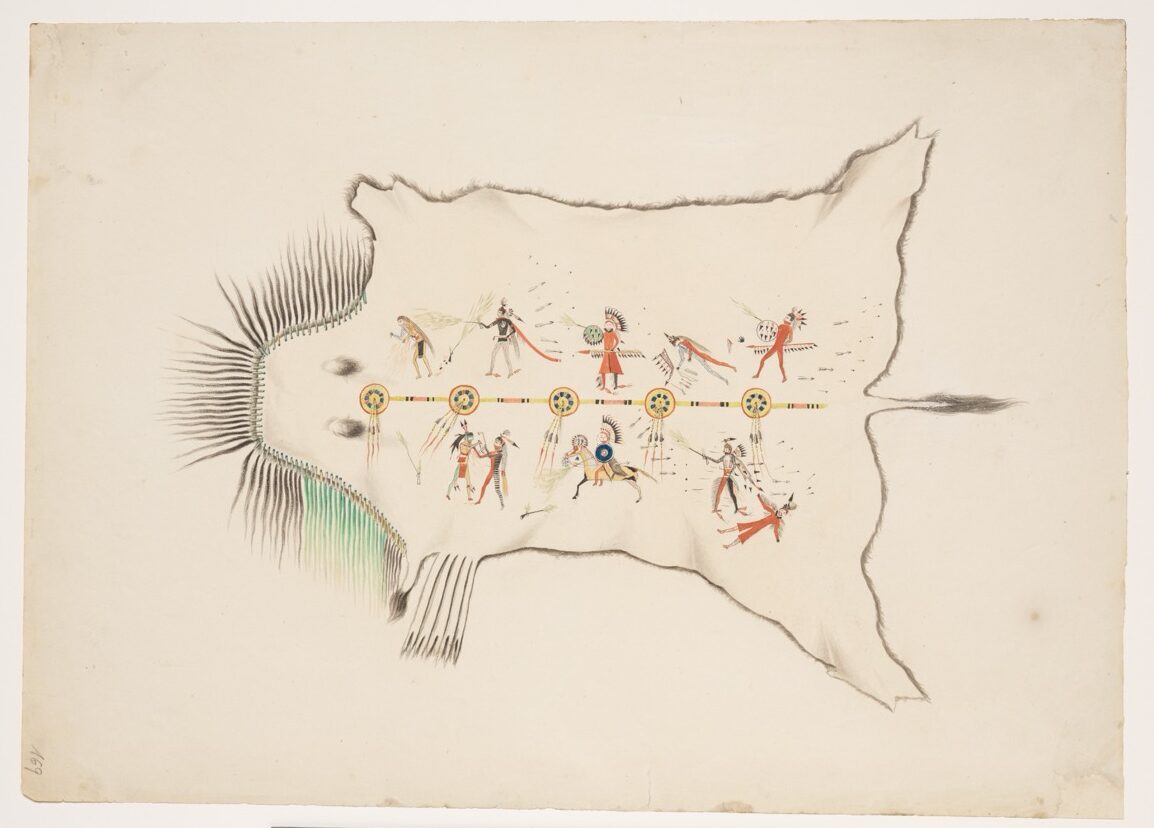
Mandan Buffalo Robe
Download
jpeg(75.36 kb)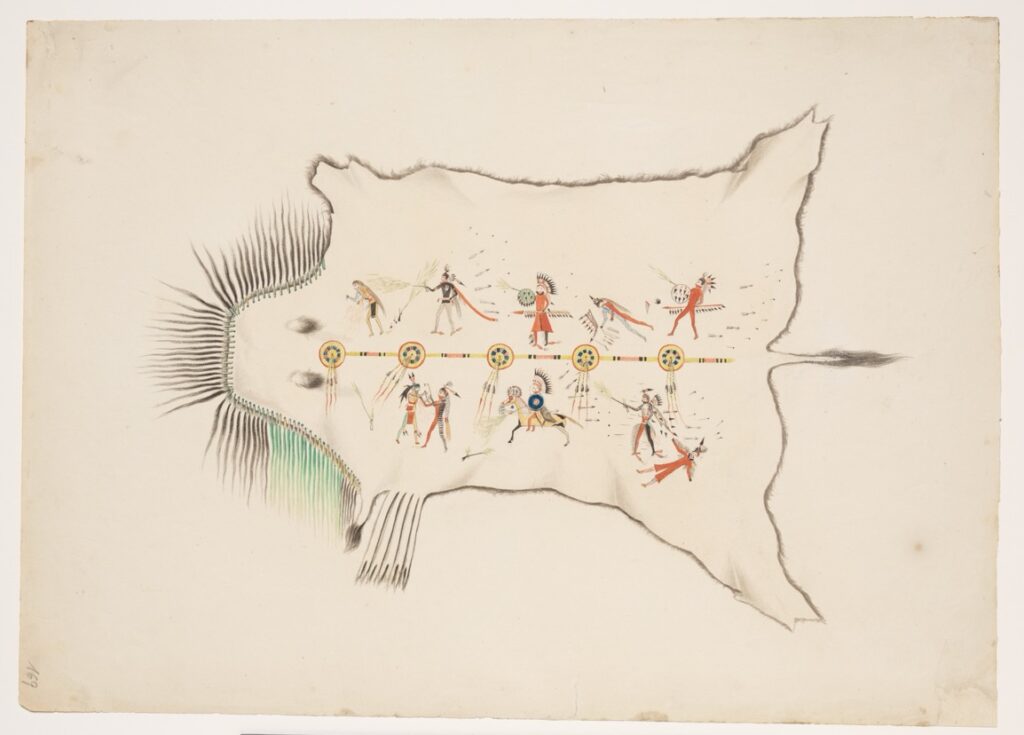
For information on accessing a high resolution version of this image suitable for print reproduction please visit the Rights and Reproduction page.
Artist
Karl BodmerBirth and death dates
1809 - 1893Artist Nationality
SwissTitle
Mandan Buffalo RobeDate
Winter 1833-34Dimensions
12 3/16 × 16 3/4 in. (31 × 42.5 cm)Medium
Watercolor on paperInstitution
Joslyn Art MuseumCredit Line
Gift of the Enron Art FoundationAccession Number
1986.49.309Rights (i.e. copyright information)
Joslyn Art MuseumPhotographer credit
Photograph © Bruce M. White, 2019Commentary
This watercolor is a copy by Bodmer of a buffalo robe painted by the Mandan chief Mató-Tópe which was purchased by Maximilian and is now at the Linden-Museum in Stuttgart. Bodmer's faithful duplication of another artist's style and subject matter lends great credence to the accuracy and realism of his portrayals overall. The robe is fringed with hair, some of it apparently dyed horsehair, and embellished with a long strip of bright quill and beadwork. The scenes depicted represent several of Mató-Tópe's exploits including his hand-to-hand combat with a Cheyenne chief shown at the lower left. Brandishing his tomahawk, Mató-Tópe is seen grabbing for his opponent's knife and wounding his own hand in the process, as indicated by the copious flow of blood. In the actual encounter he succeeded in getting the knife and used it to kill his enemy. Afterward he wore a wooden replica of the knife in his hair as an emblem of the fight. Two other episodes described by George Catlin are evidently pictured on this robe. At the upper left, Mató-Tópe defends his village against an Assiniboin attack. An Indian fires at Mató-Tópe and his gun bursts. Dropping the exploded weapon, the enemy turns to retreat and Mató-Tópe shoots him through the shoulder as he runs. He was dispatched with the tomahawk in Mató-Tópe's hand. The scene at top center may represent a battle in which Mató-Tópev, abandoned by his war party, stood his ground amidst a hail of Assiniboin fire. He killed one enemy, put the rest to flight, and drove off sixty horses. Afterward the Assiniboins said that he fought like "four bears." Catlin states that it was from this soubriquet that the chief took his name. However, both Mató-Tópe's warrior father and his young son had names referring to bears, suggesting some other derivation. This robe appears in Tableau 21 of the aquatint atlas along with several other Indian artifacts. For Bodmer's portraits of Mató-Tópe, see Image 1986.49.383 and Image 1986.49.260.
References in Journal
December 29, 1833Labels:
studyApproximate Depicted Location:
Fort Clark, North Dakota