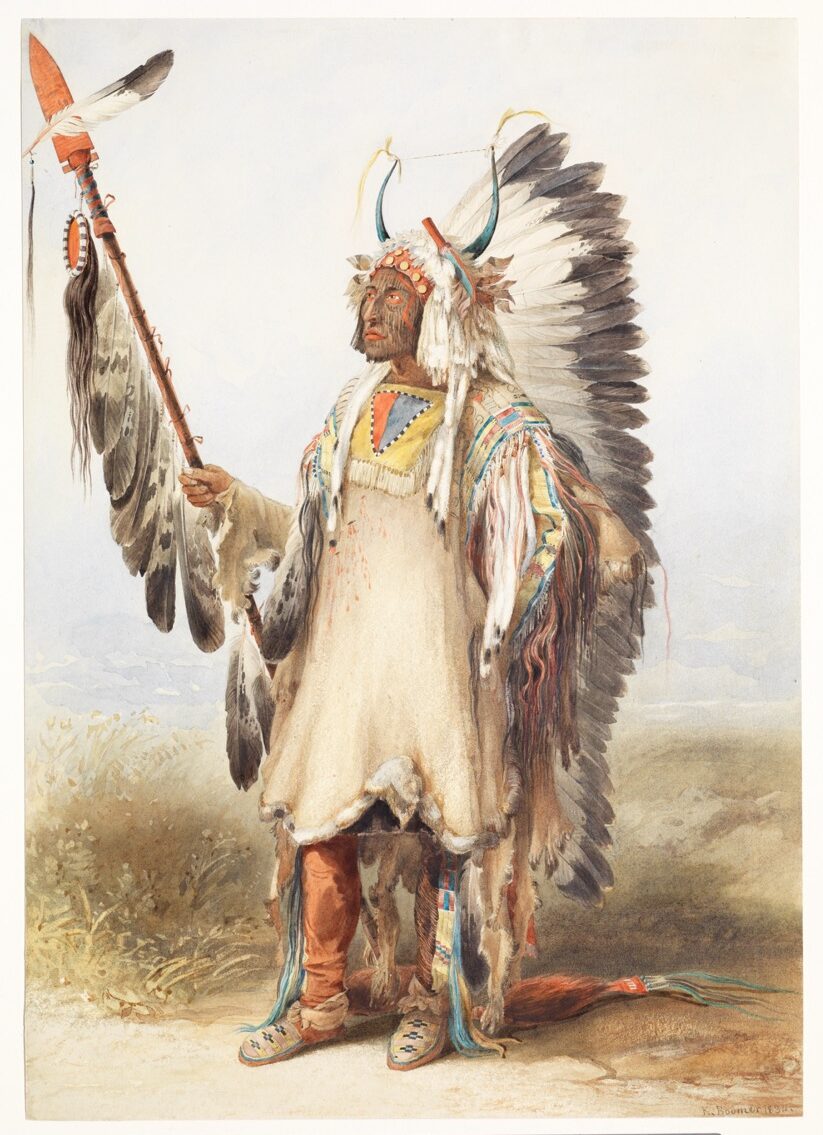
Mató-Tópe, Mandan Chief
Download
jpeg(159.11 kb)
For information on accessing a high resolution version of this image suitable for print reproduction please visit the Rights and Reproduction page.
Artist
Karl BodmerBirth and death dates
1809 - 1893Artist Nationality
SwissTitle
Mató-Tópe, Mandan ChiefDate
April 14, 1834Dimensions
16 1/2 × 11 11/16 in. (41.9 × 29.7 cm)Medium
Watercolor and graphite on paperInstitution
Joslyn Art MuseumCredit Line
Gift of the Enron Art FoundationAccession Number
1986.49.383Rights (i.e. copyright information)
Joslyn Art MuseumPhotographer credit
Photograph © Bruce M. White, 2019Commentary
Mató-Tópe ("Four Bears") was a prominent Mandan chief, popular among his people and respected for his many war exploits. Discussed at length in the writings of both Maximilian and George Catlin, he was one of the best known Indian personalities of the early nineteenth century. He was featured in numerous art works by Catlin, and two Bodmer portraits of him appeared in the aquatint atlas as Tableaus 13 and 14. These were based on the watercolors shown here and in Image 1986.49.260. Mató-Tópe closely observed Catlin and Bodmer at work and was himself an enthusiastic painter. He represented his battle feats on his person, on his clothing, and on buffalo robes; see Image 1986.49.309 for an example of the latter. In the collection there is at least one watercolor sketch by Mató-Tópe, and he presumably painted the drum reproduced by Bodmer in Image 1986.49.272. Maximilian remarked that Mató-Tópe wore something different almost every time he visited him, which was often. In this portrait he is dressed as befits his rank. His new shirt is made of bighorn leather, elaborately trimmed with ermine tails, locks of hair, and long panels of bead-outlined quillwork. On the shoulders of the shirt he has painted symbols of brave deeds. The red spattered marks on the front recall old wounds. Usually the number of eagle feathers a man wore on his head signified the number of battle coups he had made, but an impressive headdress like this one might represent instead the combined coups of a war party or perhaps of an entire men's society. Mató-Tópe wore this bonnet when he rode at the head of the Half-Shorn Society on April 31 1834. In any event it is clear that the honor of wearing such a bonnet was reserved for the most distinguished leaders. The lance may be another emblem of achievement: the spear with which Catlin says Mató-Tópe killed the Arikara murderer of his brother, the shaft adorned with the scalp of that enemy stretched on a hoop.
References in Journal
April 14, 1834Labels:
genre, portraitApproximate Depicted Location:
Fort Clark, North Dakota