Mih-Tutta-Hangkusch, Mandan Village
Download
jpeg(81.22 kb)
For information on accessing a high resolution version of this image suitable for print reproduction please visit the Rights and Reproduction page.
Title
Mih-Tutta-Hang-kusch, Mandan VillageDate
Summer 1833Dimensions
11 7/8 x 16 7/8 (30.16 x 42.86 cm)Medium
Watercolor and graphite on paperInstitution
Joslyn Art MuseumCredit Line
Gift of the Enron Art FoundationAccession Number
1986.49.166Rights (i.e. copyright information)
Joslyn Art MuseumPhotographer credit
Photograph © Bruce M. White, 2019Commentary
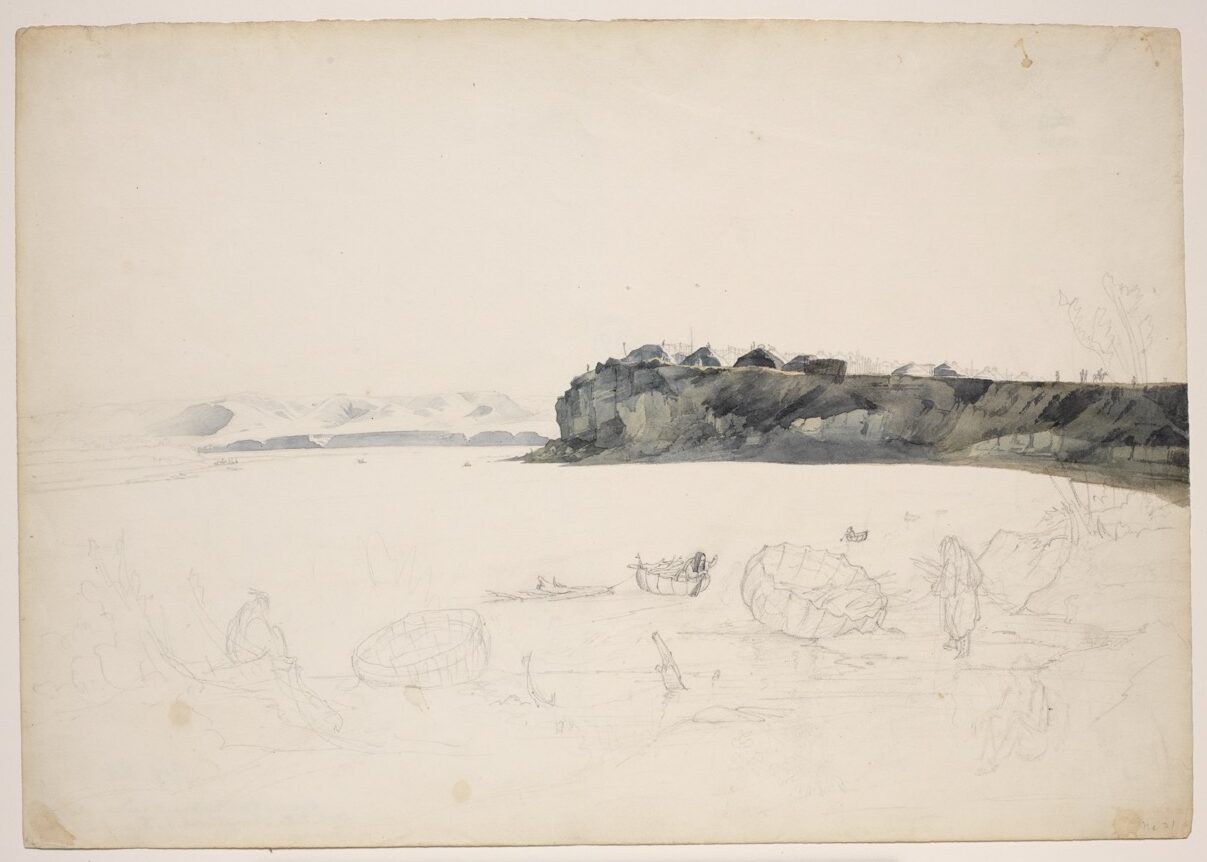
The strategic positioning of villages for defense purposes is evident in this view of Mih-Tutta-Hang-Kusch, located high on a promontory jutting out into the Missouri River with steep banks on three sides. A palisade surrounding the village offered additional protection, but this had fallen into disrepair at the time of Bodmer's sketch in the summer of 1833, and only a small portion of it can be seen in the drawing. Mih-Tutta-Hang-Kusch consisted of approximately sixty-five earth lodges or houses. House roofs were used for a variety of daily activities in fine weather, and small figures are visible on them in this scene. The scaffolds around the houses were used to dry corn and other food. In the foreground are penciled representations of women and bull boats, a form of river transportation pictured in more detail in Image 1986.49.273.B, Image 1986.49.365, and Image 1986.49.274. Bodmer cropped this scene for the aquatint (Tableau 6), bringing the village into closer view.
References in Journal
February 9, 1834Approximate Depicted Location:
Mih-Tutta-Hang-kusch, Mandan Village