August 9, 1833
Early in the morning the rain stopped; we had pleasant weather, but the mosquitoes were very troublesome. We continued our journey. On the left bank [were] the tall clay bluffs: yellowish brown on top, blackish gray underneath. Several sandbars and small, flat, sandy islands in the river, which made a sharp bend. We navigated upstream along the right bank. The bluffs on the left were very steep and over 100 feet high and afforded a singular view. On the right bank, there were gentle, intermittent hills on which four antelope were seen early today. The river turned to the right. The bluffs receded from it, and a wooded area with brush appeared before it. Sandbars in the rather narrow river.
We were just on the point of navigating around the promontory to the right when we saw five riders approaching at a gallop. All of them were whites: Mr. Patton, up to now director of the fort; Doucette; a Spaniard; and several [sic] other persons. They had good horses, the reins of which were decorated very colorfully in the Spanish style with red, yellow, and multicolored cloth. Their apparel was adventurous and wholly appropriate to this distant wilderness. They wore overcoats [made] of very colorful, partly scarlet, partly white blankets with red, blue, and black stripes; Indian leggins and shoes; shot bags decorated with red or blue; and their guns on their shoulders. They rode at a gallop up to the bank and with their right hands fired their guns over our heads. Thanks to them we were relieved of all worry, for the rumor of disagreements with the Indians proved unfounded: the Indians were behaving very well and had deliberately not approached us in order not to delay our journey. After we had eaten breakfast, they rode back to the fort, to which our two Gros Ventre Indians also went by land. We still had about 3 miles to go by water.
At 7:30, 61°F [16.1°C], overcast sky, somewhat cool. On the right bank, where we lay at anchor, there were very high hills with interesting shapes, on top of which a group of Indians stood, silhouetted against the sky, to see us. The riders also rode over these hills, and their horses, some of which were white, stood out very attractively against the dark sky. The landscape was unique. On the left bank, somewhat behind us, [was] the tall line of steep bluffs, ash-gray below, yellowish on top, the gray color cut off from the yellow by a sharp horizontal line; wooded banks and prairie everywhere along the shore. On the left bank the row of hills with tableshaped tops continued until opposite the fort and [then] even farther. On the left bank we came upon a rocky bottom, which was very dangerous for our old, already severely damaged boat. A prairie extended along the right bank, and a forest, beyond which Fort McKenzie was located. Spotted horses grazed on the prairie. The hills all around were occupied by groups of Indians. Whole bands of brown children ran along beside the ship, and mounted Indians, occasionally two to a horse, rode up and down the steep hills. Everything was in motion; even on the left bank one saw groups of Piegans on the high, steep, blackish hills, which were very scenic. A heavy rain was falling, very unfavorable because the cannon had to be fired several times.
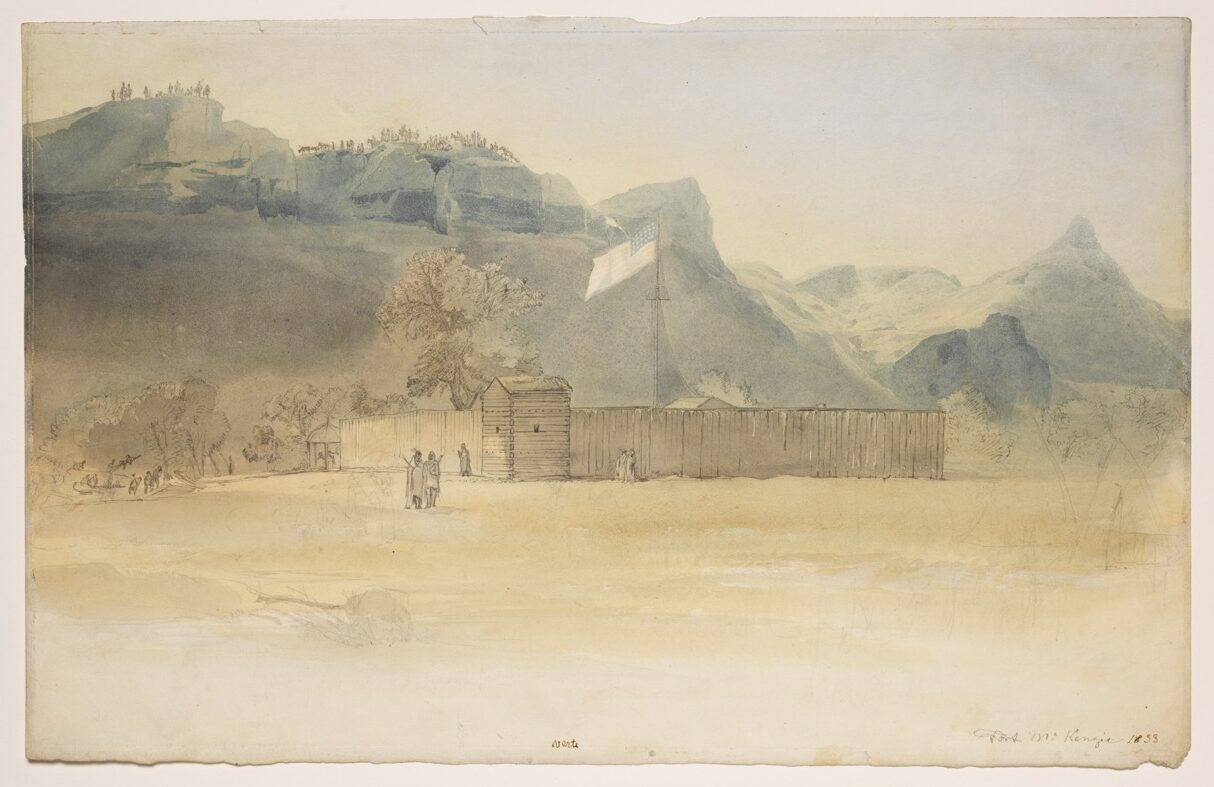
As we rounded the last bend of the river before the fort, a most interesting, animated, and unique scene was revealed. A vast prairie extended along the right bank, on the point of which, close to the river above a row of old trees, Fort McKenzie lay, built exactly like those already mentioned, with [a] flag waving on the flagstaff. A large number of Indian leather [tipis] had been pitched on the plain, and the whole region was filled with groups of the brown and brownish red (the hides covering them are painted yellowish red or reddish brown) mass of humanity, who-—some on foot, some on horseback, some spread in groups along the bank—-awaited us. Closely surrounding the fort were the men, about eight hundred Piegans, or Piëkanni, in a densely compact multitude, drawn up like a well-ordered battalion. They formed a long, dark brown border of which their heads, with their long black hair on top, formed a black line. On the palisades of the fort and on the roofs of its buildings sat Indians and their children; on the old cottonwoods and Negundo maples everywhere before the fort, one saw colorful human figures spread out, often densely crowded. From time to time, white cannon smoke rose from the fort, and the rumble that soon followed echoed beautifully in the adjacent hills.
Meanwhile, we approached slowly (and) sent a boat to a sandbar to the right, from where our crew brought (me) a huge elk antler with exactly sixteen points. There they had taken aboard an Indian, who works for the company, with several more of his people. These are called soldiers (soldats), and at Fort McKenzie there are several from all the nations and tribes living nearby: the Piegans, Blood Indians, Blackfoot, and Gros Ventres des Prairies. These people are dressed partially in the European manner and serve as a sort of guard; they are also employed for various kinds of dealings with the Indians. The present one had an aquiline nose; [a] strongly bony, broad face; and a reassuring facial expression. His dress consisted of a kind of blue cloth overcoat, [a] round hat with a feather plume around which a band of tin was fastened, Indian underclothing, and a broad scarlet band over his shoulders that was decorated with large and small bells. When he walked, there was a rattling and ringing noise such as many Indians make. He had fastened his horse to a driftwood tree on the sandbar, and it was fetched from there.
Meanwhile we moved closer and closer to the interesting reception scene. Shots were already thundering from the dark brown Indian multitude, and their shouting was heard, while, in the heavy rain, men also began shooting from our side. As we came close, we saw three or four chiefs galloping around before the throng of warriors mustered altogether in military fashion. The most distinguished one was Iron Shirt (la Chemise-de-Fer), called Mexkehme-Sukahs in his own language. He had a scarlet-red uniform with blue lapels and braid; on his head, [wore] a round hat with four red and black plumes; [held] a saber in his hand; and rode a most attractive light chestnut horse, which, without stirrups, he deftly wheeled about in the midst of all the shooting. Still other chiefs wore uniforms and on this day acted self-assured.
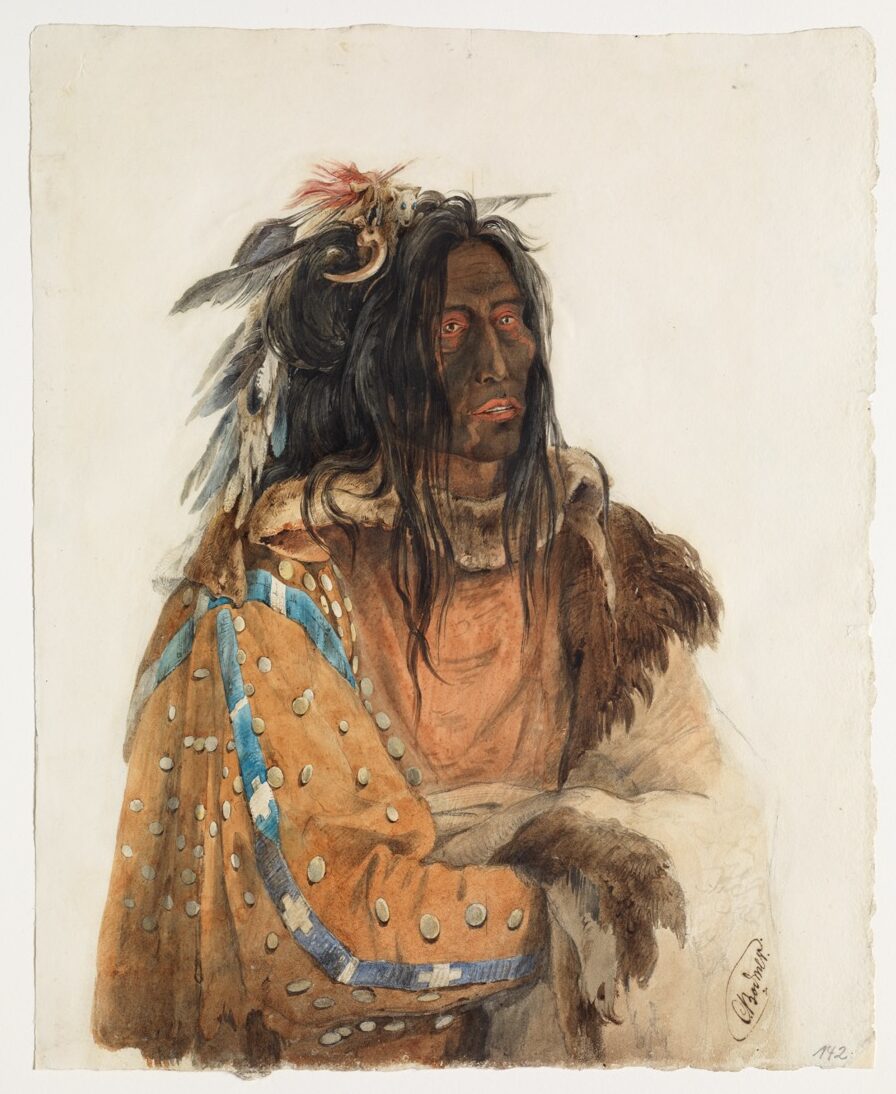
The foremost chief who is the most highly regarded now is called Spotted Elk (la Biche Caïe), Kétsepenn-Núka in his own language. He is currently held in such high esteem because, just a short time ago, he did battle with the Salish, in which forty-seven of the latter were killed. This chief was a tall man with an ugly face. He had recently changed his name, something they always do when they have accomplished a remarkable feat. He wore a long green wool overcoat and a round hat decorated with plumes of feathers and a tin band. Generally the chiefs look outlandish on such important occasions, as though they were decked out from a junk shop, since all of them have received such apparel as gifts from the trading companies. Normally they go about in their native dress, in buffalo hide with hair hanging straight down, each one usually with just a medal on his chest.
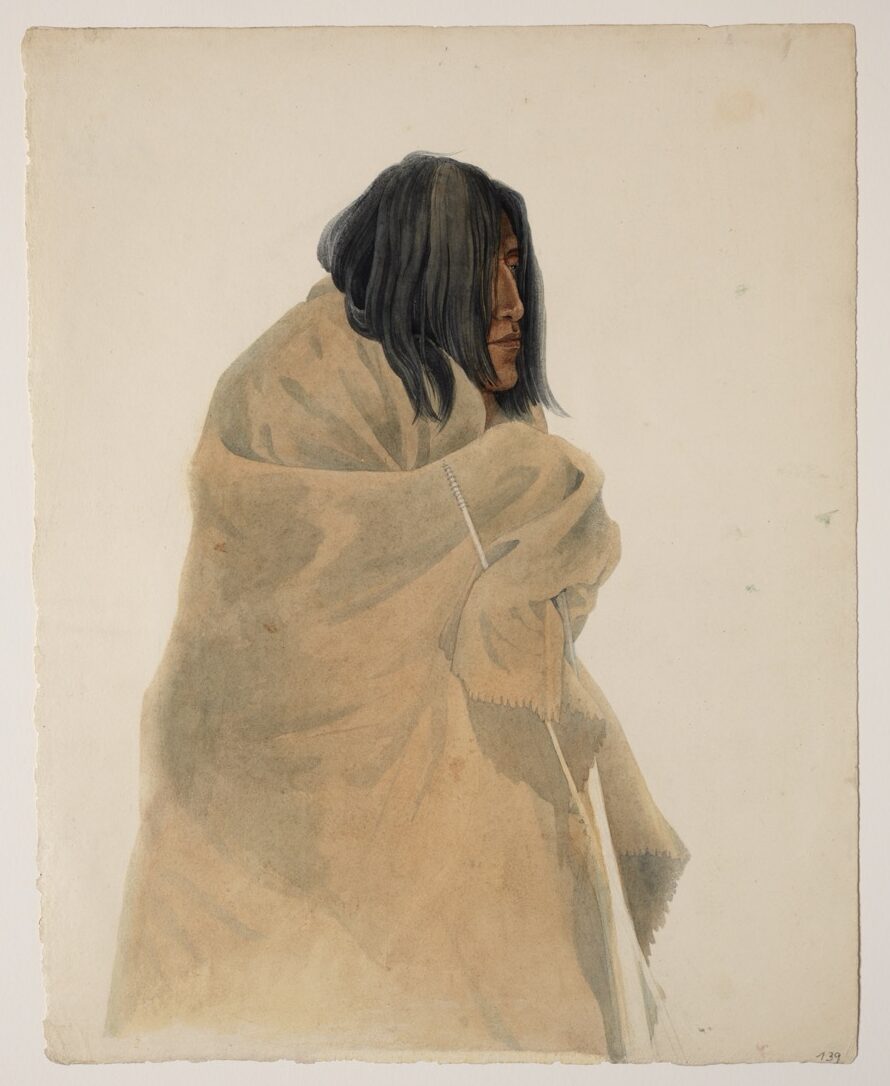
As we were about to land, the whites from the fort, drawn up in a row along shore, fired off a welcoming volley, and the Indians likewise repeatedly fired their guns. We went ashore and walked toward the fort through a colorful brown throng of the most interesting figures. Big, strong men—with faces painted vermilionred, wrapped in their often beautifully decorated leather [clothing] and in buffalo hides, their coal-black hair hanging straight down and often over the forehead in three braids, their weapons in hand—stared curiously at us in astonishment. The chiefs and the most prominent men welcomed us, and we shook their hands all down the line—[at such times] one must look them straight in the eye. There were 130 leather [tipis] of the Piegans on the plain near the fort; the remainder, as well as several other tribes, were expected daily. We now reached the fort, where, after a four-month journey from St. Louis up the Missouri, we [would] recover from the hardships of a long imprisonment. Our journey had proceeded favorably and had been without incident; it had lasted 34 days [since leaving Fort Union], and we had subsisted entirely on game. For a list of the animals killed during this period, see [manuscript] p. 337.
Fort Piegan, or as it is now called, Fort McKenzie, was built here in 1832 by Mr. Mitchell to carry on trade with the three tribes of the Blackfoot—the Piegans, the Blood Indians, and the actual Blackfoot—the Gros Ventres des Prairies, the Sarcees, and [the] Kootenais, all of whom live close enough to this place to carry on trade.
Formerly there was a fort somewhat farther downstream (see [manuscript] p. 217), which was abandoned in the same year that the new one was built. Mr. Mitchell built the fort in [——] days; the timber was obtained in the vicinity. When he came here the first time, he had to live near the keelboat for a long time. The Indians gathered in large numbers, probably four to five thousand men, and besieged him all day near his boat. Among them were dangerous tribes, and his situation was not pleasant. To judge from his description, the sight of all these red men must have been most interesting. As soon as the fort was completed, the situation of the white men improved: the Indians were no longer allowed in, appropriate security measures were taken, and some of the Piegans, who live principally in this region, encamped near the fort, where they are to be found winter and summer.

The present fort is situated 120 paces from the left bank of the Missouri. Here the direction of the river is from the south (hora 10 toward the east), and directly below the fort, it makes a bend at a sharp angle. The fort is located to the west of the river. Directly opposite the fort is a high, steep, blackish bank of clay hills ranging up to 200 feet high, a nearly vertical wall. The fort itself is a [square]; the outside length of each side is 45 to 47 paces. On the upper corner facing the river, and on the one diagonally opposite, there are quadrangular blockhouses with firing slits and several small cannon; the entire fortification is surrounded with a high wall of poles, which are closely placed vertically, one against the other, as in all these forts along the Missouri. About 800 paces behind the fort a hill chain extends from south to north. Between the hills and the fort, about 300 paces from the latter, the Piegans had pitched their camps in four sections. The entire surrounding prairie was barren and dry, trampled down by men and horses, and grazed bare. Everywhere one saw Indians and bunches of grazing horses, guarded and herded by Indian boys on horseback. The fort has about twenty horses, which are always guarded by four armed men; above and below the fort there is a strip of old timber in which various plants grow.
Somewhat below the fort, around the bend of the river, is a large island called Horse Island, overgrown with grass and bushes, on which the horses are grazed in winter. They never enter a stable, and in both winter and summer get nothing to eat but what they find out in the open. The fort itself is much smaller than Fort Union; before our arrival it contained twenty-seven whites and several Indian women married to them. Now we added fifty-three persons.

All the people living in this fort, except for the first table of six to eight persons, receive nothing other than meat for food, and they are estimated to consume the meat of two buffalo daily. The engagés sometimes have very large stomachs; it has been observed that two of them ate up almost a whole side of buffalo. We have good hunters, who are frequently sent out to hunt these animals; moreover, much meat is purchased from the Indians. For the meat of one buffalo, one usually gives them twenty bullets and the corresponding amount of powder. If the buffalo are numerous, then they receive fewer bullets; if [buffalo] are scarce, then the Indians are paid as much as forty bullets with powder. For such a fort nearly one thousand buffalo a year are required. In addition, if one considers the large consumption by the numerous Indian tribes, who live almost exclusively from these animals, then one can imagine the enormous number of bison in the interior of America. As noted, the engagés receive neither bread nor any other vegetable food.
The style of construction at Fort McKenzie is only crude and very flimsy [and] thus far behind Fort Union [in quality]. The houses have been built adjoining the [interior face of the] fencing, or circular wall, which consists of thick cottonwood trunks that are squared on two sides and set against one another. The [houses] have one story, small rooms with fireplaces, a door, a small window covered with parchment, a fireplace and chimney, [and] a very flat roof covered with sod, lower than the palisades. The flagpole stands in the middle of the courtyard. The gate is securely locked and strong; it is a double gate, and when trade with the Indians is fully under way, the inside one is closed [while] the entrance to the store between the two remains open to the Indians. This fort is of only very light construction, but a few miles higher up [the river], a new one will be built, for which glass windows and all necessary parts have been brought here. Moreover, there are now a smith, cabinetmaker, and all other necessary craftsmen here. The supplies at Fort McKenzie, both merchandise and other necessities, were replenished with our arrival. Clerks were placed in charge of the stores; special hunters provided our food; workers, woodcutters, fishermen—all were here together. There were people from all nations: Americans, Englishmen, Frenchmen, Germans, [and] Spaniards. Several of the latter were hunters. This motley crew of men gathered together was idle from the start, and Mr. Mitchell planned to reduce their number.
On the first day of our arrival, after we had entered the fort and our baggage had been brought into the room assigned to us, we inspected the fort and the interesting live animals it contained. There were, namely, three live young bears, already large, and a very delightful little prairie fox (Canis velox Say?), the former running freely about in the courtyard area. The bears were from last spring, [each] about as large as a setter but very fat and ungainly. [They were] very lively, well fed, not ill-tempered, and always teasing each other, keeping their distance from the dogs but not fighting. The swift fox was a very delightful little animal, very tame and completely trusting; it is not uncommon here in the prairies.
Our next task was to visit the Indians’ camp, which, however, we merely observed from a short distance. The camp consisted of four sections with large and small [tipis] intermingled. Piegan [tipis] are made like those of the Dacotas. Their poles are very long; very few of them were white and new; most were discolored from age. Several chiefs had [tipis] painted white and in colors, and nearby the flag was fastened to a tall pole. Packs of dogs and horses swarmed around the [tipis], which stood intermingled with one another in complete disorder.
After lunch Mr. Mitchell and I were invited to a so-called festivity in the [tipi] of one of the Piegan chiefs named Iron Shirt (la Chemise-de-Fer)))”]. We entered the center of the camp, where a large round space, which contained some of the [tipis], was surrounded with thick and slender tree branches, like a fence. At night the horses are driven into it, since the Indians are extremely fond of stealing horses and in this respect do not trust each other much. The chief’s [tipi] was large and spacious, unlike any I had yet seen, a good 15 paces in diameter, very clean, and neatly swept. In the center was the fire in a circle of stones. Without further ceremony we sat down on buffalo hides to the left of the chief; then more and more men entered and took their places in a circle until the [tipi] was full. No women or children were to be seen. The chief, a big, powerful man, was naked except for his breechcloth. Most of the men lacked a joint of the little finger, which they cut off as an offering or as a sign of mourning, as the Gros Ventres, Mandans, and other North American tribes do. Scarcely were we seated when we were presented a tin dish, or actually a container cover, in which there was a serving of dry, finely grated meat and sweetish berries (poires), which we ate with our fingers and found quite tasty. After we had eaten some, the chief took the dish away and ate from it himself. Then out of a sack he pulled a scarlet-red uniform with blue lapels, collar, and yellow braid, made in the manner of an overcoat, which he had received from the English, and laid it in front of Mr. Mitchell as a gift; in addition he gave him six red and black plumes, a dagger with sheath, a colorful handkerchief, and finally, several beaver pelts. Mr. Mitchell accepted [the gifts] and now [had to] present him [with] another costume, which is what the Indian wanted to obtain in this way. When the chief began to fill his pipe made of green stone, we stood up and departed in the Indian manner, without saying anything or looking around. We crept through the small door, besieged by old and young dogs. [As we] climbed over the wolflike dogs, some of them looked at us menacingly. Mr. Mitchell was invited to three or four more festivities of this kind, where he always received gifts.
In the afternoon the crew of the keelboat bestowed the baptême [baptism]—gunfire in the courtyard of the fort—on Mr. Mitchell and me, for which they are [typically] rewarded with whiskey. In the evening one heard the chanting and the drum of the Indians; [the drum] is beaten rapidly when the medicine men are called to their patients (see above in the section on the Assiniboines). They also make use of the chichikué, which the Blackfoot make from wood [and] leather, or a bladder, since they have no gourds. In our room we found such a large number of mice that, while we were writing, they ran around on our legs. I had brought along several traps, which caught the uninvited guests continually.