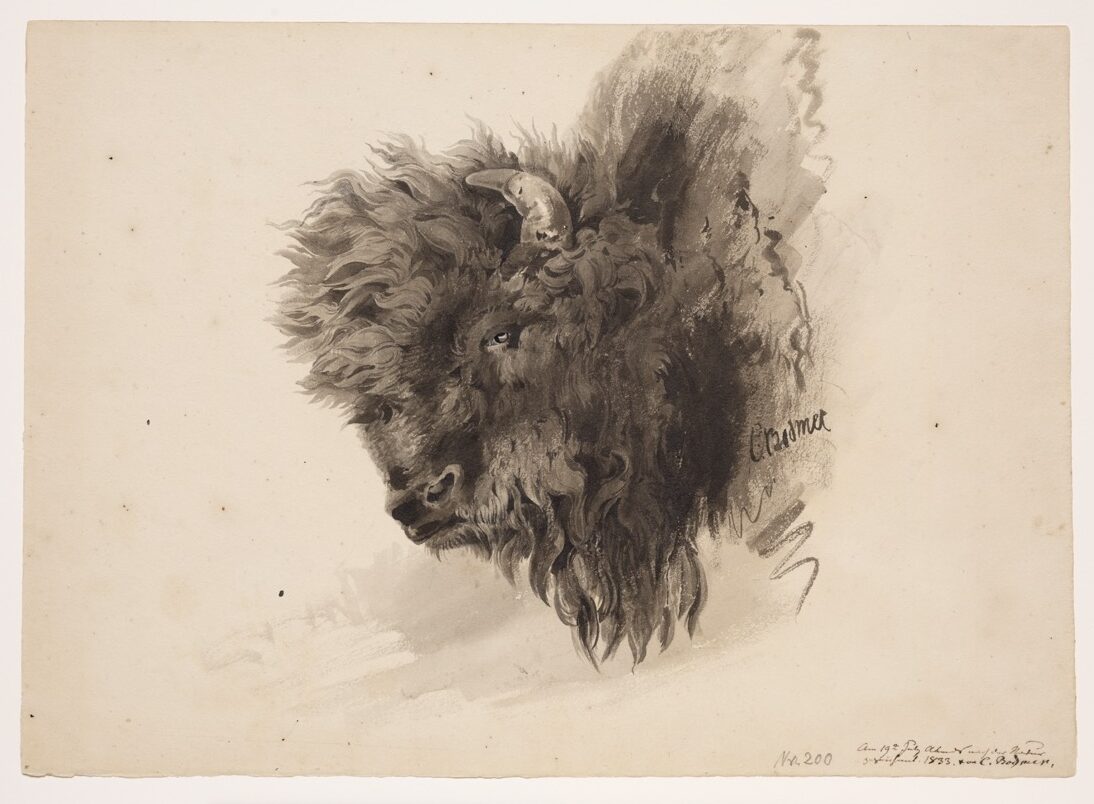
July 19, 1833
Early in the morning, bright and pleasant. We had some wind and sailed for a short stretch. At seven o’clock we approached the hill chain, which at this spot is somewhat higher than before and closer to the river, with gently rounded bare clay hills, now and then overgrown with a grayish green cover of grass and plants. Before them along the river, a steep bank about 10 feet high. On the right bank, woods. At seven o’clock the wind picked up, [and] for the first time, we could sail ahead rapidly. Somewhat farther on, the hills were completely bare, colored blackish by the nighttime rain; before and down below them, whitish blue, green Artemisia bushes. The river again turned right, away from the hills, and because of the many bends of the river, did not long maintain the direction needed for sailing. At 7:30, 72°F [22.2°C].
We prepared the skin of our bear, which I bought from the company for two dollars. Deschamps (the hunter) helped with this task and told many stories about his experiences with these dangerous bears. Once he was out with two Indians, and they saw a huge animal of this kind lying on its prey. When the grizzly bear has caught an animal and eaten part of it, it buries [the carcass] under foliage, earth, and twigs and makes its bed on top. Deschamps told the Indians, who greatly fear the bear (and because of their poor guns are often bad shots), not to shoot but to remain quiet, lying outstretched, until he had crept around behind it and could shoot the animal in the head. Scarcely had he left when a shot was fired and he heard the Indians screaming. They had not been able to wait and had wounded the bear, and it had immediately attacked. [It] caught one of the Indians and in a moment completely crushed his head. Afterward Deschamps was able to shoot [the bear] in the head.
Another time he was a witness when a bear overtook a white man who had wounded it; [the bear] took him between its forepaws and, in an erect position, walked away with him. His companion wanted to help him, so he called out to the captive that he would like to shoot but was afraid of hitting him. When the bear heard this voice, it dropped its prey. The man quickly rescued himself, completely unscathed, and the bear attacked the other man. He let this dangerous animal come within a few paces, however, and then shot it in the right place so that it rolled over and over.
Papin was on foot in the prairie with his rifle when several buffalo hunters on horseback wounded a huge bear. The bear pursued one of the horsemen, overtook him, and was just about to tear the croup off the horse when Papin brought it down with a well-aimed rifle shot [to] the throat. Last year when Mr. Mitchell was traveling up the Missouri, five of his hunters wounded a bear, which pursued the entire group in such a manner that they all had to jump into the Missouri to save themselves.
In spring, especially, one continually sees these bears along the riverbank [and] among the ice floes, where they often eat drowned buffalo lying there. Then [the bears] allow the boats to get within 30 to 40 paces without looking around, and this is the best opportunity to shoot them, because, although they like to swim and do so very easily, they still cannot catch up with the boat. Although when wounded they usually immediately attack the boat, one can then shoot them through the head [with] more certainty. Carrion and meat are this bear’s staple food, but it also digs many roots out of the ground and eats all kinds of berries; [at these times] one can often get very close to it. Lewis and Clark provide numerous examples of the dangers one is exposed to (when) hunting bear.
The sky had become somewhat overcast and there was some wind, thus not so warm as yesterday. At the right bank of the Missouri, where we navigated along the forest, there was a large beaver lodge: a higher, more cone-shaped pile of wood than the one [we saw] yesterday. We navigated along the right bank, which, with alluvial ground covered with willows, joins a narrow prairie spread out before the hills. The hills, which we reached again to the right, are very flat and uniformly covered on top with short, gray-green grass. The river turned left again; substantial sandbars; here the boat was pushed forward with poles. In several places wildgeese wild geese with their brood flew up before us. Usually each brood of the Canada goose (Anser canadensis) consists of eight or six or indeed only five chicks, [plus] the two adults. Some of the goslings are now flying like the adults.
At 11:30 we went straight across the river [to] where, on the left shore, there was prairie on the high bank along the forest. Here we found the men on our cordelle who, since this morning when we began sailing, had [not] been able to board the ship. The usual prairie plants grew here, especially the 2 1/2-foot-tall Artemisia and the yellow, star-shaped Helianthus [— —]; individual old cottonwoods were distributed along the bank; most of them had withered crowns and many dry branches. Individual paths to the river, trampled down by game, led toward the water like ravines. At twelve o’clock we paused for a moment at the prairie, completely covered with tall, whitish blue Artemisia bushes, and took in the men on the cordelle, who were [then] replaced. At noon, 82 1/2°F [28.1°C]. We followed a stretch of the prairie and again came to forest, behind which a rather imposing chain of clay hills approached the river.
About fifteen minutes after lunch, we saw a big bear standing before the forest at the sandy edge of the right bank; with the telescope we could see [it] very clearly. Finally [it] went into the river, swam to the middle, and remained there. When we saw it swimming, Deschamps, Bodmer, and Dreidoppel immediately ran to the bank and followed the forest until they were opposite the bear. It had scented a floating buffalo (a dead one) and for that reason had gone into the river. Now, however, it attempted to swim to our side. People on board had made too much noise, [or] perhaps the hunters had let it get wind of them; in short, it turned around, and everybody fired, probably twelve to fifteen shots. The bear [nonetheless] reached the opposite bank, where [it] sank in deeply, immediately pulled [it-]self up again, and then climbed into the forest. It was very large.
We continued onward, but not a half hour had gone by before our men on the cordelle saw three bears in the dense willow thickets and informed us. Mr. Mitchell was ready; about eight to ten riflemen followed him. They ran into the dense willows, and in a small ravine, Mr. Mitchell saw the she-bear, which he immediately shot behind the head so that it fell under fire. He [quickly] moved ahead and found, with the grown-up one, a young bear that reared up and screamed; he shot this one likewise. Deschamps wounded the second bear cub behind the ear on the neck, and it was captured alive. It screamed incessantly with a rough voice, constantly tried to bite, and was uncontrollable. Its mouth and legs were tied, and it was brought onto the ship. However, it was killed, since it would die seemed that it would die. The old she-bear was not nearly as large as the one killed yesterday; she had a more pale, reddish brown color, blackish brown legs, and a more whitish head. One of the cubs was totally blackish; the other one [was] yellowish white on its throat, head, and chest [but] otherwise a pale grayish brown. Nothing of these animals was used. This hunt was scarcely ended when a strong, contrary wind arose, which we waited out because it was too strong. Close before us was the mouth of the Milk River; we saw the outlet. To this point willow thickets, in which the three bears had been killed, uninterruptedly covered the banks to the left; to the right there was a long, low shore with moderately high banks, somewhat stratified and eroded by water, on which forest alternated with prairie, that is, on which the prairie was partly bare or else edged by forest.
Before the mouth of the Milk River (Rivière au Lait), which we reached at one o’clock, there was a tall cottonwood forest with underbrush; on the left bank, it did not seem to be so dense. The Milk River has a very winding course, and its water is mostly clear. One occasionally finds Assiniboines camping in this region. Opposite the mouth of the Milk River was a young willow island, which we passed to our right; we navigated upstream through a narrow channel.
Here our hunters joined us. They had shot another bear and a big buffalo bull. We soon reached the spot where the bull lay, about 150 paces from shore, and halted there for the night. We found the bison, already mostly cut up, to be huge. Mr. Bodmer sketched its head. The growth of hair on the crown of the head was enormous; the somewhat wavy, very thick, coal-black, [and] somewhat woolly hair was 18 inches long. I cut off the entire scalp and kept it. The engagés came and cut off all the meat from the bison. Several of these coarse fellows took the urinary bladder and poured all the fluid contained in it over the liver, which they then cut up and consumed raw. The bul already had a strong rutting smell.l This is the mating season, and the cow carries the calf until the following April. The bison’s remains will quickly attract wolves and bears. With the approach of night, a very strong, cool wind arose; we were glad that we now lay safely at anchor in a small, shallow channel.