Journey from Fort Pierre on the Teton River to Fort Union on the Yellowstone River
Stay at Fort Pierre – The Dacotas (Yanktons and Tetons) – The Yellow Stone returns; we travel on the Assiniboine – Difficult voyage – Cheyenne River – Cheyenne Indians – Antelope and elk – Little Cheyenne – Good day of hunting – Moreau’s River – Rivière du Rampart – Two Arikara villages – The Arikara Indians – Cannonball River – Old Mandan village – Heart River – Storms and bad weather delay us – Meeting with the Yanktonais (Dacotas) – Arrival at Fort Clark – The Mandan, Hidatsa, and Crow Indians – Five villages of the Mandans and Minitaris (Gros Ventres) [Hidatsas] – Meeting with the Hidatsas – Little Missouri – Difficult navigation around a promontory – Fire aboard ship – View of the first bears – Two Blackfoot Indians – Meeting with the Assiniboines – First glimpse of the bighorn – Muddy River – Second meeting with the Assiniboines – Yellowstone River – Fort Union
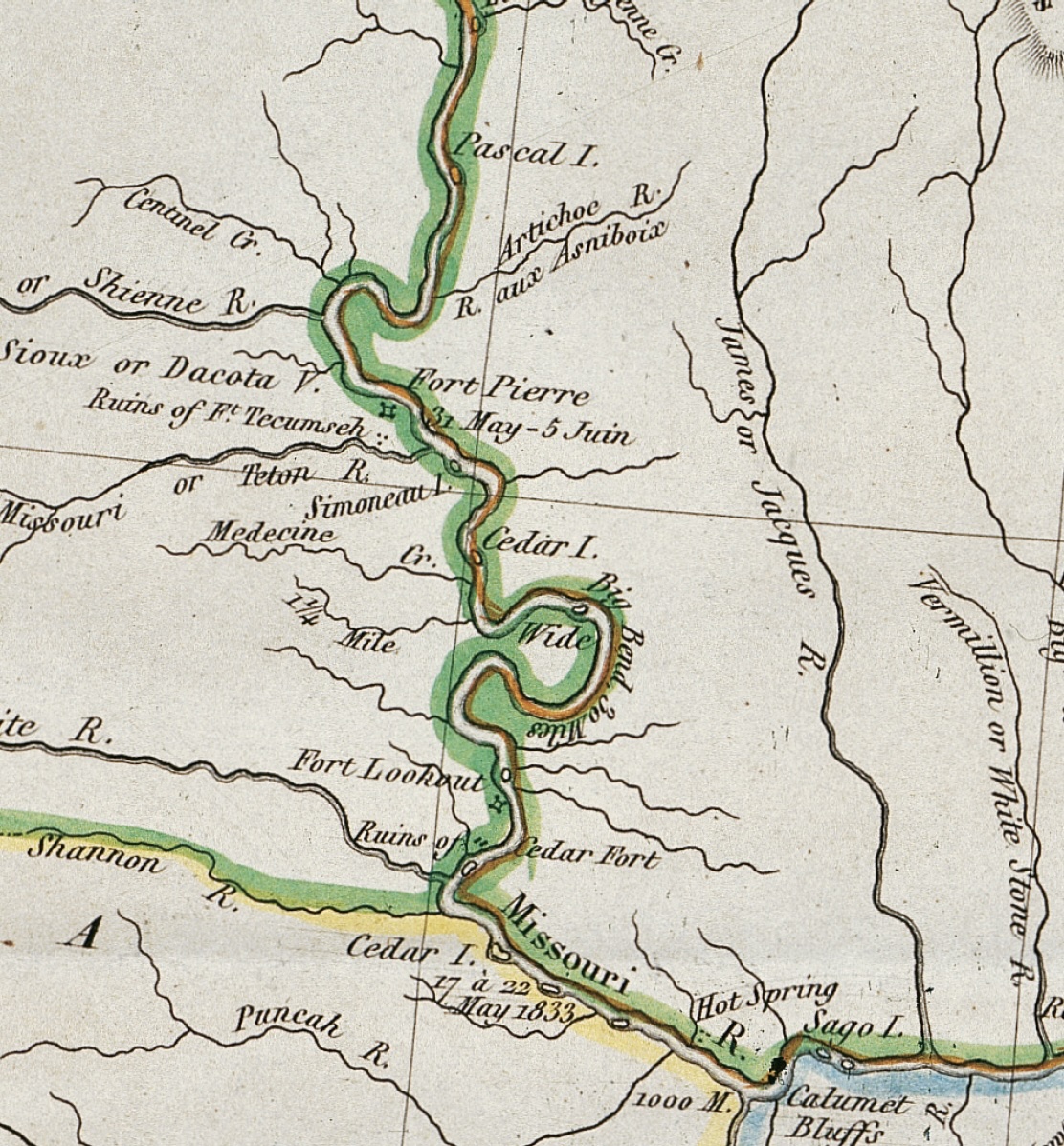
June 5, 1833
Early in the morning, overcast sky, pleasant weather. At eight o’clock, 68°F [20°C]. Mr. Bodmer finished his drawing of Wáh-Menítu. At eight o’clock the keelboat was no longer far from our vessel; our departure was nonetheless delayed until ten o’clock. Mr. McKenzie had stayed on land and rode after us. Three cannon shots were fired, the flag was hoisted, and we cast off. To the left on the prairie, the wooded border still extended far out. After an hour we reached large sandbars; soundings continued. To the right on the hills there were large accumulations of sometimes sizable isolated boulders, which perhaps had rolled down when these earth layers were burning; they were whitish, however, and seemed to come from a more distant layer. Farther on, there was a level prairie to the right with sometimes more, sometimes less dense or scattered tall old cottonwoods. Behind it [the prairie] hills rise, which are covered everywhere [with] a pale green, [yet are] bare and dead. Sometimes [the hills are] rounded off on top, cone shaped, or flattened off like a table. At twelve o’clock we had too little water; soundings were made. Mr. McKenzie, with two horsemen, came riding over the summits of the hills and dismounted at a ravine down near the water. He was brought over; with him was Mr. Laidlaw, who left after lunch.
We lay quietly on the right bank at an island that was so densely overgrown with narrow-leaved willows that one could not penetrate it. Individual wild grapevines and willows were blooming. On the sandy shore we tracked elk, and here grew two low, spreading plants [— —] and [— —]. In the afternoon we made very little progress, because the water level was too low. In the evening we again put in near the dense willows to spend the night there. Dreidoppel went ashore with Mr. McKenzie’s dog, and it caught a young elk, but the willows were too dense for them to pursue and find the animal.