July 9, 1833
In the morning, slightly overcast sky, some wind, soon some rain [and], at the same time, warm. Early in the morning the mosquitoes tormented us greatly. Between the low wooded banks with soft sand we soon found the place where the mosquitoes breed. We had to navigate around a very bad spit where the current was very strong. We cut straight across to the right bank but here got behind deposits of driftwood where the current was [also] very strong. The keelboat was secured with several ropes tied around tall trees. With great exertion, twenty-six men succeeded in overcoming the current and pulling [the keelboat] around the bend of the river; the wind was against us. On the other side we had a beautiful prairie to the right, and when we looked to the left, we caught sight of two deer swimming across the river ahead of us. They came ashore under the steep bank before our men; a large number of rifles and muskets immediately went into action, but the marksman farthest up front missed at 10 paces. The deer swam back, and [although] greeted by a hail of bullets, [they] escaped. One seemed to be wounded in the head. We stopped and the men had breakfast. Somewhat farther [on], we saw two buffalo in the forest to the left.
At 7:30, 71°F [21.7°C]. Here the river made very sharp turns. Papin had already fired several times in the forest to the left; Deschamps was hunting on the right bank. When we put in at the left bank, Dreidoppel and Culbertson also went hunting. Our deck now has venison hanging all over it; one elk provides nourishment for some time. The men break open the leg bones, eat the marrow, and lubricate their gunlocks with it. All wild animals have beautiful coloration now, but the bucks are all in velvet and their antlers are not yet fully developed. The hides of the bagged game belong to the company, which uses them to have shoes made for the men. From a large elk hide, one [can] make about twelve pairs of moccasins, for which the maker receives one dollar. A deerskin does not provide more than five or six pairs. If they are provided with soles, they are very useful but are not waterproof.
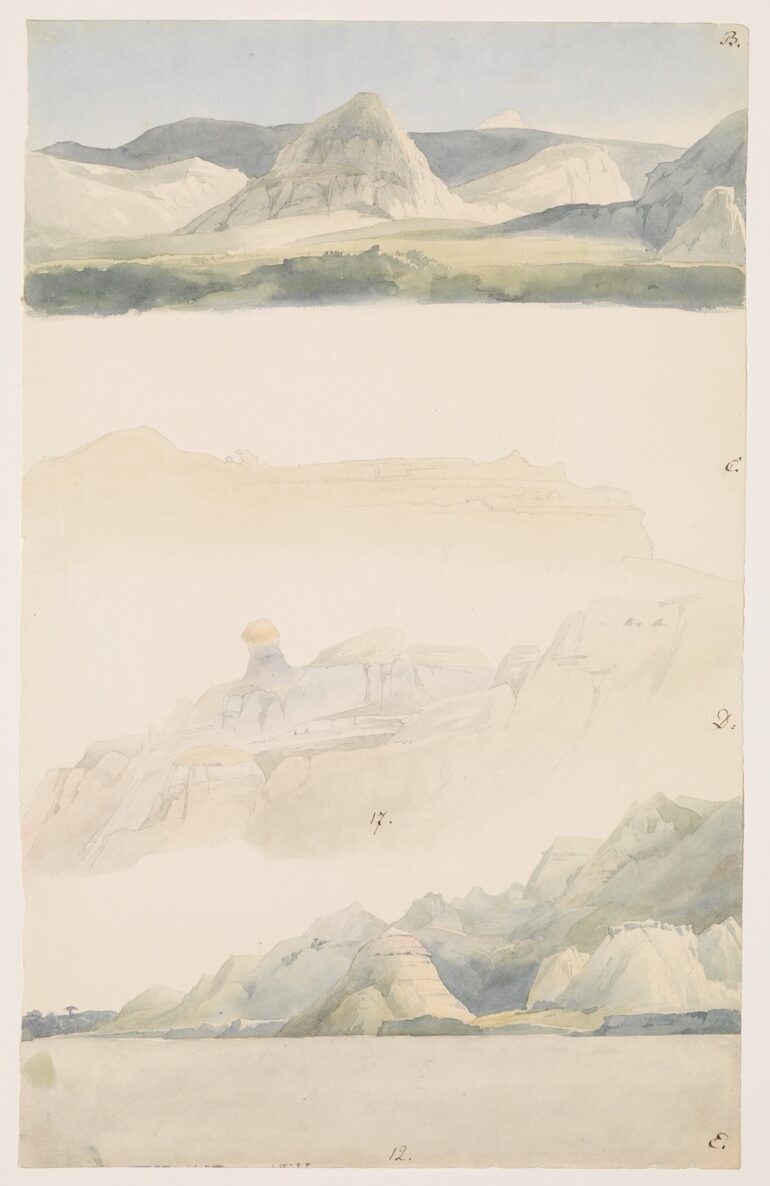
As we were navigating along the left bank, a tree shattered our already damaged cabin door for the second time. Papin brought in a deer and [then], shortly afterward, two even larger ones. He had wounded the largest one we had seen but had not gotten it. The sky had become overcast, and for a time it rained heavily, whereby the mosquitoes were troublesome. In the forest to the left there was a dense carpet of blooming roses and red willows; crows called out in the tall timber. We again reached the strange chain of clay hills with conical domes and red and black patches; before [the hills] is a plain with wormwood. A storm thundered severely between nine and ten o’clock; it also rained, and the mosquitoes were very troublesome. At the place where the river again turns right and away from the hills lay a long, yellowish clay elevation shaped like a fortress or one of its fortifications (sketch C.). Here a small, level prairie again joined a large, beautiful wooded shore. Before the fortress lay small hills with several isolated cones, some of which consisted of a violet clay (sketch D.). Mr. Culbertson and a hunter came in from the prairie and brought an elk antler with seven magnificent long tines, which had a circumference of 7 inches 7 1/2 lines above the bay antler. The boat remained here for a while, and Mr. Bodmer made yet a third sketch (E.). 25
The hills—the light colors of which were grayish yellow, greenish, reddish, and violet—[presented] a quite singular view. Dreidoppel had gone farther on; he had found very fresh buffalo tracks and followed them. To the right, in the forest and in the willow thickets, one heard the thrushes (Turdus rufus) singing, and in the prairie, the big yellow-breasted lark (Sturnella).
As we navigated past the forest before us, we reached a sandbar with willows behind it, where our men could scarcely make their way with the cordelle. They completely undressed, and some sank in up to their hips: a strange sight to see, these naked, half-black men, like South Sea islanders, pulling the rope while laughing heartily the whole time. Deschamps joined us without having shot anything. On the right bank, he had seen an Indian riding on the prairie. The wind had become very strong; we crossed over to the forest of the right bank. Dreidoppel was waiting on the left bank. At twelve o’clock, 81°F [27.2°C]. We anchored to the right by the forest and remained here for several hours, until a very severe wind was succeeded by rain. [The wind] had blown the sand high into the air. Dreidoppel had to wait a long time; [he] was fetched by the dinghy after we had eaten.
Where we lay at anchor, the forest was densely overgrown with willows, roses, and red willows along the bank; various pretty plants were blooming here. On the sand we found spruce cones, which the river had washed down from upstream. At two o’clock Messrs. Mitchell and Bodmer went into the woods to hunt. From here on, the bank along the forest was very soft and eroded in various ways; one constantly saw large masses of it caving in, and at one spot, grave peril threatened us. A heavy cottonwood stood in just such a spot close to the bank. When our men went over that way, it collapsed. The big tree threatened to fall on our boat, which was moving close to the bank, and would have crushed it. The helmsman urged us to run to the prow. The earth broke loose, but fortunately the big tree remained upright, and later we laughed about the incident. Farther ahead the forest was so dense that the men had to clear the way with axes; many persons sprang ashore, and despite great exertion, we struggled ahead only very slowly. Opposite to the left, a swampy, flat point of land; Mr. Culbertson rowed there in the [small] boat to look for his dog, which had been left on land that morning and which we heard barking. The hunters came back empty-handed.
The high hills have come to an end, [and] the region is now flat. We see banks overgrown with vegetation; in the distance on all sides, flat, gentle hills; for the most part, lowlands. Beautiful black and white butterflies (Papilio [— —]) came to the boat and alighted on the skins of game spread out there to dry without our being able to catch any. Mr. Culbertson brought back his dog. We remained near the forest. Here was tall timber and, beneath it, as in all woodlands up to now, a carpet of shrubs blooming, with small, pale red flowers, a darker violet-red on the outside ([— —]). In addition, several other interesting plants. We stayed here until nearly seven o’clock in the evening; when the wind subsided, we crossed the river and moored the boat at the left bank near a tall cottonwood forest. The wind had driven off the mosquitos a bit, and we were somewhat more at ease.