Voyage from Europe to Boston
Maximilian’s expedition began with a 48-day voyage from Europe to America. Maximilian, Bodmer, and Driedoppel departed from the Dutch port of Helvoet on the brig Janus. Always at the mercy of the weather, the sail-powered ship was frequently subjected to violent storms, then becalmed by windless days.
June 20, 1832
In the morning, very wet on the ship. Fog. Course northwest. Wind moderate. At eight thirty, temperature of the air 5 1/4°R [43.8°F, 6.6°C], that of the water much cooler, 2 3/4°R [38.2°F, 3.4°C], probably because we are on the Bank of Newfoundland. Our breakfast today consisted of fried meat and liver from the dolphin with coffee. When fried, that meat is very tasty, tender, and has no aftertaste of blubber, though very black. Much of this meat was cut into narrow strips (beef steaks) and suspended on the lower ropes and yards, where they keep well.
A brisk wind drives the ship rather well; at the same time fog, which covers the clothing as though it were hoarfrost. Today one sees many birds, even flights of twenty. From this we know that we are close to the Bank and coasts of Newfoundland. At noon the fog is so dense that no observation of the sun is possible. At two o’clock in the afternoon, the temperature of the air 8°R [50°F, 10°C], the surface of the water registers 4°R [41°F, 5°C], thus about the same as the air yesterday. The wind blows briskly and continuously from the southwest, and the ship runs at 5 knots. Until the approaching evening, very brisk wind and dense, wet fog. Shortly before six o’clock the wind became stronger and stronger.
Suddenly about seven o’clock, a calm, whereupon the ship rolls to an extraordinary degree and one can hardly keep one’s footing on the slippery deck. About seven o’clock temperature of the air 7°R [47.8°F, 8.8°C], that of the water 4 1/2°R [42.1°F, 5.6°C]. We see many marine birds; several swim near us. From a fishing boat (a two-masted vessel of seventy to eighty tons, a schooner), which we recognize in the fog, we realize that we are on the Great Bank of Newfoundland. Two large cetaceans swim close beside us and blow their stream of water into the air.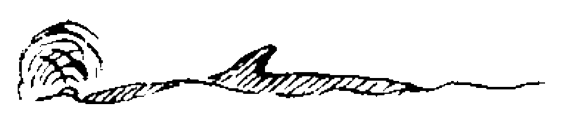 They were north of the ship and vanished in the west. The lead was thrown out and touched bottom at 35 fathoms, proof that we are on the Great Bank.
The fog presently disappeared completely. The ship did not move forward but rolled very violently. This period of immobility was used for fishing. A lead was tossed out on which several fishing hooks with blubber were fastened, and with virtually the first haul a nice, large codfish was caught (see the Natural History Diary), which here on the bank are especially abundant and are caught in large number. The fish was immediately cut open, and out of its stomach several clams, Glycimeris siliqua, were taken, with which the fishing hooks were immediately baited again, but nothing more was caught. The night was calm.