Four-and-a-Half Months’ Stay in New Harmony
Description of the region – Natural history – Messrs. Say, Lesueur, and Owen – Hunting excursions in Indiana and Illinois – Wabash, Fox River – Illinois prairies – Albion – Black River – Mr. Bodmer’s trip to New Orleans
February 15, 1833
In the morning, the entire countryside covered with a beautiful 3- to 4-[inch]-deep tracking snow; the sky slightly overcast. At seven thirty, -1°R [29.8°F, -1.3°C]. We put amphibians into metal containers. Then I went to the duck creek in the thorn bushes, followed fox tracks half-covered by snow, shot three times at ducks, and bagged a nice mallard drake. At twelve noon, 5°R [43.3°F, 6.3°C]; at one o’clock, 6°R [45.5°F, 7.5°C]. Extraordinarily warm in the sun. At three o’clock in the afternoon, Mr. Bodmer returned from his journey to New Orleans. Dreidoppel had gone out and in the evening brought back a duck (Anas rufitorques), a crow, a squirrel, and a woodpecker. We spent the evening at Mr. Say’s, where Mr. Bodmer gave us the following account of his journey, which I am adding here in the footnote:
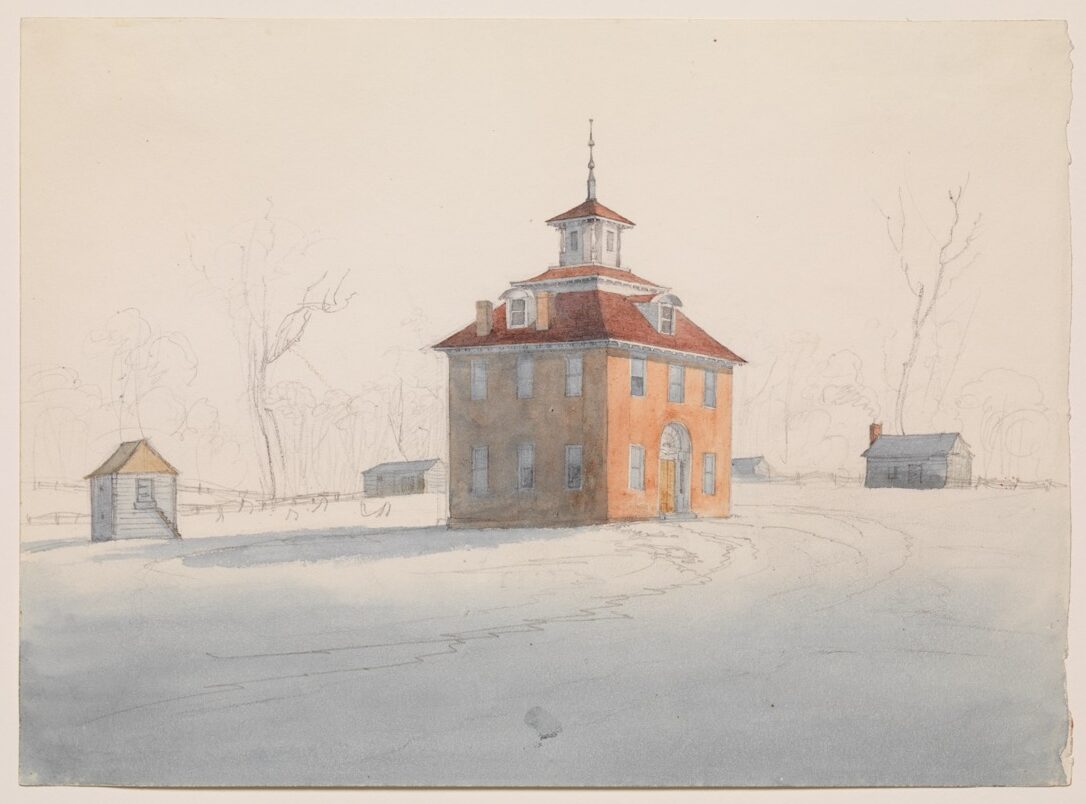
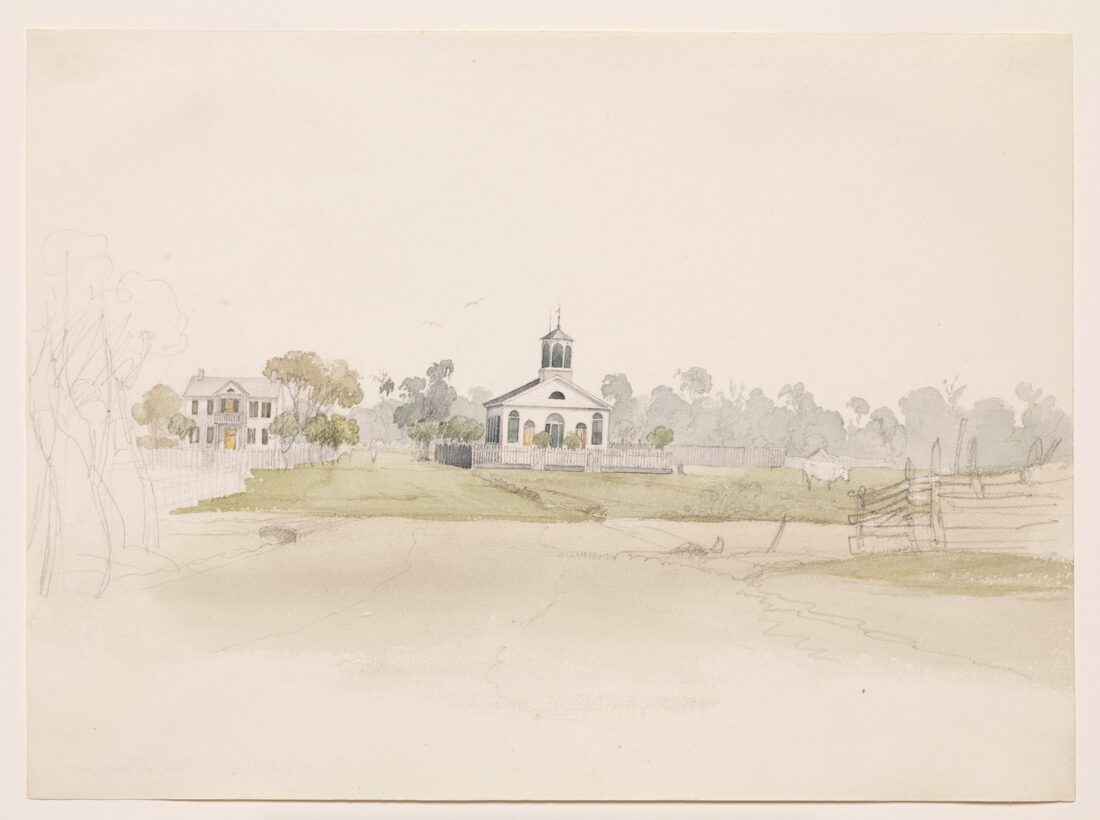
Mr. Bodmer had to wait five days in Mount Vernon for a steamboat. Repeatedly during the night they went to the bank and called out to the steamboats. Once someone on a ship asked what kinds of passengers there were, and the reply was: two cabin passengers with 150 barrels of whiskey (which Mr. Twigg had with him). Then they bargained about the fare, but the captain no longer responded and continued on. Mr. Bodmer sketched the courthouse at Mount Vernon. Was also at a dance there, where he saw some amusing scenes, including the manner in which ladies sometimes faced the fireplace while dancing and did not look at their partners at all.
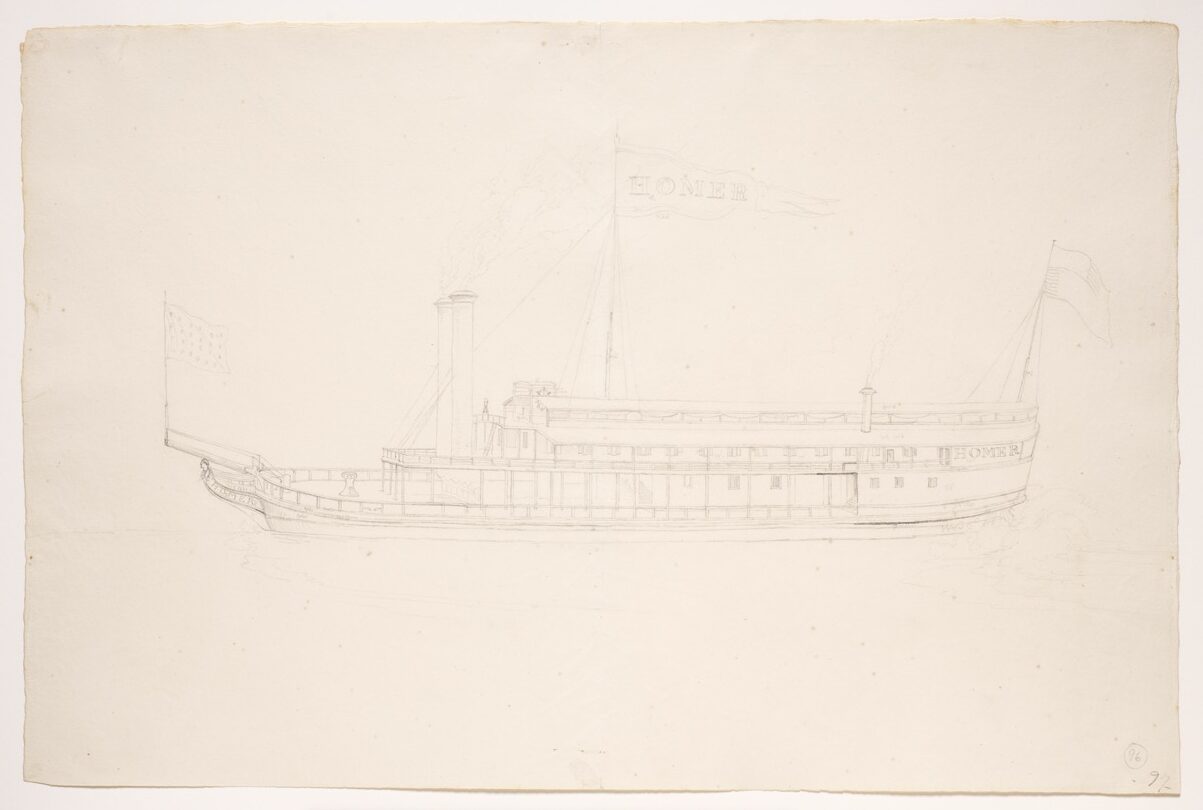
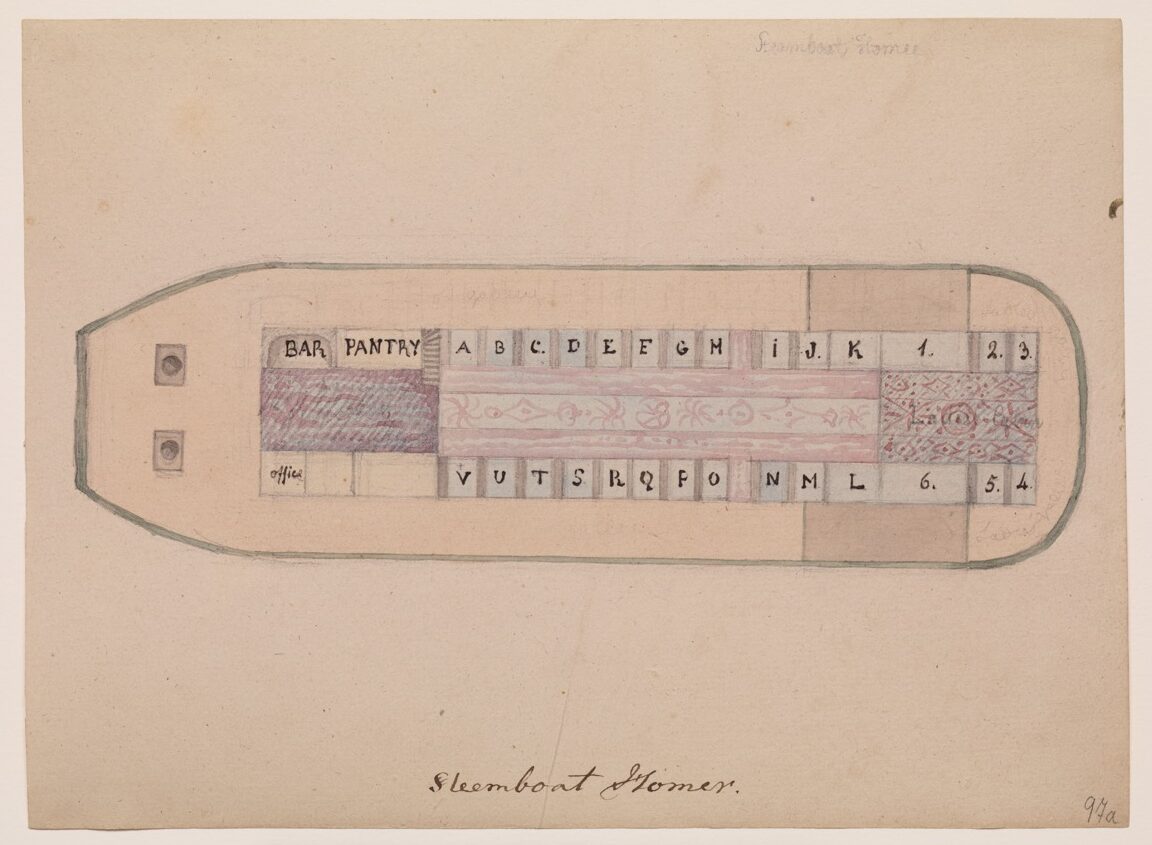
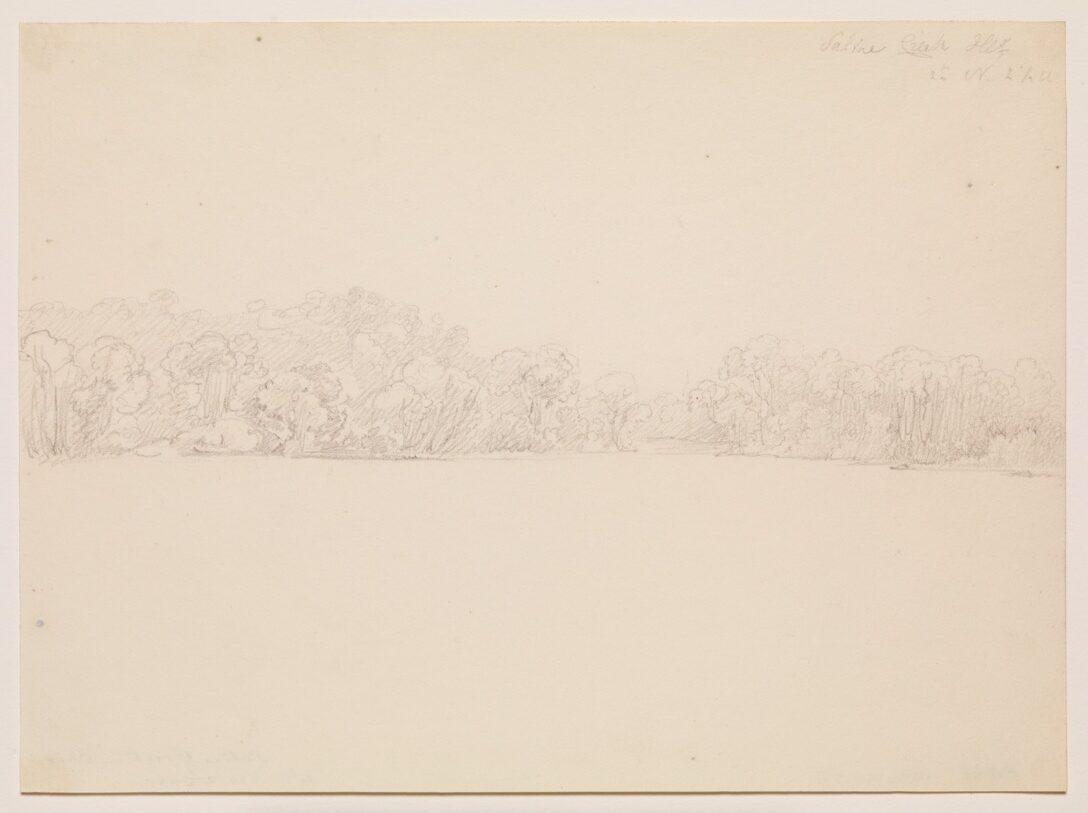
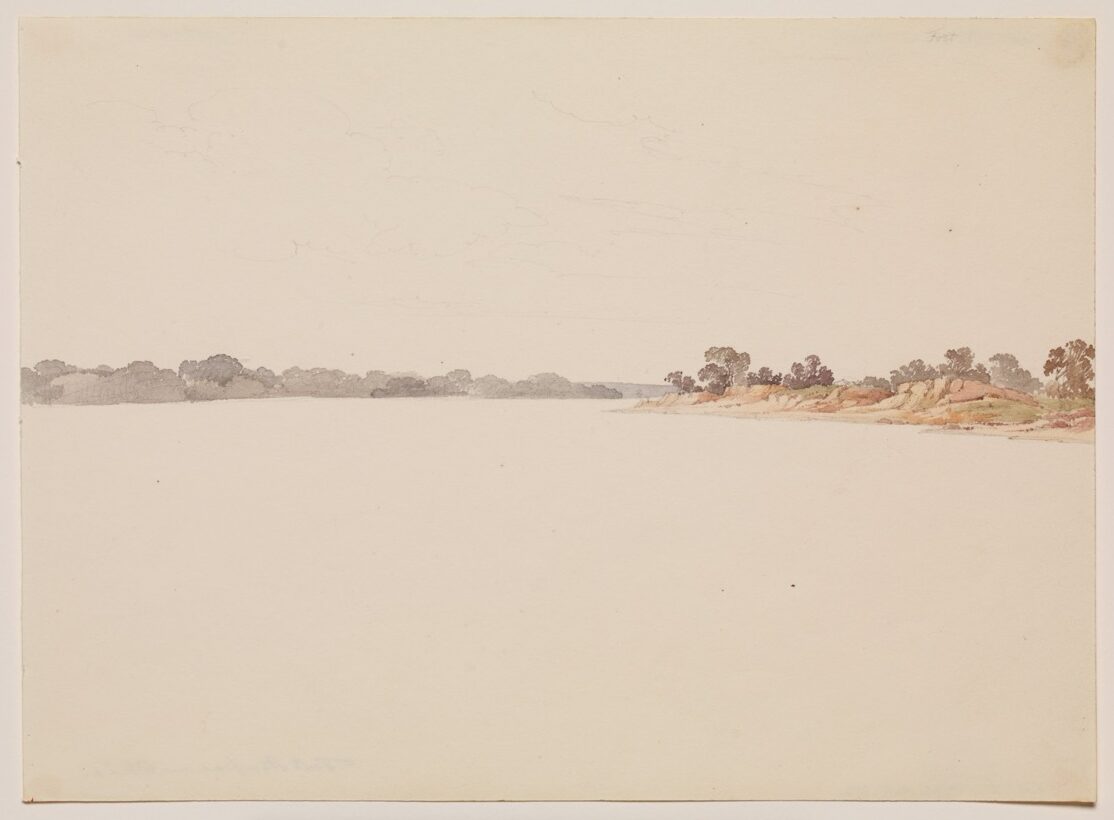
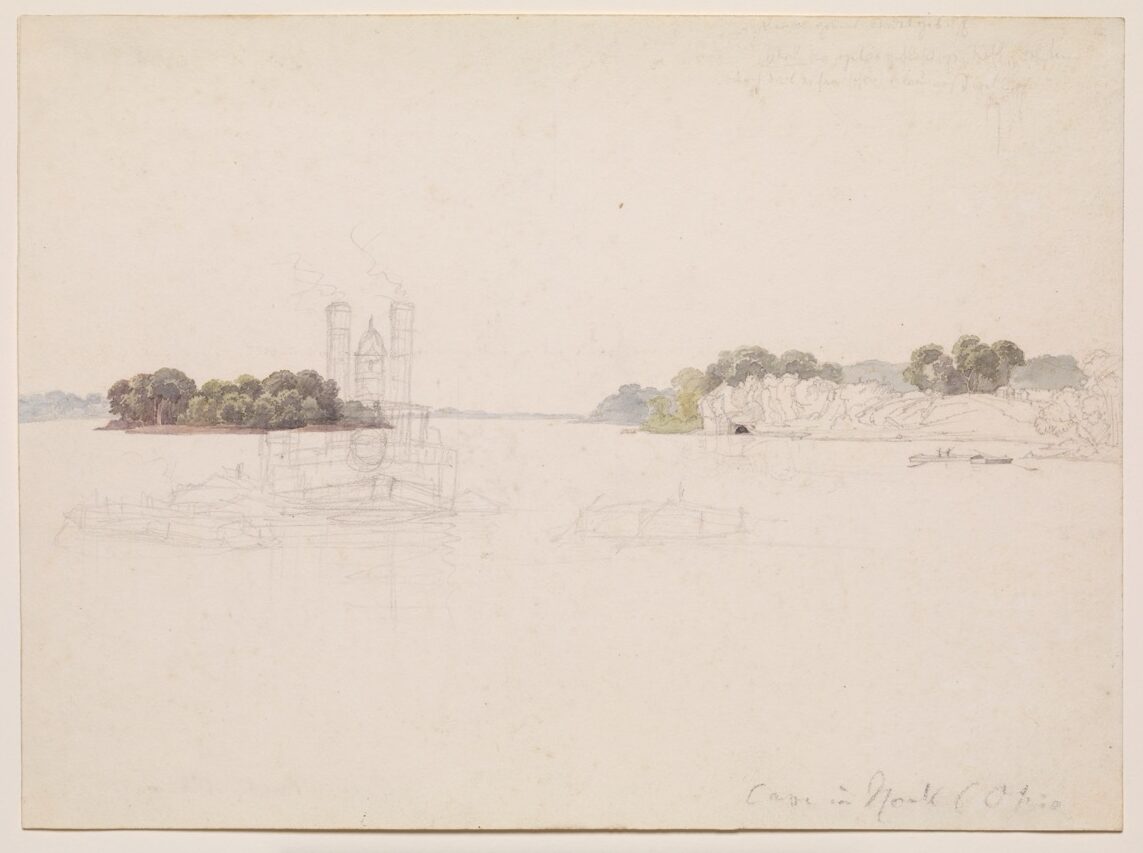
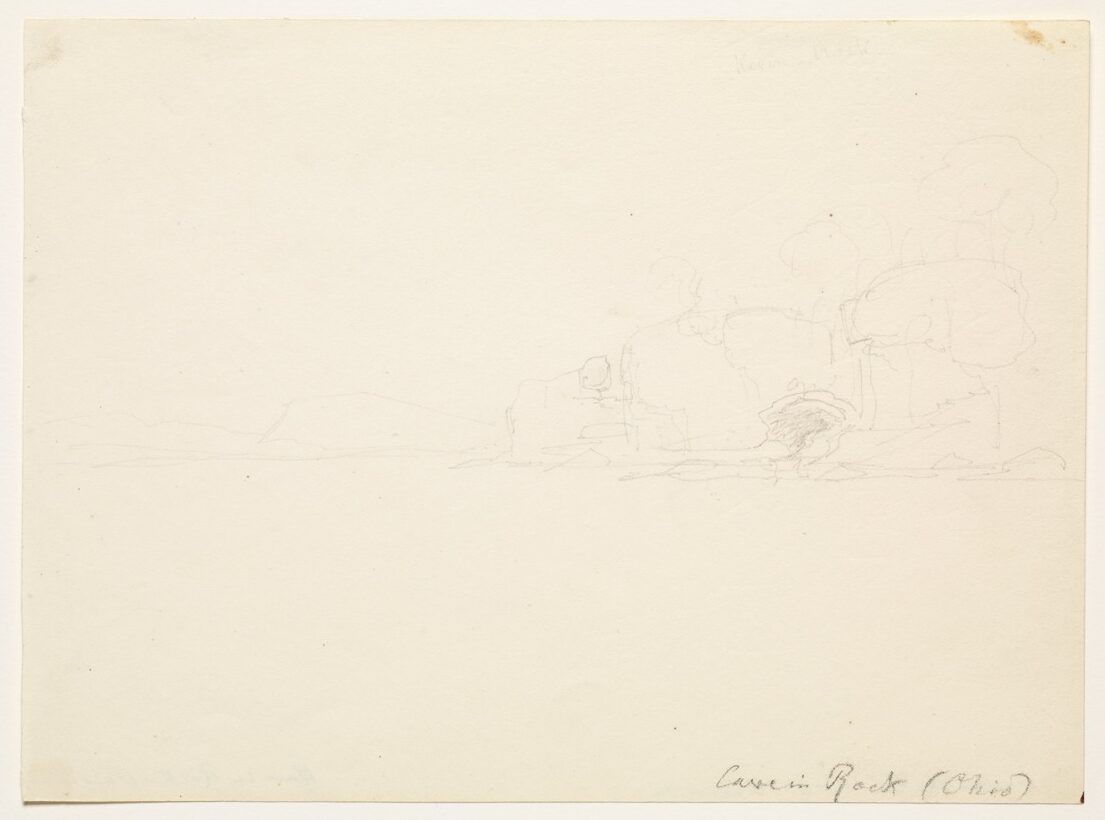
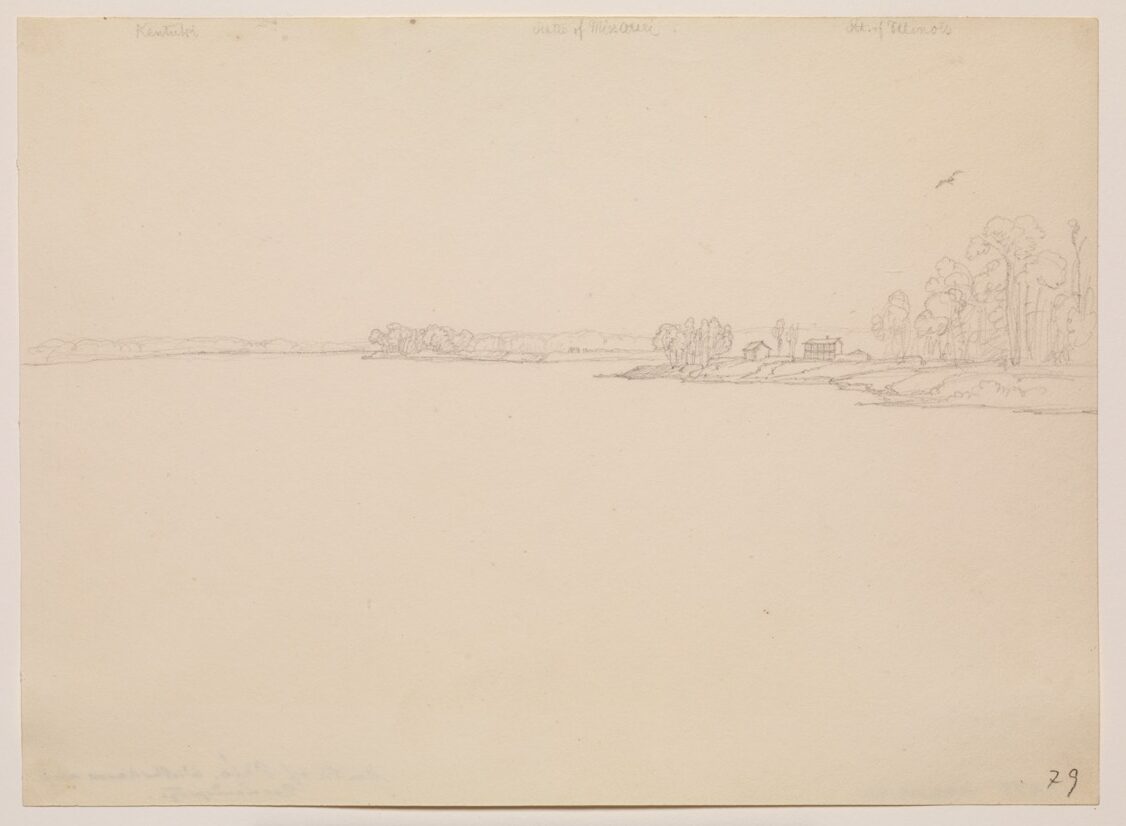
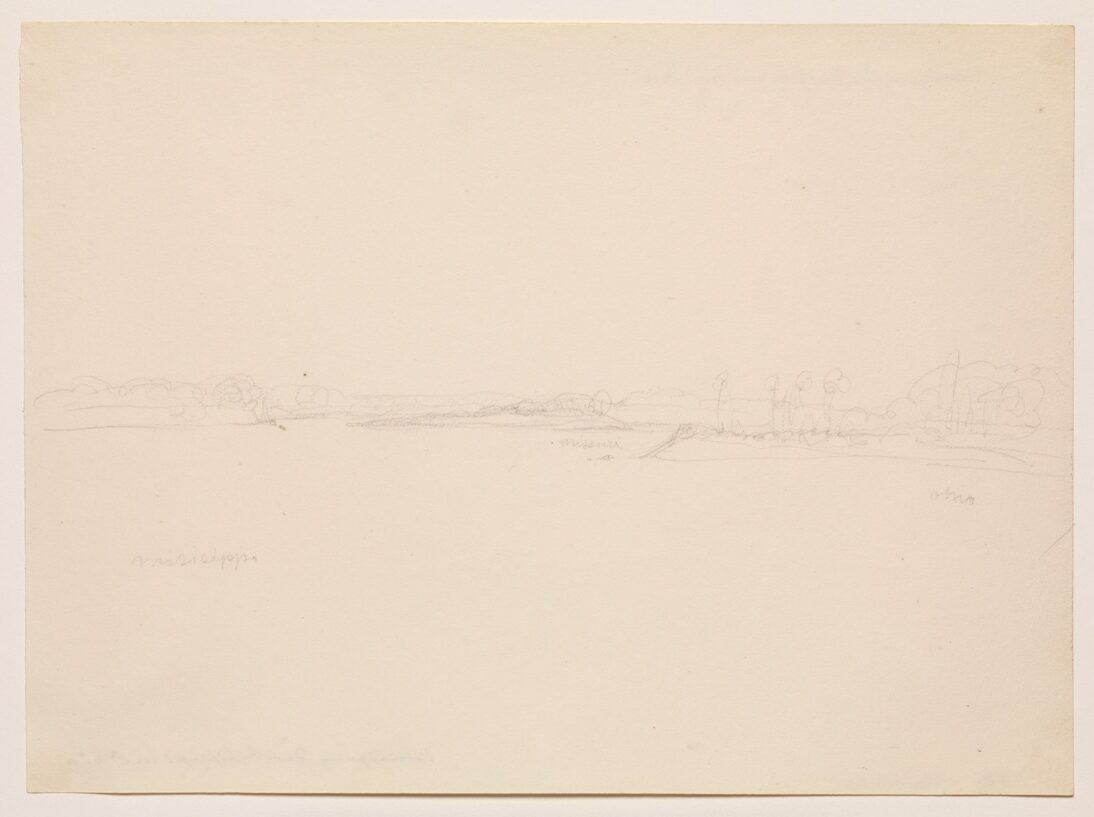
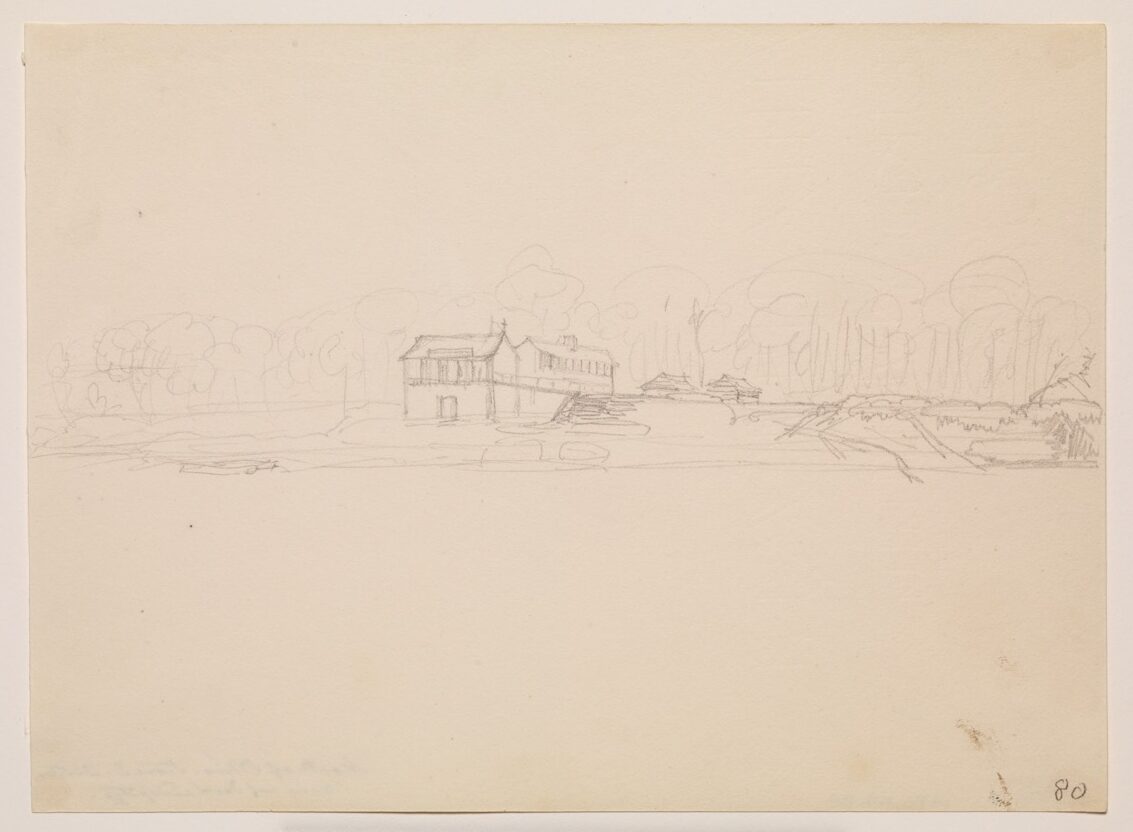
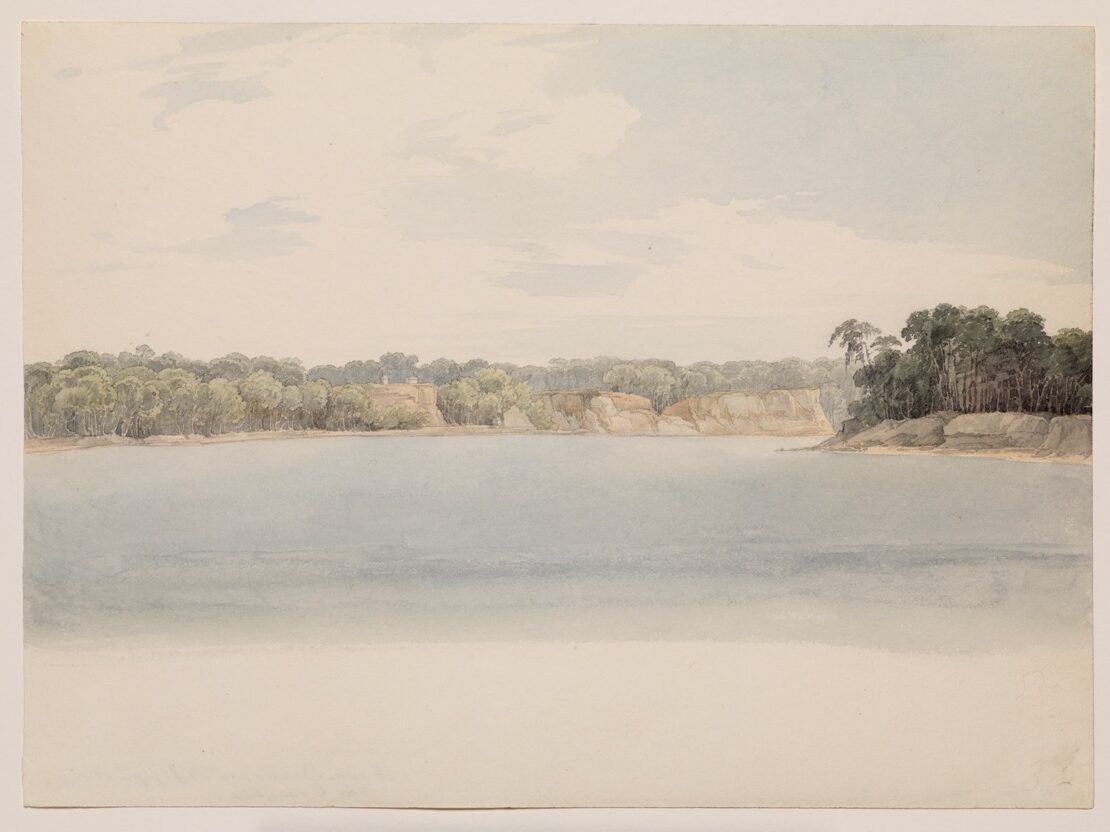
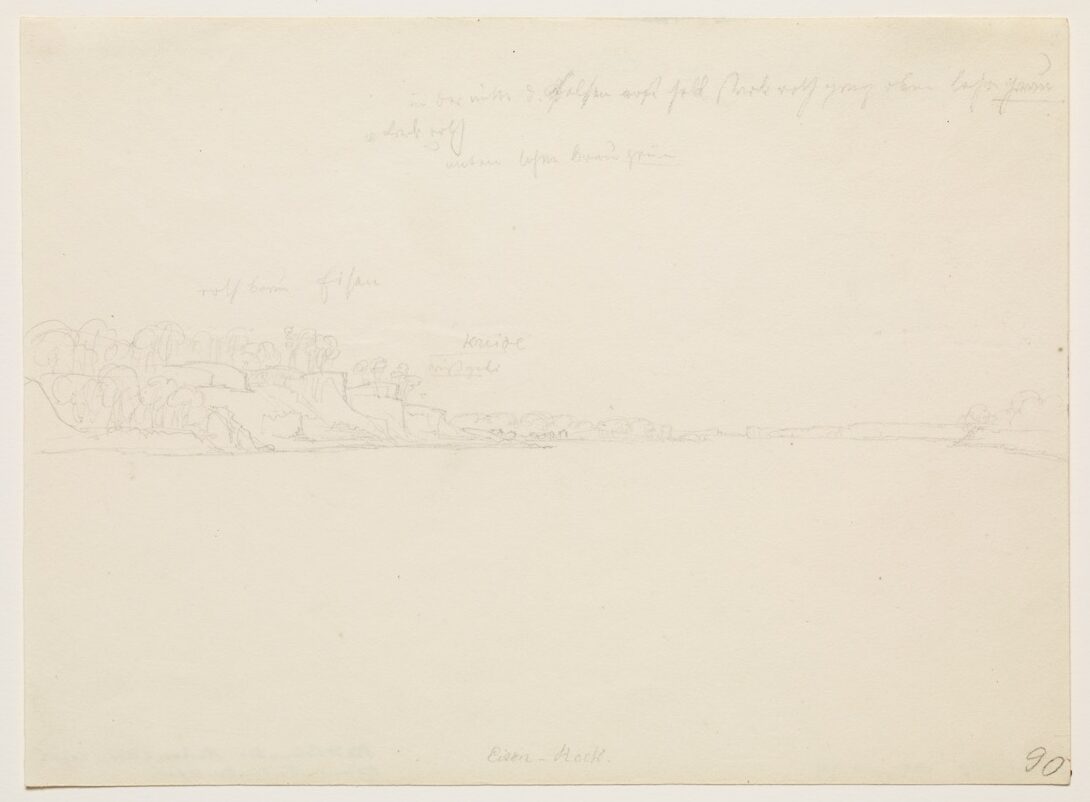
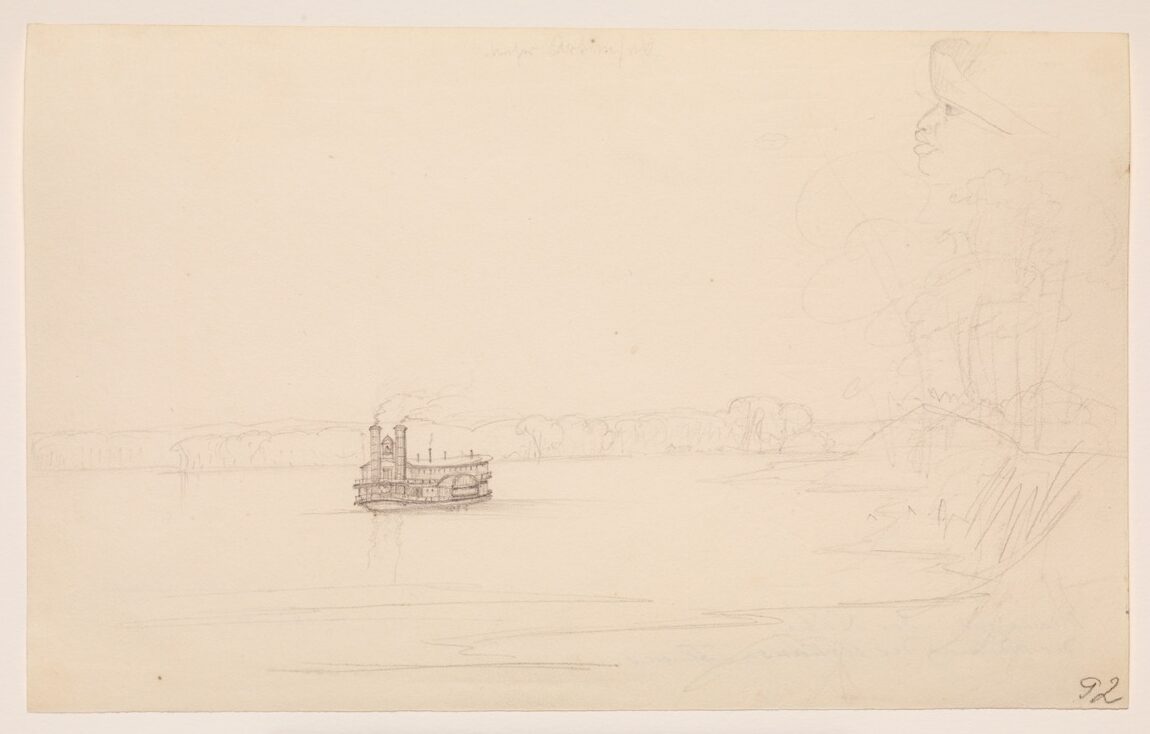
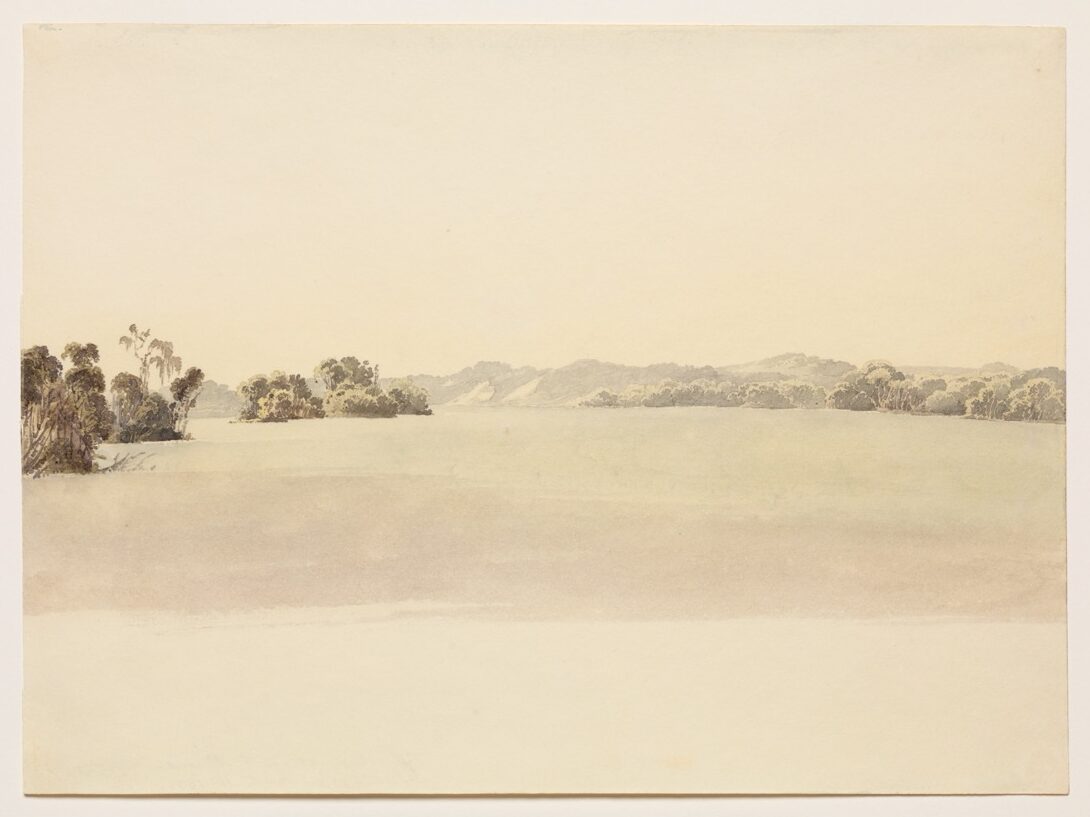
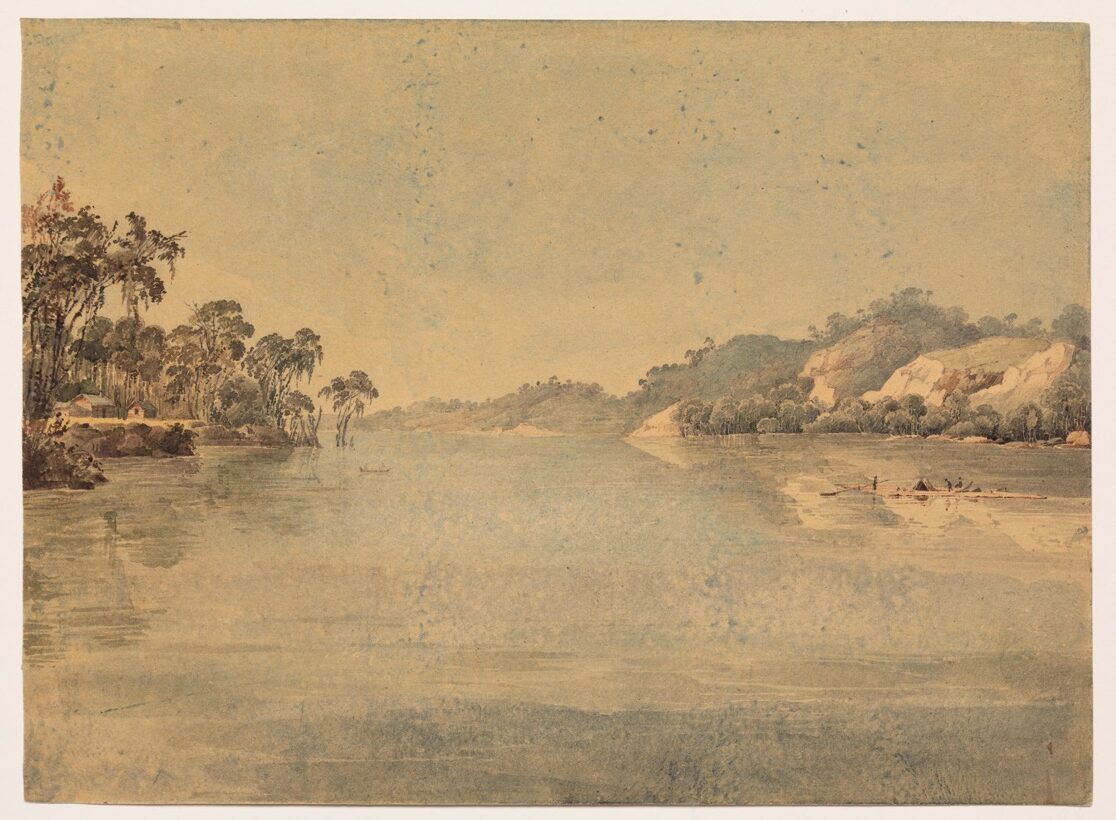
Finally, on 3 January after midnight, the steamship Homer arrived, the finest now plying the Mississippi, and the travelers embarked. This steamship has small cabins with two bunks, where people are separated. From Louisville to New Orleans, its expenses amount to 6,000 dollars for wages, wood, food, and the like. The views along the Ohio are nicer than those along the upper Mississippi. Mr. Bodmer sketched various views, including Saline Creek, Fort Massac, Cave-in-Rock, where there is a cave, etc. At the confluence of the Ohio and Mississippi, the region is flat. On the point of land to the right, there is a single poor inn with a store and several small adjoining buildings. The banks of the Mississippi lack variety up to the vicinity of Iron Banks. At this place there is a high, steep bank that runs continuously until close to Columbia, where it has already changed into white clay. Columbia has twenty to twenty-four houses.
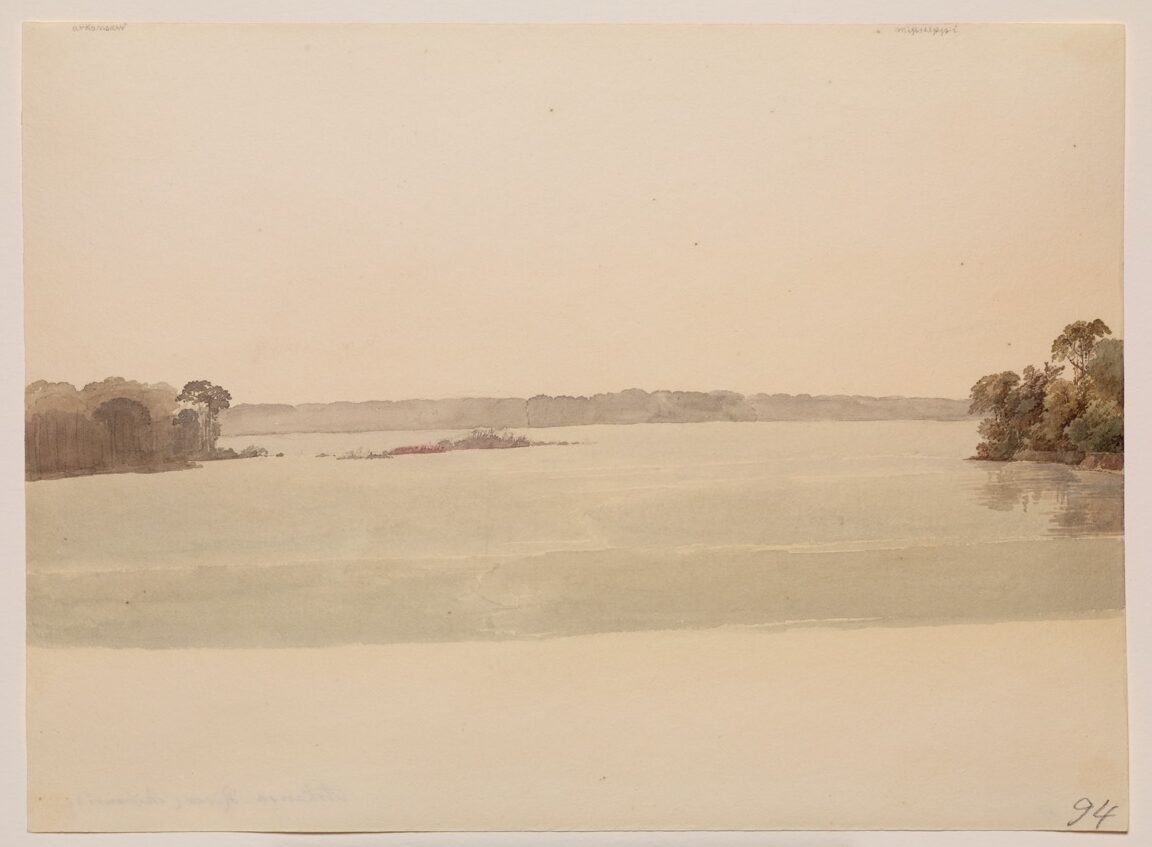
On 7 January the travelers are in New Mexico, a small town of ten to twelve houses. Here the right bank is very flat and wooded. Before that spot, one sees primarily sandy banks, tall cane, and cypresses. Memphis is situated to the left on a high bank and is a rather important town. The mouth of the Arkansas River is on the right bank, very low land. The mouth of the river is not noticeable.
Natchez is situated on picturesque elevations. On the bank below lies Natchez-under-the-Hill, a bad, dirty town notorious for gamblers and dissolute women—a dirty, unhealthful place. Large numbers of flatboats, which lie joined together here. There is lively trade. The steamship stopped here for an hour and took on wood [and] the travelers picked a beautiful bouquet of flowers. Roses bloomed out in the open in profusion. One already saw much Tillandsia usneoides hanging from the trees in long strands.
The sudden climatic change that one experienced in two days made a most pleasant, interesting impression. In two days one passed from deep winter into the most beautiful spring. When the passengers disembarked, they witnessed on shore a cruel cockfight that was started by someone near the ship. Numerous spectators gathered immediately.
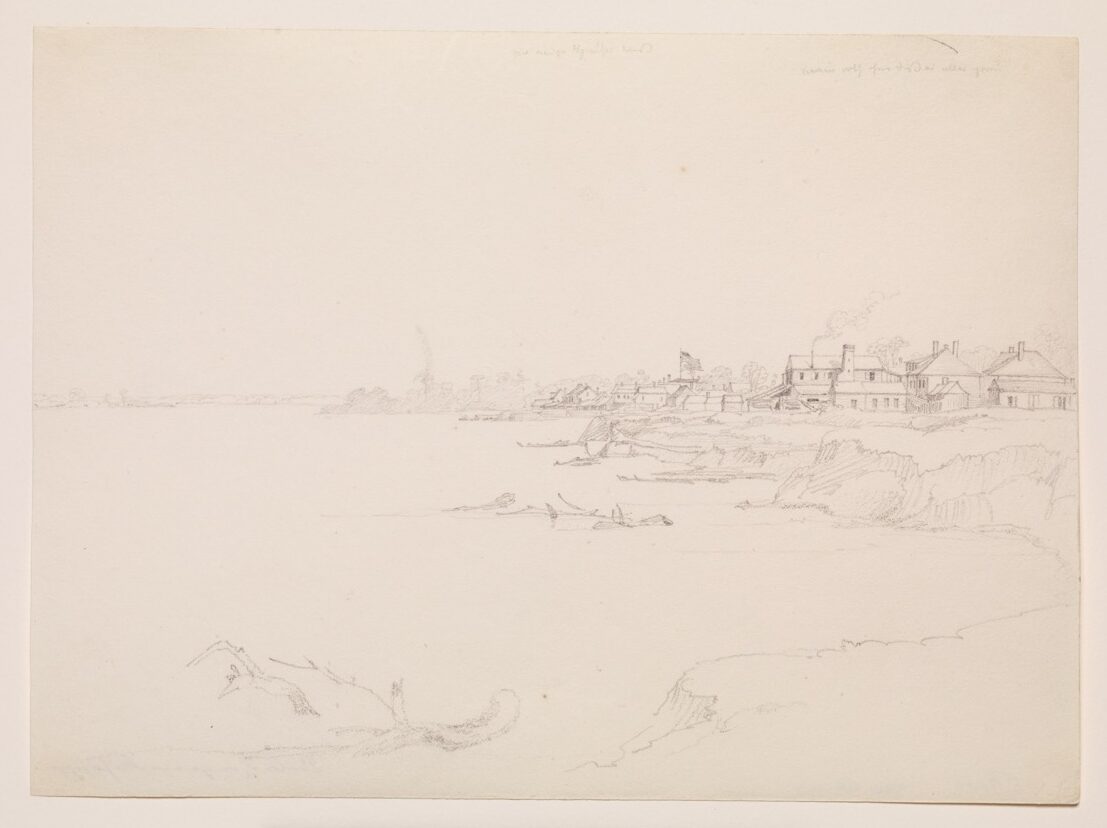
Fort Adams [Mississippi] is situated on picturesque hills on the left bank of the river. It is a town of about twenty houses, but the actual fort no longer exists. The travelers passed the mouth of the Red River at night, as well as Bayou Sara or St. Francisville. Very early in the morning, they arrived in Baton Rouge (see the sketches). The town has an attractive location on the left bank. During the evening they lay at anchor before New Orleans.
On the following morning at about eight o’clock, they arrived in that city, which is built entirely on a level, very flat tract of land on the Mississippi bank, before which a forest of masts and ships extends. The opposite bank is extremely flat. Thirty to forty steamboats are tied up at the quay.
Mr. Bodmer was given a friendly reception by the druggist Barrabino, an Italian, and invited to live in his home. Mr. Barrabino is a friend of Lesueur and a correspondent of Mr. Say. He is a generous, pleasant, well-to-do man; speaks many languages; is well informed and also well-versed in natural history; [and] makes collections. He sent me a fine present of five bottles of Louisiana amphibians, including a young alligator (Crocodilus lucius), an Amphiuma (Amphiuma tridactylum Cuv.), two water moccasins (Cenchris mokesson), and many others.
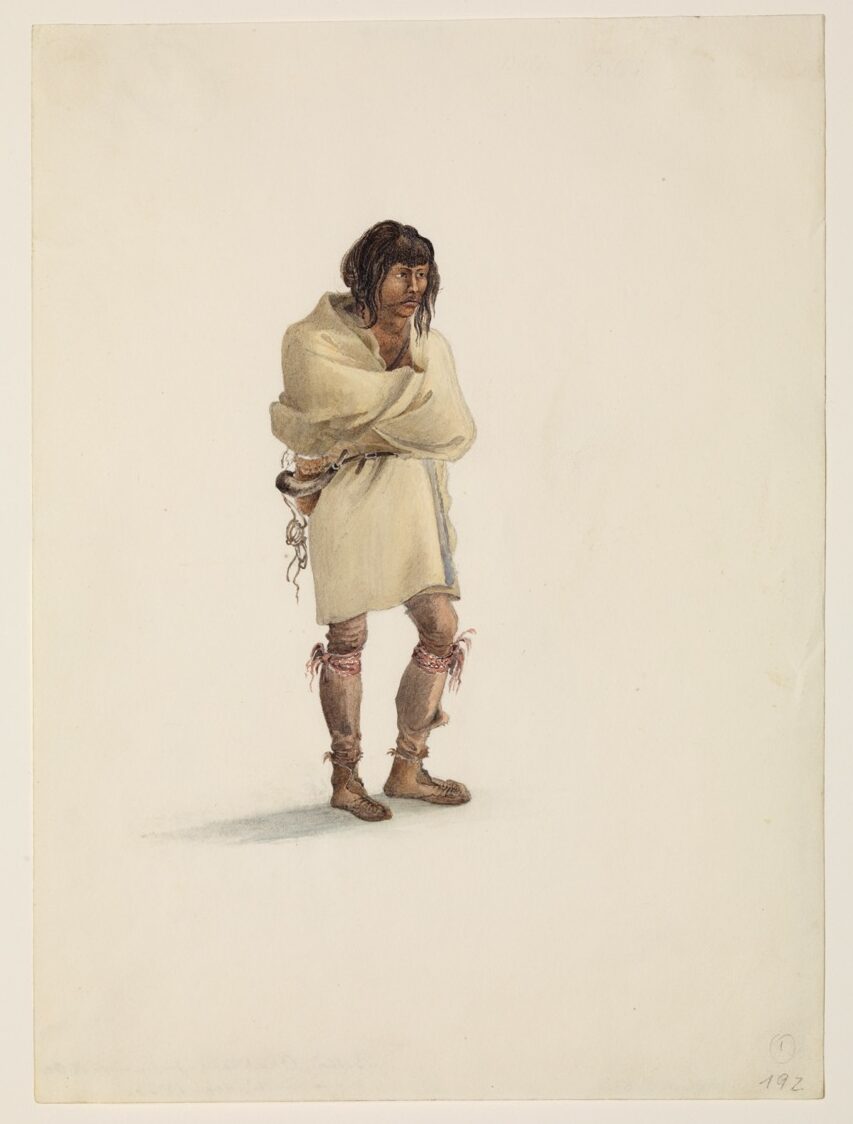
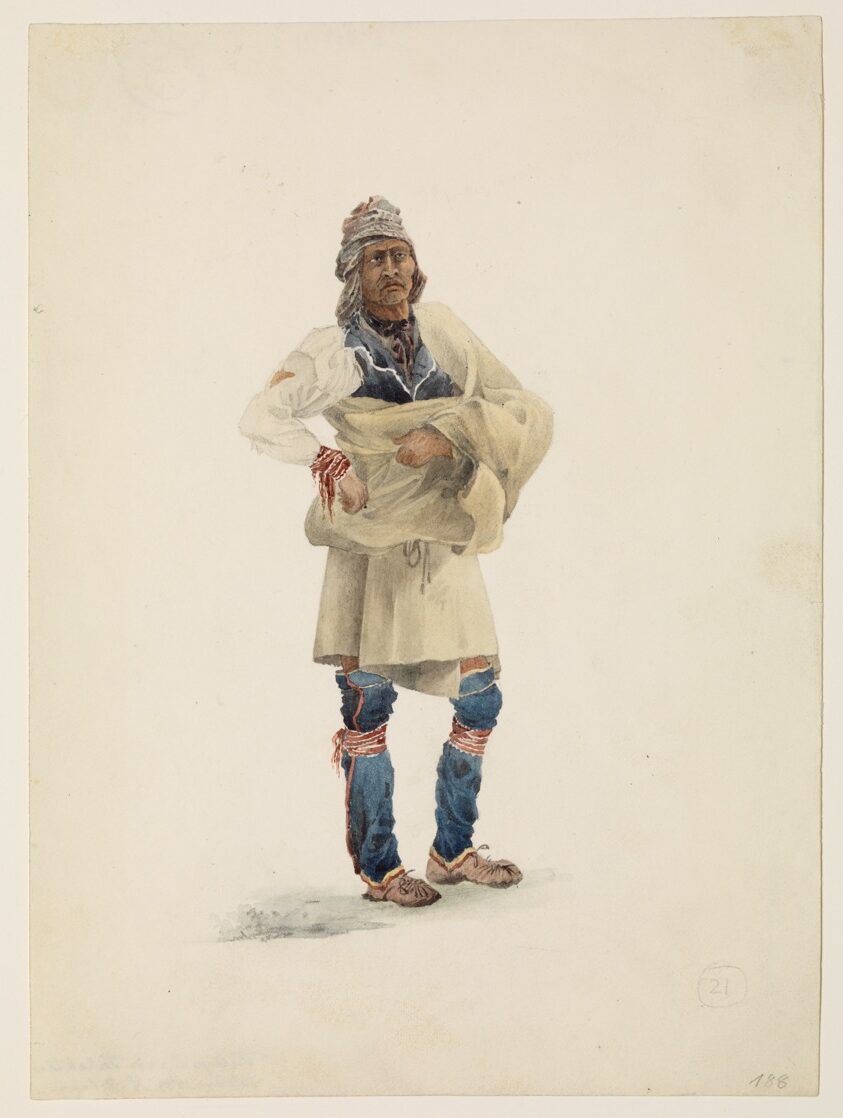
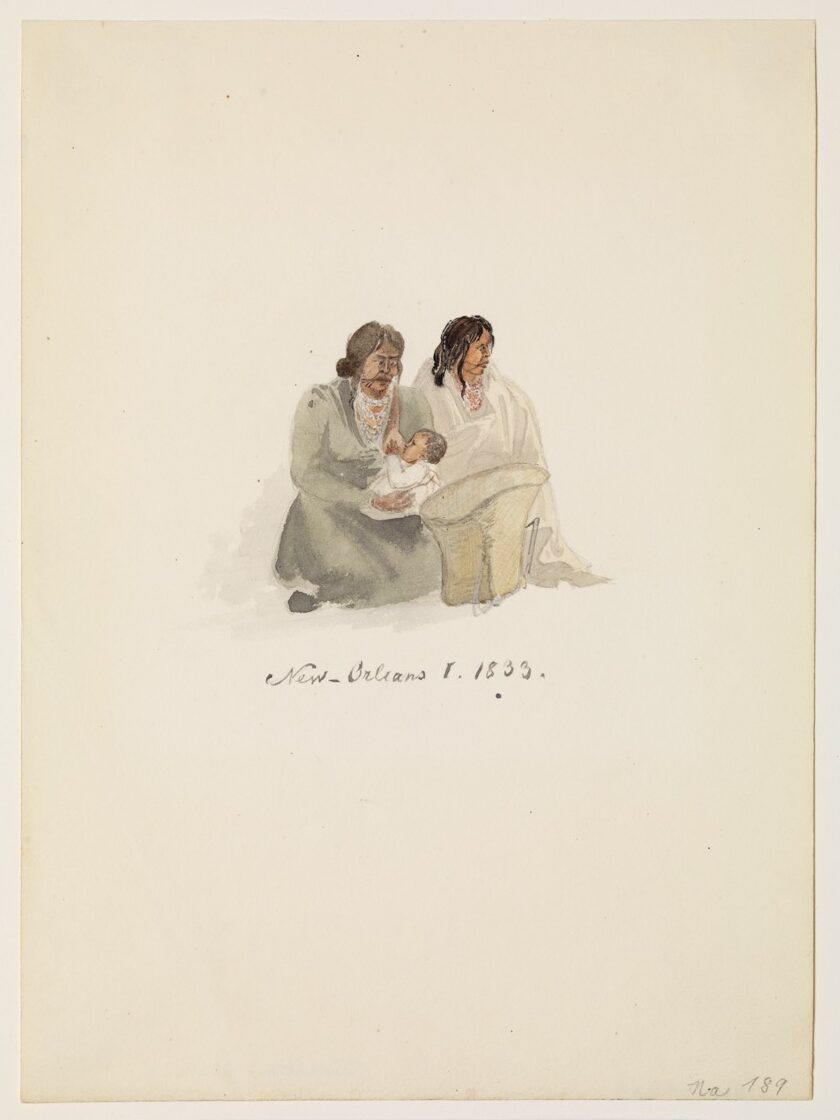
Mr. Barrabino provided Mr. Bodmer the opportunity of drawing several Indians, who live here in a dismally idle condition like Gypsies. They come from the tribes of the once powerful and numerous Choctaws, Cherokees, and Chickasaws. Now they bring all kinds of produce to market and are frequently in a sad state of drunkenness and degradation. Some of them make fires in the streets, just as the black women make coffee and their meal of gumbo, an overcooked meat dish, there.
Mr. Barrabino lives near the marketplace. Here, parallel to the river, there are two large market halls where one can find in abundance all kinds of produce and foodstuffs, such as meat, fish, and turtles. Mr. Bodmer obtained two kinds of turtles, one very similar to the centrata or concentrica of Philadelphia and the other to the serrata of Daudin. Because it was winter, other varieties were not obtainable.
The different races of humanity were most interesting, for this city has people of all nations, especially many Negroes and their various degrees of mixture. The quadroons are praised as being especially handsome. For one dollar entrée, Mr. Barrabino and Mr. Bodmer attended a rather ordinary dance of these people.
A railroad to Lake Pontchartrain runs through swampy forests with hanging Spanish moss (Tillandsia). The vegetation was luxuriant, but everything was under water. The banks of Pontchartrain are very low. The whole scene presents a bleak, sad sight. At the end of the railroad, a fine inn has been constructed on some pilework, where in the summer the residents cool off in the cool breezes and eat fish, which is very good here.
Several ships lay at anchor here, including a packet boat full of Negro slaves bound for Mobile. Depressing scene of how this class of humanity is treated. Mr. Bodmer saw them being sold and punished. A Negress was led to the gallows to be hanged because she had struck the slave overseer. Poor police institutions; a police inspector jerked a white man about by the hair. A Spaniard and a Negro boxed with bare fists. The white man knocked one of the eyes out of the Negro’s head and then fell down on his knees before him to beg forgiveness.
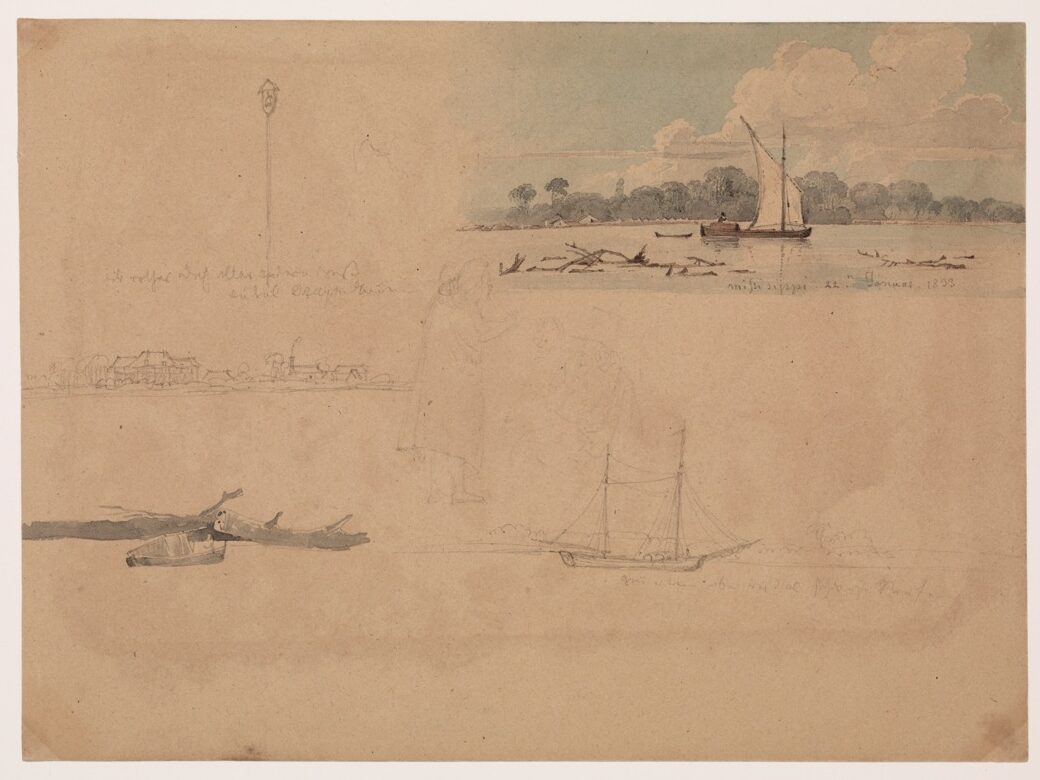
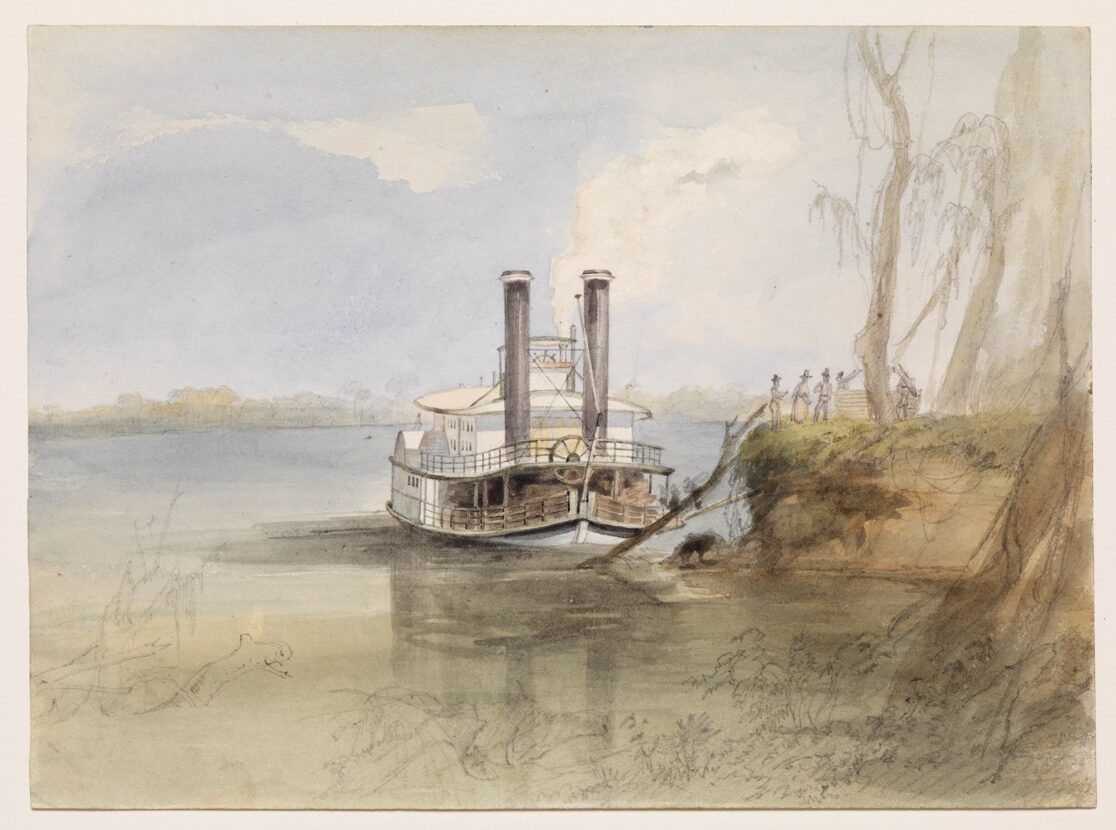
After a stay of about a week, [and] after our financial affairs had been settled with Mr. Nicolet, Mr. Bodmer embarked on the steamship Arkansa for Baton Rouge. On 22 January they departed. Immediately [there was] a race with other steamships, which usually causes accidents. A swarm of crows and white birds, undoubtedly sea swallows and gulls. Soon the entire river is literally covered with driftwood and tree trunks. Large floating logs and trees compel the captain to ring the bell every few minutes to stop the engines in order to avoid the danger of the ship being shattered. On both sides, very low, green, unwooded banks; behind the edge of the bank, the land is often lower than the river. The land is fertile and full of cultivated fields. Here the houses of the black slaves form a small village around the owners’ homes, which are often nice. Some oceangoing ships were anchored near the fields in order to load the products sugar and cotton. Oceangoing ships make a daylong journey up the Mississippi; they are towed by steamboats designed for this purpose.
Usually the planters’ homes are barely a gunshot away from the bank. A broad path leads through lanes of orange trees and through the garden to the house. In 1831 nearly all the orange trees were frozen (there had never before been a very cold winter here); therefore, there was no fruit. The dwelling is usually large, built of brick, provided with verandahs and galleries, and has a red roof. The house is white with green or yellow shutters. In two rows on both sides of it, one sees small board houses painted white, where the slaves live. In the center stands a large pole with a bell, which gives the signal for work and rest. The factory buildings, made of brick and powered by steam, are usually located a quarter mile back. The smaller plantations usually have a one-story house with a high red or whitish roof, which provides a pleasant, attractive sight.
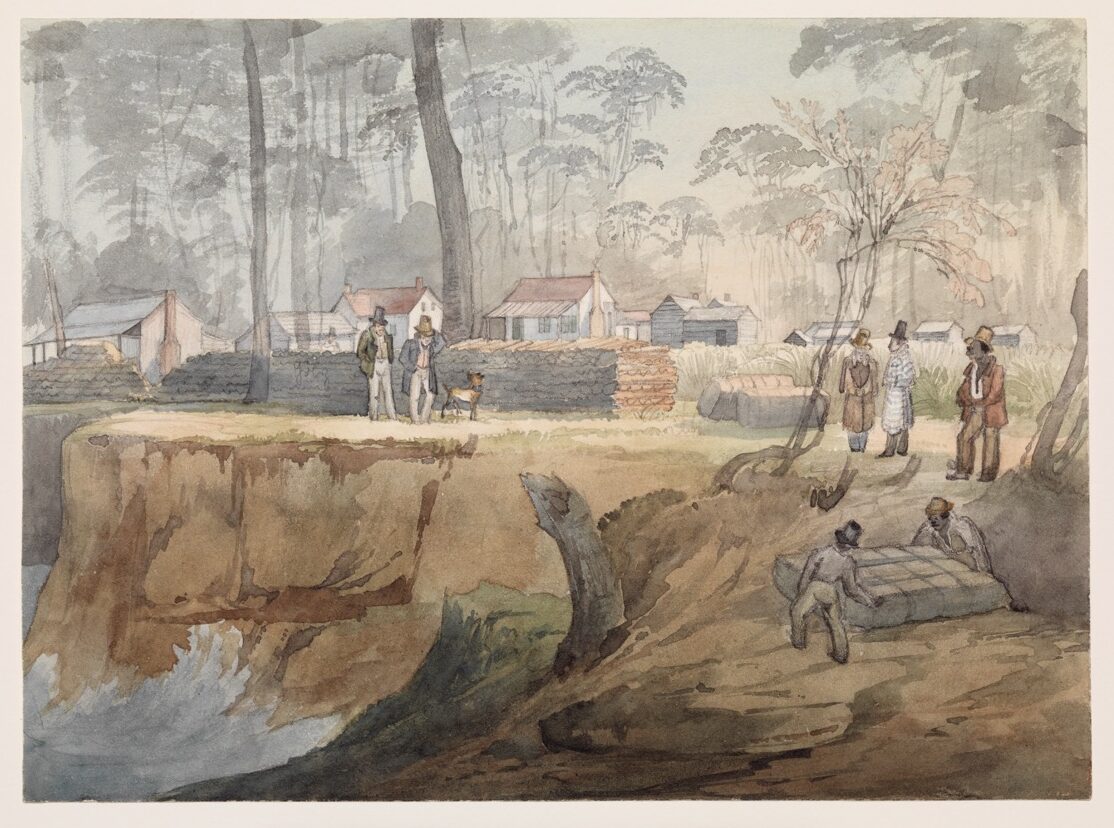
Here and there are tall, sap-filled evergreen oaks (live oak, Quercus sempervirens) with silver-gray fibers hanging from them. A certain general is said to own a plantation with 1,200 Negro slaves near Baton Rouge. Although the meadows were green, the trees were still mostly without foliage, but the Spanish moss (Tillandsia) gave them a unique appearance, like that of a fir forest. A still-green sugar field with standing cane was a rare sight for this time of year. Several times, paddles on the wheels of the steamboat broke, even though the crew was cautious and often stopped the engines. The ship received powerful jolts from the driftwood. On a large plantation, many Negroes, women especially, were occupied pulling driftwood out of the river. It is split and piled up for the steamboats; some of it is used as construction timber. Cypress wood splits in round strips and thus is particularly suitable for barrel staves.
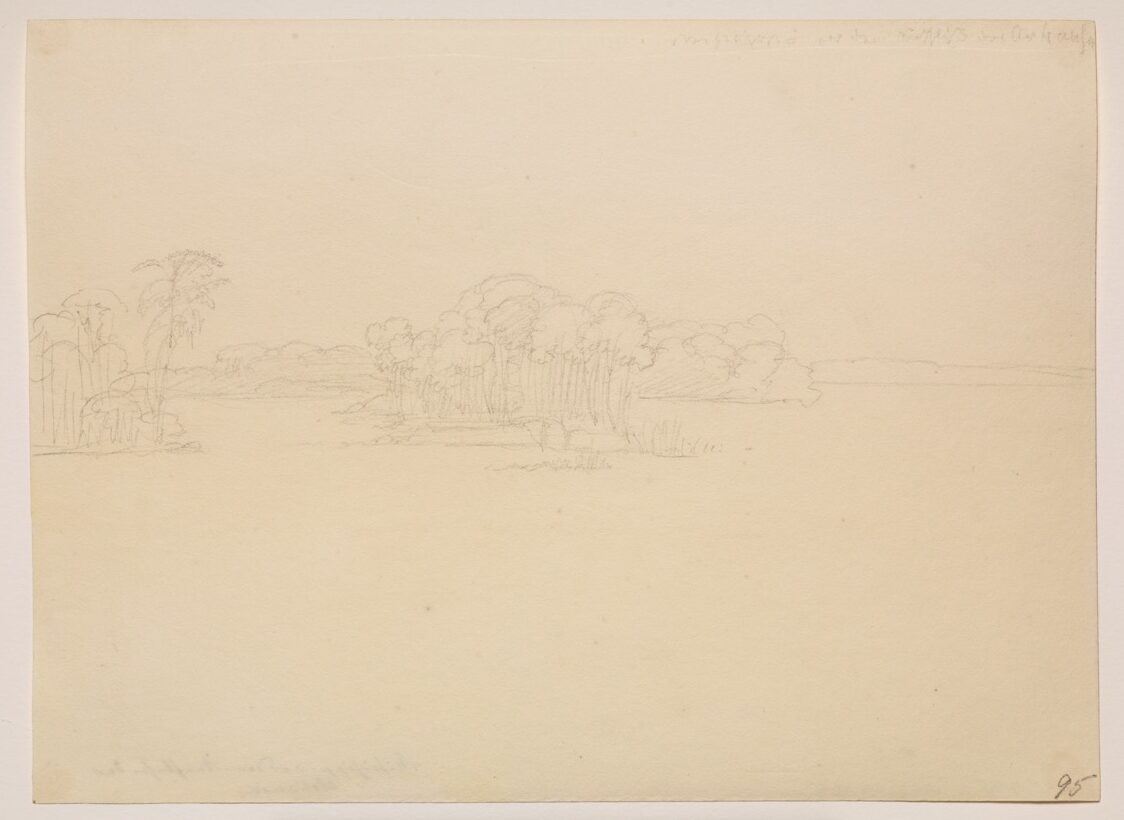
The river is very swift between New Orleans and Baton Rouge. Very picturesque during the evening especially, resembling a lake. The water is turbid and the color of loam, yet in the evening light it looks like a clear lake. At night one often sees, at short intervals along the bank, fires that inform the steamships where supplies of piled-up wood are to be found. These fires create highly picturesque night scenes, splendid for transparencies.
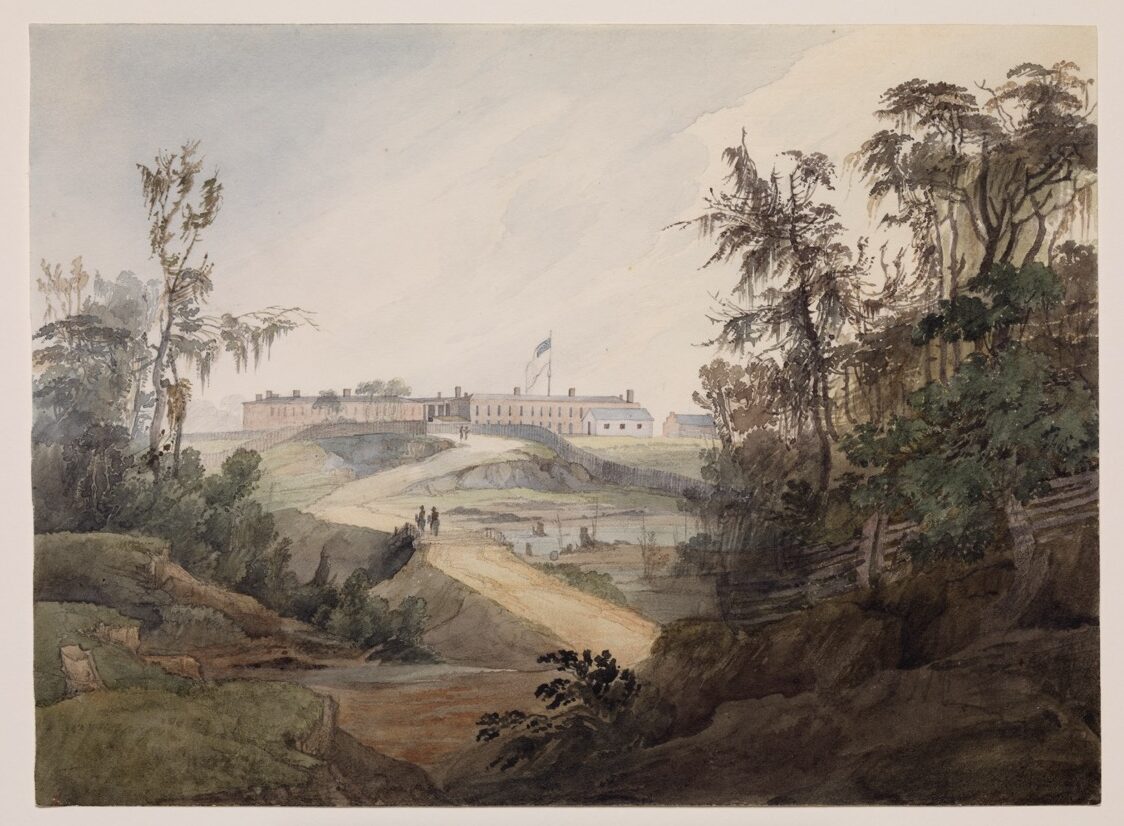
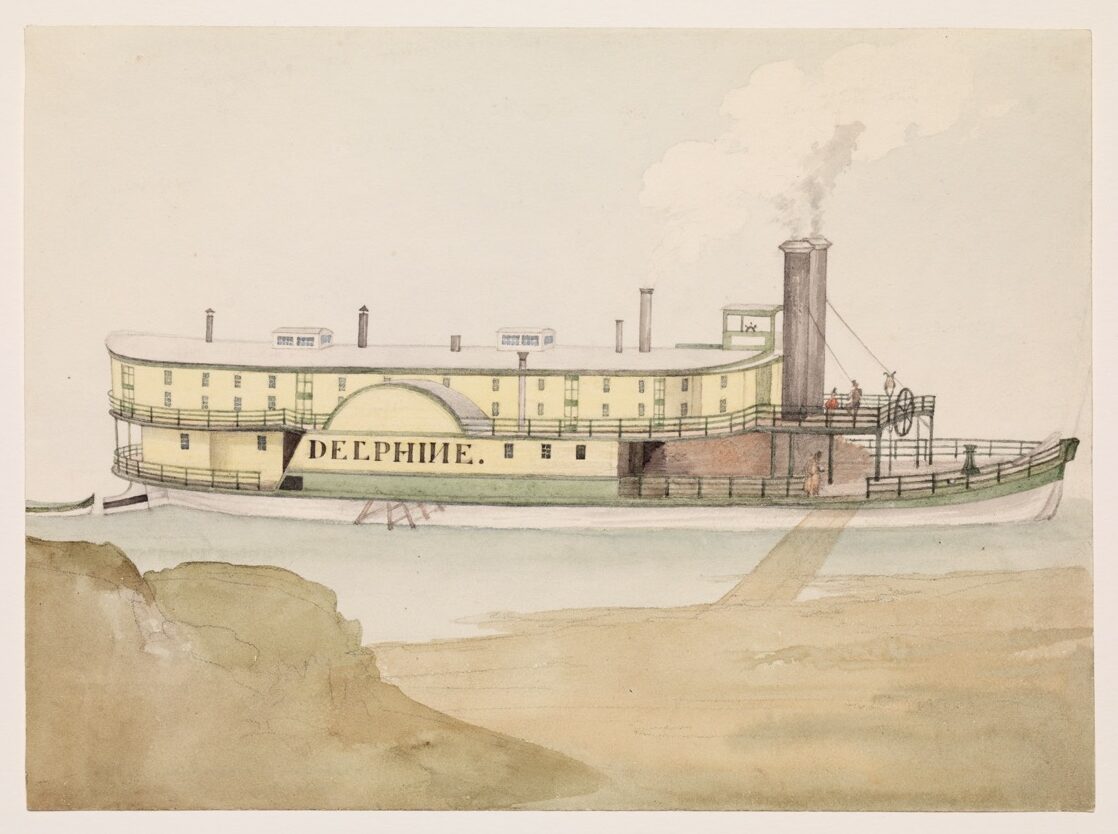
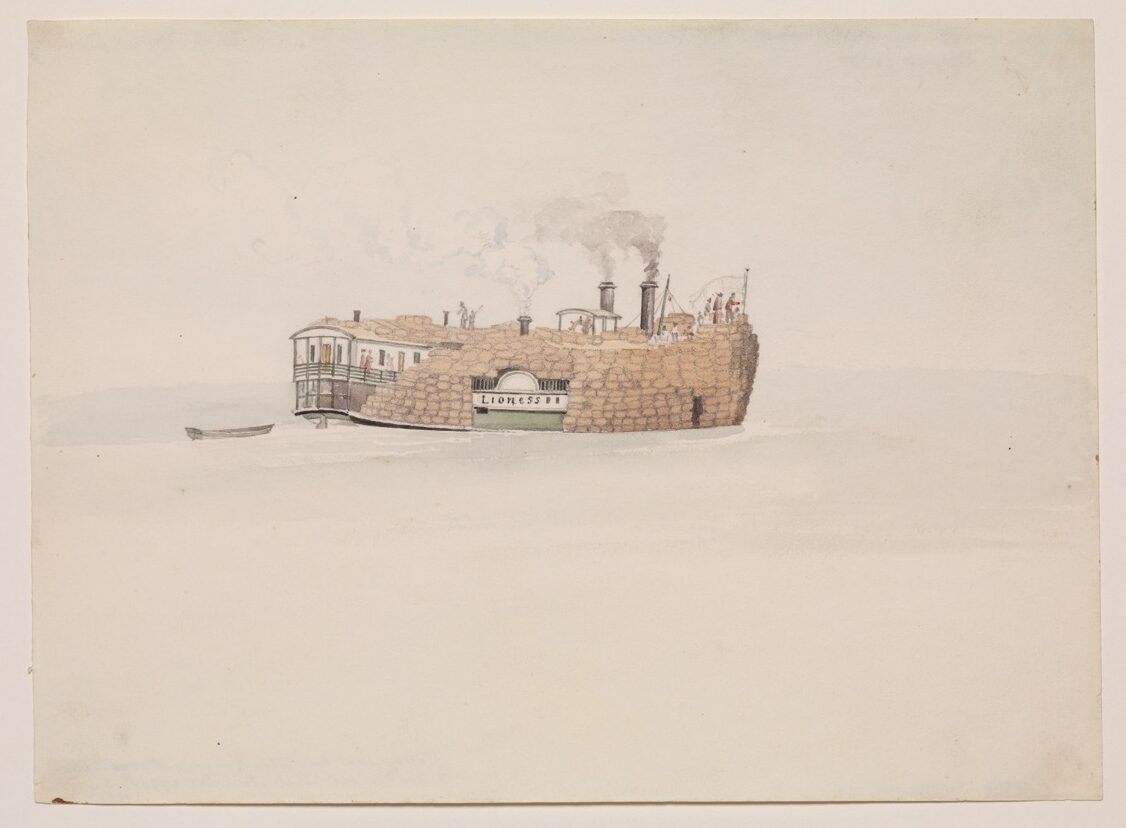
Mr. Bodmer stayed at Baton Rouge for three days and did several sketches, including one of the barracks located up the river, where about 150 men and five or six officers of the regular military are stationed. A captain was on duty: he wore a military overcoat; his saber; a round, civilian hat; white stockings; and shoes. Incidentally, he seemed to be an educated man who had lost an arm. Soldiers—well attired, with blue [jackets] with white lapels and collars and nice rifles. The band—attired in red and white. One could see a row of cannon barrels, which were trophies and presents, some captured from the English, some French, etc. The master of the arsenal wanted to buy Mr. Bodmer’s sketch of the barracks. Soldiers’ quarters very nice and pleasant. Here sketches were made of the steamboats Delphine and Lioness (cottonboat).
Steamboat Napoleon boarded that evening. Numerous flatboats slowly glide down the river. Formerly, before there were steamships, a great many keelboats plied this river; now they are rare. Missouri boats with animal hides came here from several thousand miles away. When navigating upstream, one stays scarcely a stone’s throw from the bank to avoid the power of the current. Between Bayou Sara and Fort Adams, there is a place where the river is divided into four or five channels by some islands. Here it is very wide and presents a magnificent view. Only last year [the river] made a new bed here for itself. Petit Gulf has an attractive location and consists of forty to fifty houses and barracks. Here is the mouth of a nice creek. Grand Gulf [Mississippi] is somewhat larger, built at the foot of the hills. The river makes a big bend here and looks as though it were enclosed by the curving, tall bank. An acre of land planted with cotton is said to provide a yearly income of forty to fifty dollars; with Indian corn, twenty dollars a year.
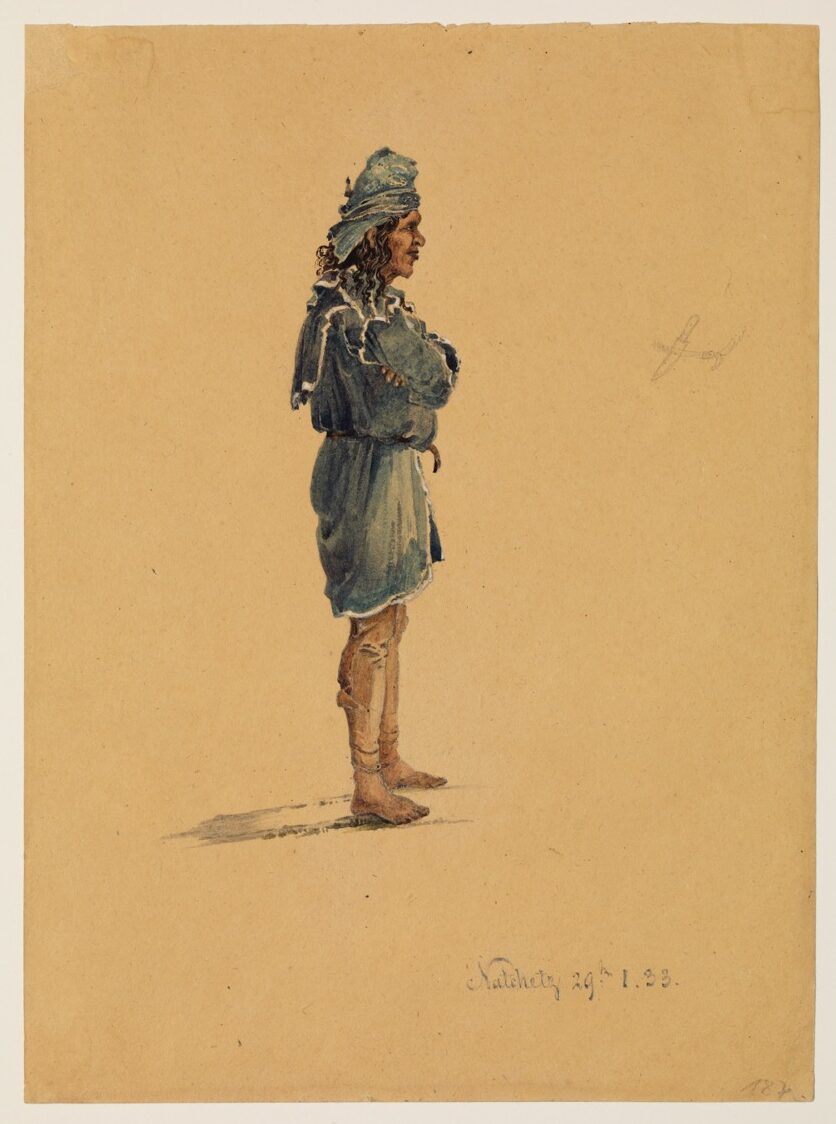
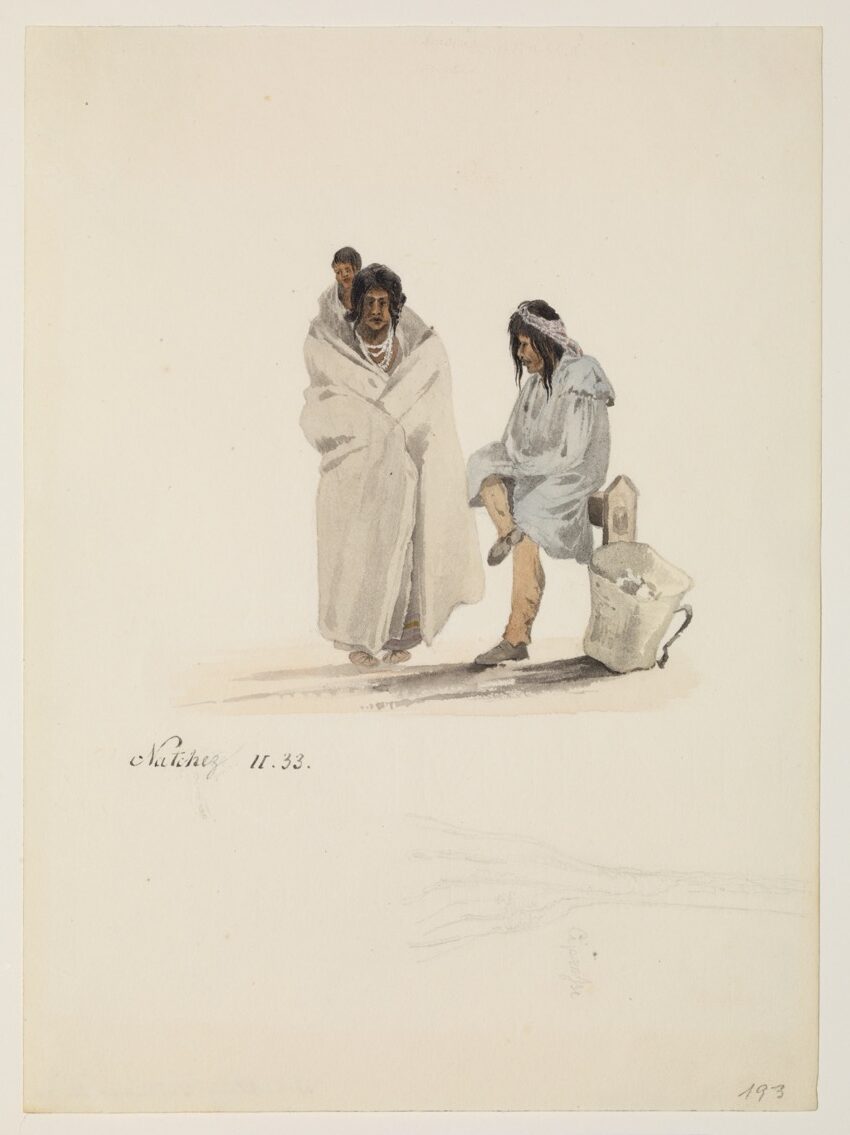
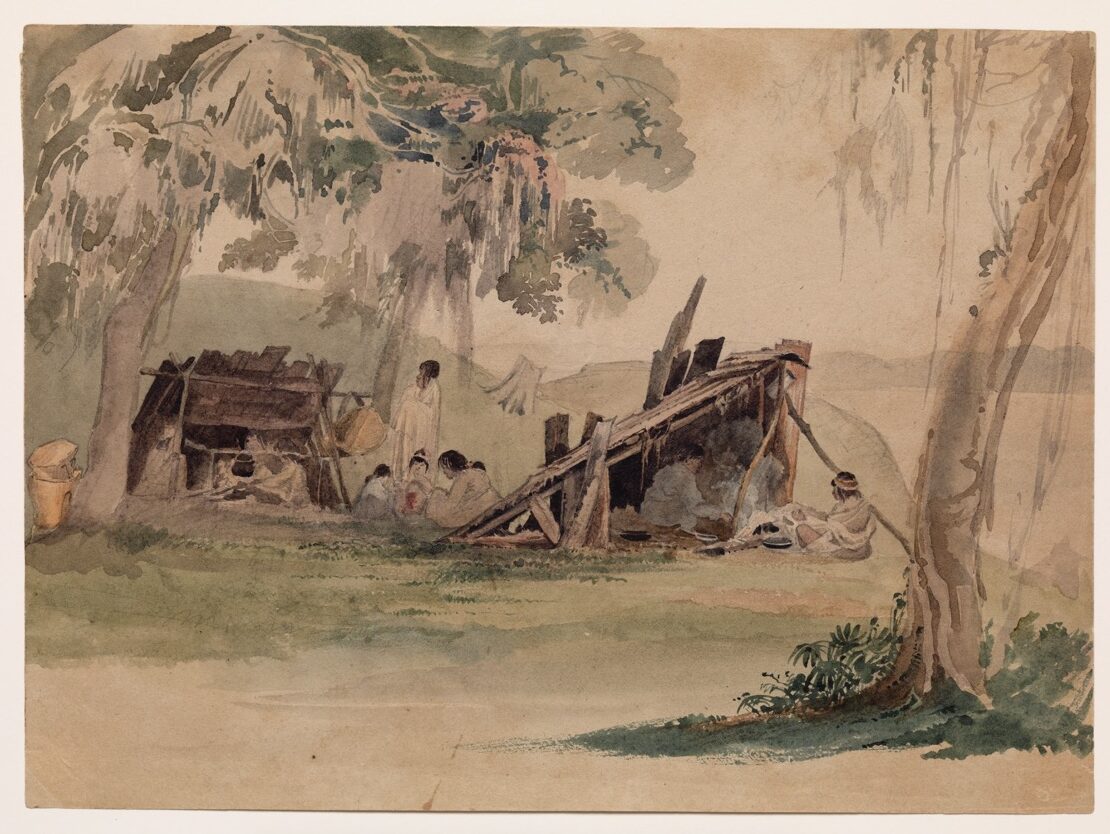
Mr. Bodmer stayed in Natchez for a week. He saw many Choctaw Indians [and] sketched several of them, as well as four huts of this tribe on the riverbank a mile upstream (see sketch collection). One of these Indians brought a large wild turkey, which he wanted to sell for a dollar. Another brought two partially bad beaver pelts, which he sold for seventeen and one-quarter dollars. Here Mr. Bodmer sketched an old Cherokee, who at first did not want to cooperate but later agreed when he was shown the drawings.
The upper part of the city of Natchez is clean and attractive and has a good (i. e., healthful) location. There is a significant cotton trade here. Often the streets are completely choked with wagons coming from the plantations; often these are drawn by five pairs of oxen harnessed in tandem. The wagons are like those in the rest of North America. About six bales of cotton, each weighing 400 pounds, are loaded onto one wagon. Mr. Bodmer made a nice large sketch of Natchez and another one as an example of the remarkable sandy ravines near the city. On the bank of the Mississippi, he found belemnite and other rock samples. At the highest point here, there is a lighthouse, which is lighted at night. On several hills there are beautiful country homes. The cotton trade is very brisk at Natchez, especially after the harvest. Several steamships go back and forth between New Orleans and Natchez exclusively for this purpose. Some of them carry 2,730 bales of cotton (see the sketch of the Lioness).
In Natchez Mr. Bodmer boarded the steamboat Cavalier. It had many passengers. It stopped for half an hour in Memphis, an attractive, rather important town of about fifty houses, on a high bank. Below [the town] there is an old steamboat turned into a store, where boats dock. There are also several flatboats that sell provisions. Later a fistfight broke out between two passengers on board the steamboat, as a result of which all the passengers wanted to leave the ship in a group. The brawlers wanted to fight; pistols were loaded. At about eight o’clock in the morning, the Cavalier docked in Mount Vernon, and Mr. Bodmer immediately rode to Harmony, where he arrived on 15 February.