Four-and-a-Half Months’ Stay in New Harmony
Description of the region – Natural history – Messrs. Say, Lesueur, and Owen – Hunting excursions in Indiana and Illinois – Wabash, Fox River – Illinois prairies – Albion – Black River – Mr. Bodmer’s trip to New Orleans
March 6, 1833
During the night, much wind; in the morning, calm, partly cloudy sky, slight frost. During the night the snow melted completely. At seven thirty, 0°R [32°F, 0°C]. Dreidoppel and I went out and, with Duclos’ icebound boat, broke through the ice, which was 2 1/2 inches thick, a task that detained us for half an hour. Dreidoppel went up along the Wabash; I went downstream. I shot a wild dove (Columba migratoria) and, farther on, an especially fine wood duck. High in the sky, three flights of cranes headed northeast. Skeins of wild geese and ducks [flew] over the Wabash. Duclos, who had concealed himself, shot a female mallard. Today several small birds let their spring songs be heard at noon, when it was pleasantly warm. At one o’clock, 6 1/2°R [46.6°F, 8.1°C]. A brisk wind blew along the Wabash. In the forest it was very warm and pleasant; some insects flew about.
After lunch I entered Mr. Maclure’s orchard, where Achilles was pruning the apple trees. There I saw bluebirds and robins. Mr. Lesueur returned from hunting; [he] had shot a duck, which he did not get. Last evening young Duclos shot a wild goose (Anser canadensis). I spoke for a few minutes with Mr. Say and obtained some interesting bits of information from him. This afternoon Mr. Bodmer visited Mr. Owen and took some of his sketches along. During the afternoon the weather was incomparable; the sun [shone] extremely warmly, but the ground was bottomless.
Today Mr. Twigg wanted to show me the machine invented by Mr. Fountleroy for shearing hair from furs, but I did not get to see it. This machine is important for hat makers. It operates a small knife that in a short time so thoroughly and exactly shears the skin, which is stretched over a block and drawn through two cylinders moving against each other, that not a trace of hair remains. Up to now, hat makers have usually cut the hair from hides with great difficulty and never get them completely clean. This machine does everything very quickly and thoroughly. The inventor will soon travel to various countries, probably to Europe, too, in order to reap the benefits from his invention. In fact, Mr. Fountleroy has much mechanical ingenuity; recently he also invented an improvement for the flintlock. He sketched very clear designs, profiles, and views of these different objects, all of this without having received any kind of guidance. He owns good books on mechanics and mechanical engineering.
At the home of Mr. Say today, I met a potter who told me that one could not find very good potter’s clay here, with the apparent exception of one of Mr. Maclure’s fields. White Mississippi clay, he said, is not very good either. On the lower Missouri, there is a very good red clay from which the Indians make their pipe bowls. If hostile Indians meet at this place, they do not harm each other. They cut out clay, which hardens in the air. The Indians have pipe bowls with very diverse shapes, about which there will be a more detailed discussion below. When the Europeans first came to America, the Indians were already cultivating tobacco, and smoking with clay pipe bowls was one of their customs, and common. The Blackfeet Indians raise a special variety of tobacco, which is mentioned in Lewis and Clark’s Journey. It has also been described [elsewhere] (by Nuttall, I believe). Since tobacco is so expensive among the Indians, they mix it with other leaves, particularly those of the sumac (Rhus typhinum). The Indian pipe bowls that are found in the Wabash region in graves and other places usually do not have the following shape, for these come from still-existing Indians; but rather, they are like the one pictured [below, left].
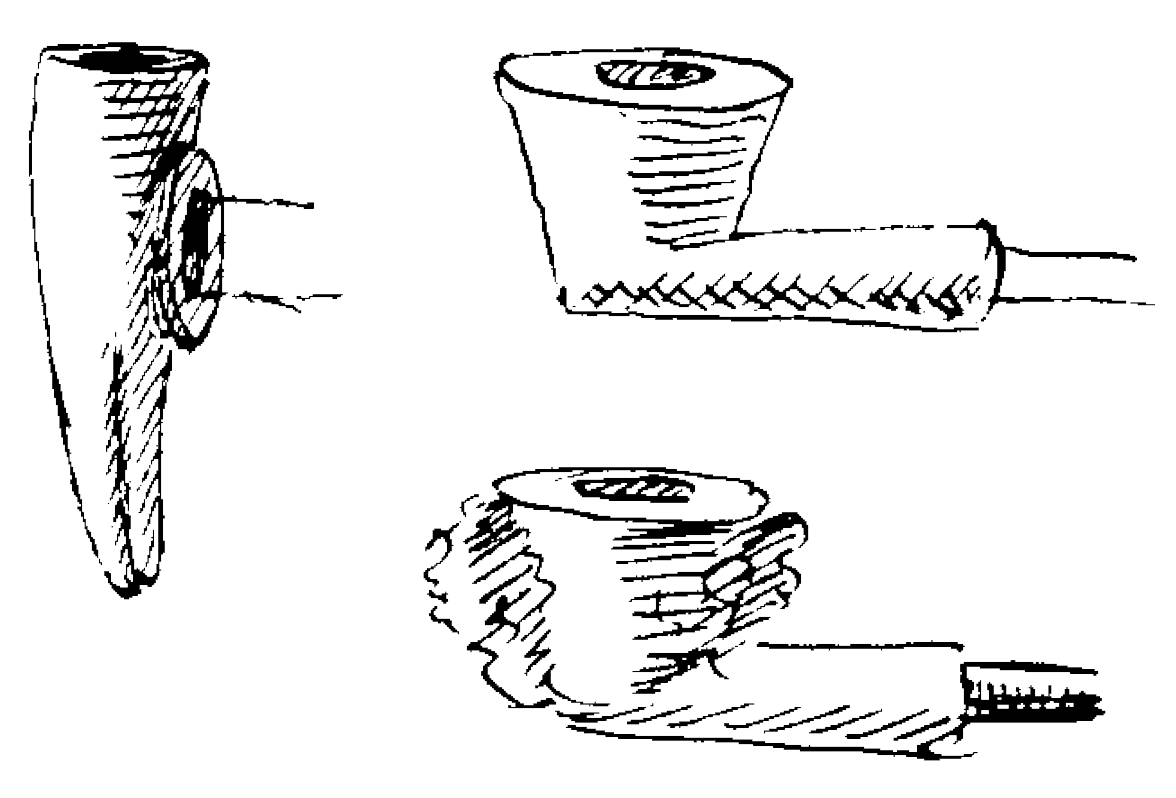
The sunset was bright and clear and promised a beautiful, clear day tomorrow. Dreidoppel had gone out with the shotgun that afternoon, too. He returned in the evening bringing a mallard (Anas boschas), which he had shot in flight above the Wabash at Cutoff Island. He had seen many wild geese moving back and forth in the air and very clearly distinguished two varieties. The Anser canadensis has a call similar to that of our wild goose; the Anser albifrons has a high-pitched call.
Later that evening, visit to Mr. Say, where we talked much with Mr. Maclure about the constitution of this country. The judge is now moving about in the area and for more than two weeks now has presided over trials ([—-—]) in Mount Vernon. Several lawyers (advocates) are there, and many persons gathered as litigants and witnesses. If the litigants are not satisfied with the decision, they appeal first to the highest court of the state (supreme court of each state) and then to the highest court of law (Supreme Court) of the United States, in Washington.