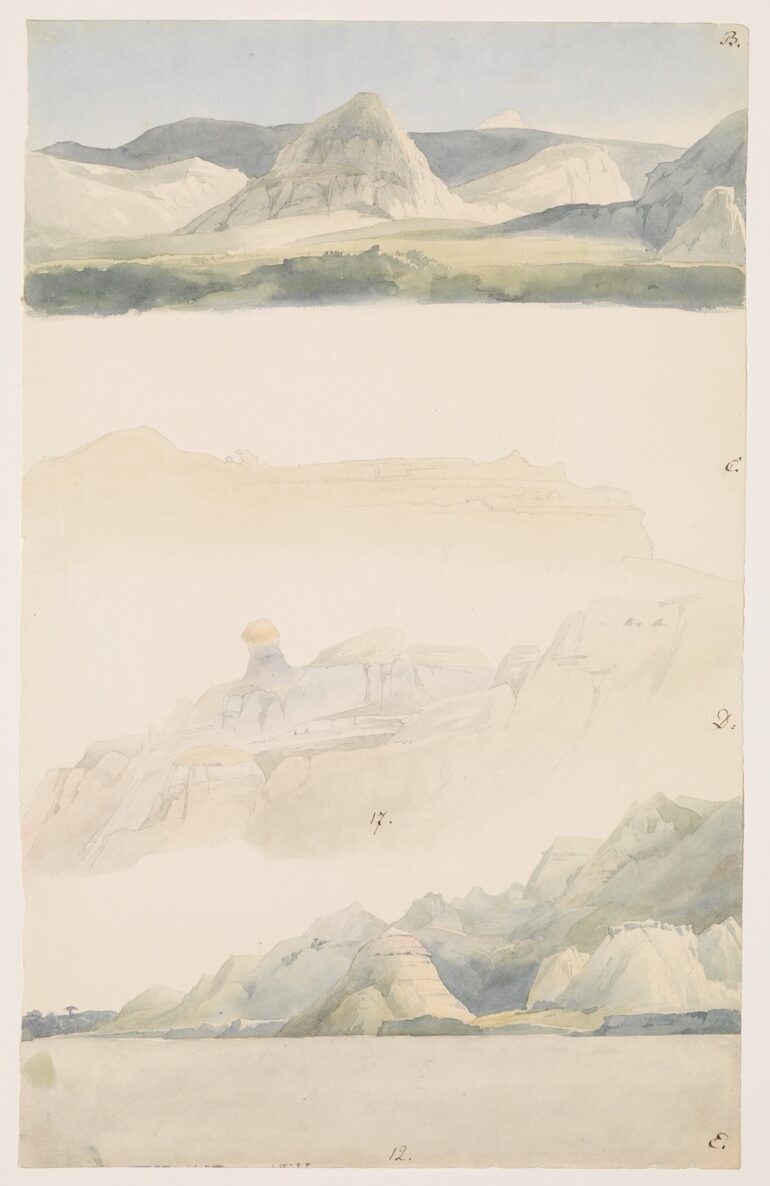
July 8, 1833
In the morning, pleasant weather, sunshine. We left our position early and sailed past the end of the bend the river made toward the south and past a series of striking bluffs, where again many brick-red conical hills lay before gray clay hills. Beyond the woods [and] above the hills, where the river turned right again, we let the hunters out. Farther on, to the right, a prairie, behind which extend flat, rather unimposing hills. Our hunters soon fired five or six times. The keelboat ran aground near a sandbar off the right bank, and we freed ourselves only after great exertion. The men stood up to their hips in the water and pushed. We then crossed the river and moved left along the forest. To [land] the men with the cordelle onto the steep clay and sand banks, we had to put down a plank at a steep angle, which they climbed up like monkeys. Here Mr. Bodmer also went hunting.
At 7:30, 71°F [21.7°C]. This morning we had the mouth of a small creek on the left bank. In the area where we stayed last evening, several of our men had met a large band of Assiniboines last spring on the bank that remained to our right; on the same side, our hunters had also found fresh traces of their leather [tipis]. We followed the left bank, where the half-Indian Deschamps (with the clubfoot that was maimed so badly from frostbite) brought back large quantities of scraped-off cottonwood bark. The pulp, or sapwood, underneath the bark of this tree is soft [and] extremely succulent; [it] is eaten by people here. It bears some resemblance to watermelons, and its taste is sweet. The Indians often subsist on this pulp if they have nothing better. The French here call it la sèvre. On the forest floor there was a very dense growth of roses and buffalo berry.
At a small slew, Bodmer returned. Along the bank above the forest there was a prairie, [and] then a large, broad forest began again, where we put Messrs. Mitchell, Bodmer, and Culbertson out to hunt; the remaining hunters had not yet reappeared. In the forest one found very large toads (Bufo clamosus). On the right bank, we now had low hills of gray [and], occasionally, brick-red clay; [they were] flat and level on top, [with] willow and cottonwood forest before them. Along the left bank, our men often could not advance; the loose, barren sand often collapsed, and then they were in danger of falling into the river. Three Assiniboines, who had sat down under the bank, perished this way several years ago; the bank collapsed and killed them.
We now had a long stretch of river where pulling was impossible because of the soft soil along the bank. Therefore the men had to push the boat. For [this] purpose there is a 1 1/2-foot-wide footpace, with crosspieces on each side of the boat, on which they tread back and forth. To the right the hill chain receded behind the forest; here was the mouth of a brook with a soft bottom which the French call la rivière bourbeuse aux Trembles. From here on, the prairie to our right had a narrow border of cottonwood and willow; the hills [were] somewhat more distant. To the left, a wide, flat point of land covered with short willows after the big forest has come to an end. Here on the tongue of land, Messrs. Mitchell and Culbertson rejoined us; they had not shot anything. On the opposite bank other hunters called out that they wished to be taken aboard.
At twelve o’ clock, 77°F [25°C]. The wind was rather strong but unfavorable for sailing; we had to pole the boat around the spit.
Papin had shot a fat deer (Cervus virginianus); Mr. Mitchell had seen two deer. The dinghy was sent out to fetch the hunters on the other bank; they arrived at last but had not shot anything. Our men had great difficulty with the boat; they sank up to their waist in mud [and] had to undress completely, swim ashore, and wade, whereby very comical scenes occurred. We did not have lunch until the expected deer arrived, which we waited for at the sandbar. The young man who was carrying the venison, wrapped in [its] hide, sank deeply with his load, fell over, and threw down the venison. [It was] three o’clock [when] the deer arrived; its antlers indicated five points. They chopped the venison into pieces and began preparing some of it for us. We pushed around the sandbar with poles and slowly advanced against the current. Before the bank by the forest there were flat sandbars in the river, which we had to pass on the outside. Here the crew sank so deeply that they fell down and [could] push forward only very slowly. Beyond these bars, along [the] shore in the river, were long stretches of driftwood, partially compacted; foam and branches formed a cover between them. The crew had to get over this with the cordelle; they sometimes fell into the deep water, and three or four fearfulyoung fearful young men, to the laughter of the remaining men on board, fell completely behind; one of them shuddered so violently that this could be seen from the ship.
When these obstacles had been surmounted, we reached a level prairie on a high bank where, about 150 to 200 paces from the shore, the strangest clay pyramids, like pastries, were piled up. (See sketch B.) Here both hunters, Papin and Deschamps, left us again to hunt. The latter had returned to us in the last forest and had not shot anything but a variable hare (Lepus variabilis). In the same forest, our men found many gooseberries ([— —]), which they eagerly sought and consumed, even though these were still unripe and had a poor taste. Mr. Bodmer also went hunting again. The sun was already low, and a considerable number of mosquitoes had gotten into our cabin, where it was very hot. We continued on beneath high clay bluffs, where several black horizontal strata stood out. This black stripe, about 2 feet wide, was formed from a black, claylike mass split into small strata and transverse sections by fissures with an admixture of rust-brown here and there. It was remarkable to see how our men, in a long row, clambered over the high, sometimes very steep, clay walls. Indeed, one could not proceed any farther here, and therefore we crossed the river, where we saw a big white wolf standing near the young willows.
After the sun had set, we tied up for the night at the willow thickets on the right bank. The hunters came in; Deschamps had shot a cow elk. Mr. Bodmer brought back a rattlesnake (Crotalus tergeminus). In the willow thickets there were very many mosquitoes; fortunately, a light wind kept them from our ship. Caprimulgus americanus was flying above the willows. Our catch today: one elk and one deer.