Journey from New Harmony on the Wabash to St. Louis on the Mississippi and Stay There
Mount Vernon – Shawneetown – Cave-in-Rock – Mouth of the Wabash – Cumberland and Tennessee River – Mouth of Ohio – Mississippi – Commerce – Cape Girardeau – Grand Tower – Devil’s Bake Oven – Kaskaskia River and Indians – Ste. Genevieve – Selma – Herculaneum – Merrimac River – Jefferson Barracks – Vide Poche – St. Louis – The Sauk (Sac) and Meskwaki Indians1 – Black Hawk – Meeting with the prisoners – Preparations for continuing journey

March 18, 1833
Morning of [18 March]: dreary, heavily clouded sky. At seven thirty, temperature of 8°R [50°F, 10°C]. During the night two steamboats had gone upstream, but none had come down. Two families had rented wagons, which were to take them up the Wabash. The clergyman had a large freight wagon with five horses, for which he paid two dollars a day to go as far as Vincennes, but he had to pay the expenses of the owner and the horses both up and back. The closest route went by way of Princeton.
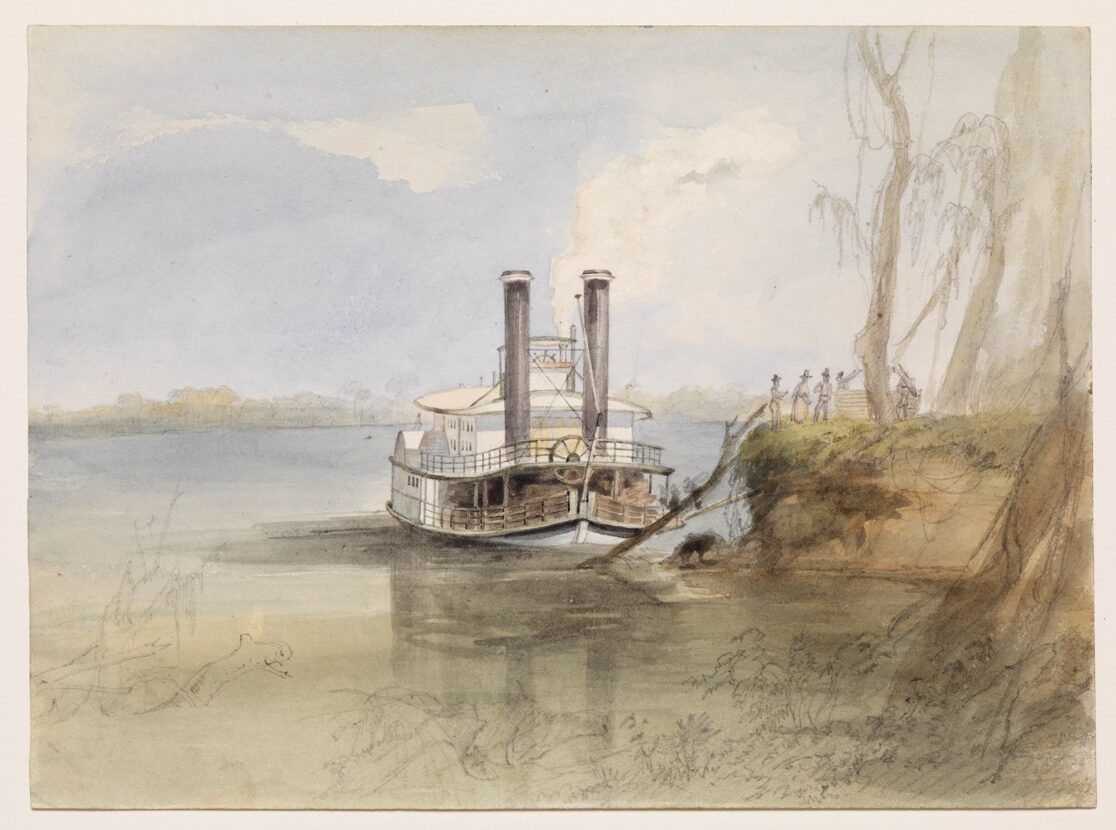
In Mount Vernon we went about with scarcely anything to do and were bored in this miserable place, from which we hoped every moment for deliverance. At ten o’clock two steamboats came down the river. The first one, the Conveyance, lay to and took on wood. The second one, the Napoleon, on which Mr. Bodmer had traveled, did not understand us correctly, stopped, and turned back after it had already lowered its boat. Thus we had to board the Conveyance, which was supposed to sail up the Cumberland River. It was small and much slower than the large, swift Napoleon (see Mr. Bodmer’s sketches). At eleven o’clock our boat departed. We paid three dollars’ passage for two persons to Shawneetown. The ship’s cabin had sixteen berths. The deck passengers had had to carry much wood on board.
The region opposite Mount Vernon has tall forest all around, as is the case all along the Ohio. Whitish sand on the bank. Behind Mount Vernon the right bank is rather high and steeply eroded; it has rugged hills with downed trees, which lay crisscross. In the woods one sees snow-white Platanus everywhere. Not far from the bank, an elevation of moderate height runs in a parallel direction. Before it, low, flat ground with tall timber. The river soon divides around Slim Island, the tip of which is sandy and overgrown with cottonwoods, but which is covered elsewhere with forest, part of which has been cut down to make way for fields and where individual dwellings are found. The powerful cold wind and light rainfall worked against us.
Four gentlemen were playing cards in the cabin. Though well dressed, they still blow their noses after the fashion of our German peasants, chew tobacco, and spit on the rug. We watched the Napoleon; it had a long lead. To the left in the forest, the ground is everywhere overgrown with cane (as along the Wabash). Heavy rain. Banks steep, eroded, [of] clay mixed with whitish yellow sand. flatboats float slowly down the river. On the bank, yellowish-reddish willows. The banks of the Ohio [are] generally low [and] everywhere covered with forest. White Platanus gleam in them. The rain subsided.
We reached Wabash Island, with tall timber and cottonwoods on its broad, rounded tip. We moved through the narrower channel to the left and thus did not see the mouth of the Wabash; we saw it only from a distance, after we had passed the island. The small island beside the large one remained to our right. Our course closely [followed] the southern bank. The small island [is] very low, overgrown with low willow thickets; one does not see much of them. Wild ducks and geese. When we sat down to eat, we could already see the white buildings of Shawneetown at the end of a long, straight stretch of the river. After our meal we were exactly at the place where the Napoleon still lay at anchor. We disembarked in the ship’s boat, and the innkeeper led us to his house while an old Negro took our luggage there.
Shawneetown, or Shawaneetown, is a miserable place, actually constructed parallel to the river, in a line along the bank—a flat, bare expanse on a steep, somewhat elevated bank. It has 700 inhabitants and is dismal and lifeless. The principal buildings are several stores, a post office, taverns, and the like. It looks even more wretched than Mount Vernon. The inn is rather good.
Indians of the Shawnee, Shawanee, or Shawanno, tribe and some Delawares once lived here. They had villages in this place and in the vicinity. The Wabash was the dividing line between them and the Muskhoges. Recently a brook or the river washed away a bank, [and] a large number of skeletons were found. Flint arrowheads are found everywhere.
Fifteen miles inland from here is Equality [Illinois], where there are salt mines, the first of which is only 7 miles from here. They are the most important ones in the United States. The salt is obtained from springs. During the fall, large quantities of it are brought here to be shipped off.
We wanted to stay here for several days to sketch the cavern of Cave-in-Rock but learned we had been misinformed and that this place is still 25 miles from here. Since there was no reason to stay here, we decided to leave on the next steamboat. Soon the Free Trader—a small, heavily laden steamboat—appeared. A Negro brought our baggage to the dock; he waved a red-and-white flag, but the ship did not put in. Since we now had some leisure time, we went into the forest. Here, as in Mount Vernon, everything was dirty, wet, [and] swampy. [There were] many brooks in which numerous small tree frogs were chirruping, but we were unable to catch any of them. The weather was dreary, cool, and windy, and it rained intermittently. In the swampy ground we found tubes made by crawfish. There were bluebirds, beautiful and in large umbers, which uttered their spring chirping.
Around the puddles the grass was already sprouting; vividly green, irislike leaves were bursting forth. On the river one saw gulls. Toward evening there was heavy rain. The gentlemen sat around the open fire; others lay about lazily on a kind of sofa.
Here, for the first time in a long while, we saw fire from bituminous coal. The coal is washed out by a creek 7 miles from here; it seems to be of good quality. The evening was dark and foggy on the river. At such times steamships usually lay to if the water level is low. In Shawneetown we saw many Negroes, but only a few in Mount Vernon and Harmony, as in Ohio and Illinois. During the evening we occupied ourselves in our room.