Four-and-a-Half Months’ Stay in New Harmony
Description of the region – Natural history – Messrs. Say, Lesueur, and Owen – Hunting excursions in Indiana and Illinois – Wabash, Fox River – Illinois prairies – Albion – Black River – Mr. Bodmer’s trip to New Orleans
March 10, 1833
In the morning, warm; very nice, bright sky; at seven thirty, 1°R [34.3°F, 1.3°C]. Yesterday I saw a large wooden model of Mr. Fountleroy’s machine. The knife has a broad blade like the iron [blade] of a chisel and is pushed back and forth by another instrument while pressed against the stretched hide. A long brush, rotated at the same time, immediately sweeps back the shorn hair. A smaller version of this machine will be made from metal and will cost about seventy-five dollars to produce. It saves much work, and, consequently, its usefulness will certainly be recognized.
Early this morning the two Duclos took us to the Fox River. I got out first but found so many people everywhere, since it was Sunday, that one was almost unable to shoot because of the hunters. We saw ducks and diving ducks in large numbers, also wild geese. At noon I approached Mr. Bodmer, who was sitting and sketching. He had shot a purple finch (Fringilla purpurea), which was a new arrival of spring. Duclos had shot a beautiful wood duck.
Today I saw a large number of turtles sitting on all the old trunks and logs lying in the water. They were large and small and in groups of four or five. The spring sun very warm today—in Harmony, 11°R [56.8°F, 13.8°C] at twelve o’clock—and lured all these creatures out to sun themselves, but they were very shy and immediately dived into the water when they saw people at a distance. Some of them were very large and glistened in the sun. I saw three such creatures sitting close to each other on a trunk and tried to capture them with my gun, since there seemed to be no other way to do this. When I fired, one of them remained lying there while two escaped. The one I hit was alive but severely wounded by two pellets. It was the first specimen of this beautiful species with two nice red spots behind the head. Mr. Say has described it under the name Emys biguttata. Scarcely had I fired when a magnificent wild turkey swept across the Fox River and over my head. We spent a long time trying to retrieve a wounded diving duck (Mergus).
I saw a flight of parakeets, heard an owl calling inside an enormous tall Platanus, [and] saw a wild turkey streak across the Wabash. On our way back [we] felt the magnificent evening springtime temperature [and admired] the serenely smooth, broad surface of the Wabash, in whose waters the snow-white trunks of Platanus were mirrored. A woodcock in the forest, the young leaves of elder (Sambucus canadensis), and fully blossoming plants of Arabis bulbosa Mühlenb. were [all] distinct tokens of spring. We returned to Harmony at dusk.
Visit later at the home of Mr. Lesueur. Here the discussion again turned to the pipe bowls that had been found in the old Indian graves near Harmony, and Mr. Lesueur made the following sketches of them for me.
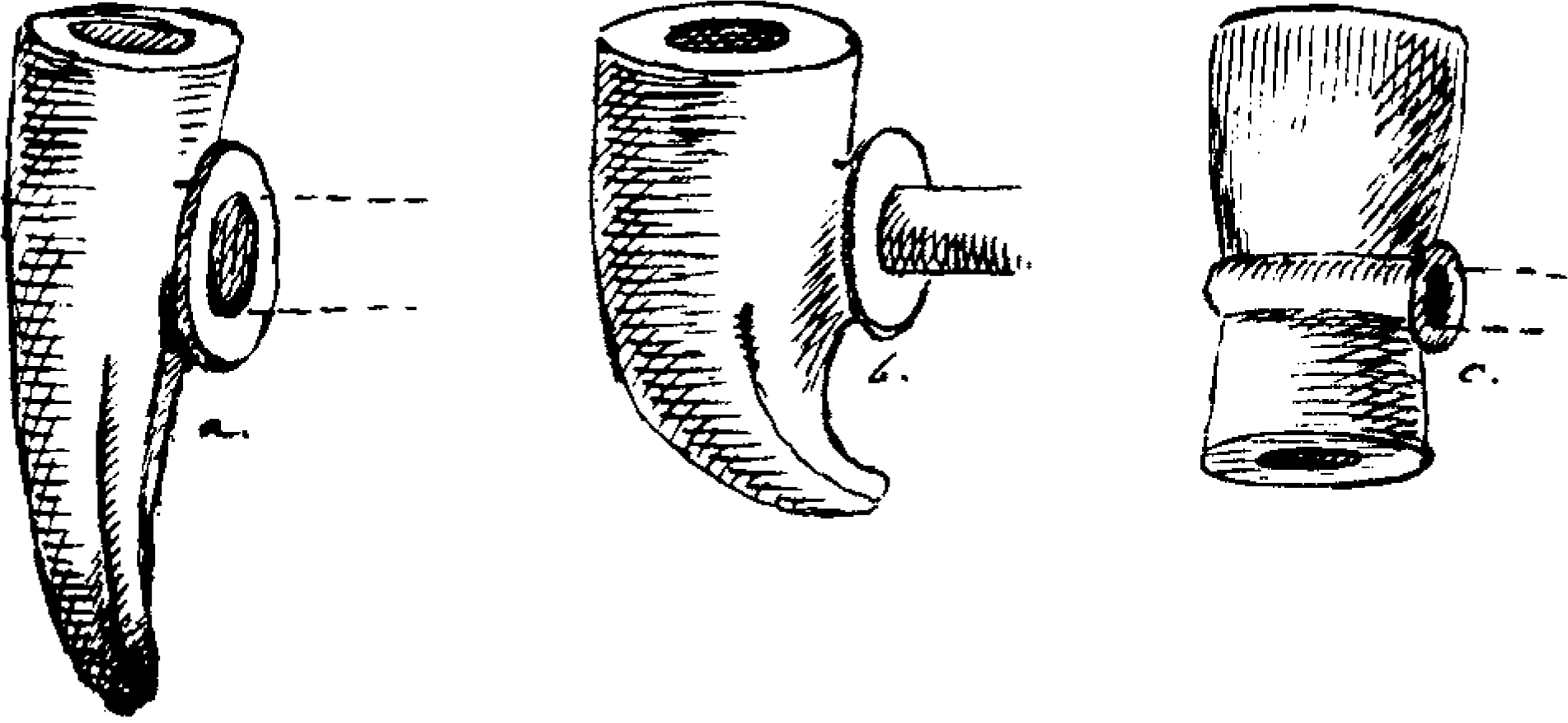
Other pipes clearly represented a sitting frog, the mouth of which contained the opening for tobacco.
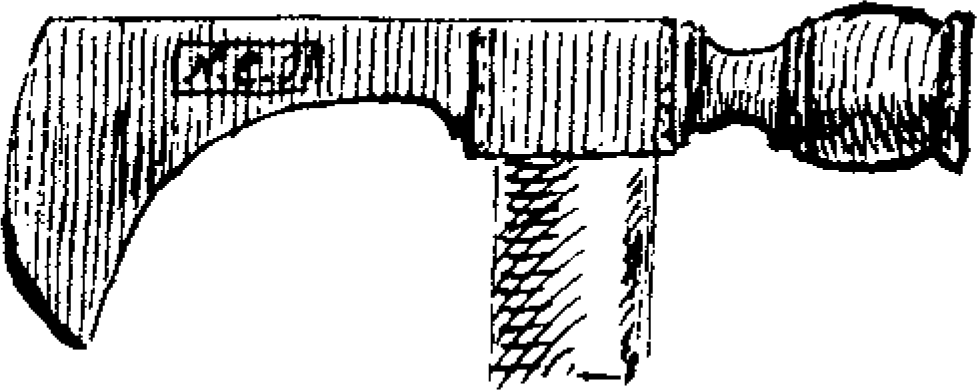 Mr. Fountleroy, who was present, told us about a very fine battle-ax found in an Indian grave in Tennessee; it was made of steel and was even provided with some gilding and with several letters. Probably it had been presented as a gift to this chief by some European power or authority. It had the following shape. The letters “N. E. J.” are on the blade of the ax. Mr. Fountleroy added that ancient coins, probably Roman ones, had also been found in these graves.