July 29, 1833
Warm early in the morning; calm, overcast sky. Sultry at eight o’clock. We followed the bend of the river, and intermittently there were blackish gray bluffs of bare clay, sand, and argillite and flat green areas with tall, slender cottonwood forests and willows. Someone saw a bear near one of these early this morning. As usual, the hunters went out early. At 7:30 the men on the cordelle were taken in, and we pushed upstream with poles in the rather shallow river, the water of which was very turbid today. It must have rained heavily farther upstream. In this region the surrounding hills are flattened on top and have no domes, as they did shortly before. Some of them are bare and blackish gray or grayish brown. Here and there some have a hint of green from sparse vegetation.
We crossed the river to the right bank. At 7:30, 69°F [20.6°C]. The men on the cordelle were relieved, and dry wood was loaded. Several times Mr. Mitchell pulled on the cordelle, since he happened to be walking alongshore near the men. He had discovered several fresh bear tracks. Near the next bluffs we again crossed the river to the left bank. Here Papin, who had made a kill, came in. The men were placed on the cordelle. The sand and clay banks along the whole Missouri are interwoven with the roots of willows, which hang out freely 10 to 15 feet and more where the bank has been torn away. Here one sees what an excellent plant the willow is for holding loose soil together.
Somewhat farther away there was a big tree in the water, where the cordelle got caught. Two big, thick branches had to be cut off to free it again. There was a light rainfall. The hills beneath which we moved today had a rather green overgrowth with no distinctive shapes. The birds that one continually sees flying [over] the surface of the river are Hirundo purpurea, fulva, and often bicolor, and in some places riparia.
About eleven o’clock, heavy rain, which penetrated our cabin at various places but fortunately did not last much longer than a good half hour. The region was attractive, with intermittent green wooded riverbanks, refreshed by the rain, and mountains always forming a mostly picturesque background. We were now traveling along [a] clay and argillite wall; mica or micalike fossils had been washed out from [this] in many places and lay scattered, shining [and] glittering in the sun. Somewhat farther on, we put in near dense, narrow-leaved willows on the bank.
Far below on the hills behind them grew conifer trees 30 to 40 feet high, probably a variety of pine, about which more later. Opposite us on the right bank was an old forest of sparse cottonwoods where Deschamps and Dauphin, who were carrying something, had just arrived. The men were taken on board, because we had now come to a slew or outlet in the bank immediately above which was an island, probably Lewis and Clark’s Winding Island. At twelve o’clock, 70°F [21.1°C]. The island was long [and] overgrown with willows and cottonwoods; just before its end, the water had broken through it with a channel and washed up large amounts of wood. Deschamps arrived and brought two prairie dogs along. He had seen only one buffalo and two bears: an old and a young one. Culbertson came back with him.
Opposite the island, which lay to our right as we passed, we encountered such a powerful current that almost all the men had to be put on the cordelle. The rest pushed with poles. Bald eagles hovered above the hills. Messrs. Mitchell and Bodmer went hunting. The woods they combed were large, with [an] understory of roses. I frequently saw Asclepias on the bank. The hills opposite were bare [and] steeply eroded on the side facing the river. No pines grew on them either. They were partially overgrown with yellowish and light green grass. Some had steep, barren walls with short, yellow grass [and] many isolated small green bushes. Near these bare, strange mountains, the river turned left; [it] was very narrow here, only about 80 paces wide. Messrs. Mitchell and Bodmer, who had just been shooting at wild geese, sat on the sandy promontory before the forest, around which the river bends to the left. In the vertically descending gullies of the mountain to the right, we saw several openings or caves. The region up ahead was pleasant and varied. Green broadleaf thickets along the bank, [and] above them, green grassy ridges of various shapes on which blackish green evergreens grew higher up. Here the riverbank to the right was gray, steep, and about 20 feet high. Mr. Mitchell returned; he had seen nothing but three great horned owls, one of which he shot with his rifle.
On the right bank we now saw an impressive bison bull standing on a prairie surrounded by unusual hills. Papin, Deschamps, Saucier, and Dauphin quickly went ashore and by stalking [and] sometimes running tried to get closer, but the splendid animal watched all of us for a long time, then turned around and galloped off. Rain was falling again. 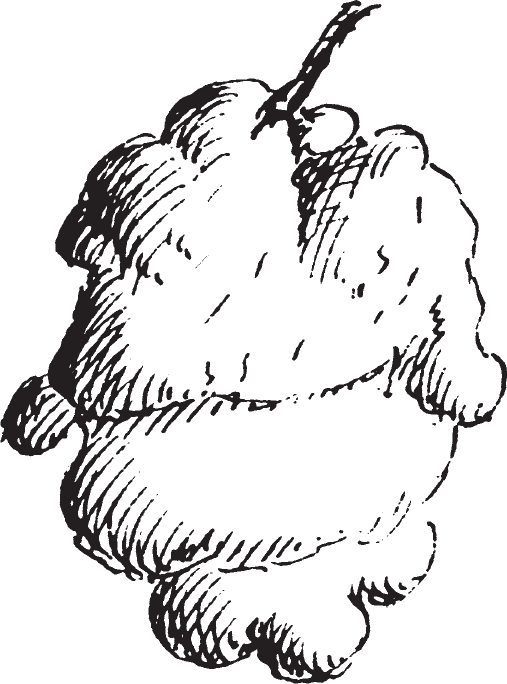 The hills from which the river emerged were dull green and heavily overgrown with conifers on their lower sections. To the left, on the high bank in the tall forest, the ground was again completely overgrown with Rosa [— —]. On these rose shrubs, one often finds a shiny, dark red growth produced by insects, not unlike a potato, with smooth, shiny skin. Here and there it has small, roughly scarred fissures; often they are twice as big as the sketch. If one opens these growths, one finds maggots in them. The strange fibrous rose apples occurring on rosebushes in Europe are never found here.
The river turns right along the mountains, where long-needled pines grow, and flows for a stretch between wooded banks. Here Papin brought a deer he had just shot. From the high clay bank, someone brought me a bivalve mussel, which seemed to be an Ostrea. Deschamps and Dauphin appeared empty-handed above the forest to the right. The hills that follow to the right were overgrown with vegetation. Here and there, scattered pines. At six o’clock in the evening, it was already rather cool. The rain had ceased; the sky had nicely cleared. We pushed with poles up [the] river, which is rather narrow here. Above the prairie, to the right, hills arose again on which many pine trees grow, especially in the valleys and ravines. Here the riverbank was steep and 30 to 40 feet high, clay and sand with several completely white layers. On the sandbars near the bank, one now sees much rocky debris, proof that we are coming closer to rocky regions. Papin had gone out again and shot another doe on the left bank; another man shot a doe and a fawn.
At dusk we landed on the left bank at the mouth of a small, [currently] dried up creek. Deschamps had not shot anything. The evening was beautiful but somewhat cool. The region we were in was wild and jaggedly hilly. All the hills and level areas were overgrown with the thorny, thick-leaved shrub as well as with Artemisia. Buffalo paths cut through this rugged wilderness in all directions; [buffalo] bones lay about everywhere. All over we found wolf, buffalo, and deer tracks. As usual, part of our crew slept on shore, where they carried their blankets and buffalo hides. Dreidoppel and Bodmer were out during the evening and brought back branches of the pines that grow here on the mountains. They have needles 4 inches long, 2 in each sheath. The pinecone (strobilus) has somewhat the shape of those on our pines but seems to be slightly more elongated. According to Nuttall, this tree seems to be Pinus [— —]. It is about 40 feet high. It is occurring more and more now. It is taller, sturdier, and already partly covers the mountains. Its growth is more narrow than that of our pines; otherwise, [there is] a great similarity. The branches extended more horizontally.