July 18, 1833
Good night and a beautiful, bright morning. In the morning twilight, very many mosquitoes in our cabin. We navigated through low-lying regions: forest, sandbars, and willow thickets along the bank. Driftwood here and there. The low hill chain before us in the distance. At 7:30, 72°F [22.2°C]. Our hunters had gone out very early in the cool of morning. Mr. Bodmer went for a short [walk] and saw a wolf trotting out of the bushes toward the prairie. Twenty-five fish were caught, mostly catfish (Barbus) of the whitish or ash-blue variety and several poissons blancs ([— —]). The former are tastier.
At eight o’clock we got into a very strong current along the left bank, which drove us against the wood lying in the water in such a way that we had to use great force to ward off the thick, long branches from our cabin door. Somewhat farther upstream the bank had been entirely trampled down by a huge buffalo herd: the tracks were perfectly fresh; grass and willows as well as other plants had been trampled down or completely into the sand and clay. The narrow-leaved willows already had seed tufts. Among these willows, Apocynum [— —], with its white flowers, beautiful green leaves, and red stem, was blooming everywhere. Here it replaces Cornus sericea, which grows abundantly farther south downstream. The cries of the wild geese and the common crows (Corvus [— —]) were heard on the broad surface of the river and in the woodlands along its banks.
Here I could not cease thinking of my voyages on Brazilian rivers. There, where nature is so magnificent, luxuriant, grand, and abundant, one heard the cries of the araras, parrots, surucuás, and monkeys, where here, as a rule, everything is still, dead, and solitary. The vast prairies have hardly any living creatures, that is, those one could hear or see from a distance, except the huge bison and the antelope, and in the low wooded ground along the river, the dangerous bear, three species of deer, the wolves, and farther upstream in the steep hills along the river, the bighorn, or argali. If one meets buffalo herds in the prairie, then it is indeed animated, but more often one finds it desolate and dead. I believe that these arid, withered, and, in winter, frozen prairies bear a strong resemblance to African scenes of this kind. One cannot call them luxuriant grasslands or savannas; they are dry plains alternating with ranges of hills—often vast regions of gentle hills, often (at least near the upper Missouri) high, strange, [and] bare clay hills. Luxuriant grass is found in only a few isolated spots, [yet] interesting plants [occur] in most places.
At nine o’clock we found the hunters on the bank. [They] had shot a big bison bull, [and] we sent men to bring the meat aboard. We [then] navigated through a [side] channel 50 to 60 paces wide, through which we were able to shorten our route by several miles. On both banks there were young willows interspersed with several other plants; in [this growth] we everywhere found numerous bison and elk tracks. Indeed, in some places trails led down into the water. In this channel the water finally decreased and the boat ran aground. Mr. Mitchell went ahead with Mr. Culbertson to inspect the channel; meanwhile, our men worked in the water to free the ship. They finally succeeded, and [we] found enough water in the channel, which, at the end where it emptied into the Missouri, was not more than 15 paces wide. Having entered the Missouri, we pushed ourselves ahead with poles, since sandbars and downed trees were found along the bank.
At twelve o’clock, 85°F [29.4°C]. The light wind made the heat much more tolerable today than yesterday. Before us the hill chain, with gradual domes of moderate height, appeared again; forest bounds the prairie at its base and partly covers the riverbank. The river is wide and majestic, [with] forest or densely crowded willow thickets along its bank; between the willows [one saw] the [— —], with its milky juice and red stem, some of them 3 to 4 feet high. Under tall, shady but airy trees we found an entrenchment of a small Indian war party directly on the edge of the steep left bank. It consisted of a fence made of trunks and tree branches, placed one on top of the other [at] several angles. [It] was of small compass and adjoined the river at its back end, which was open. Inside the enclosure there was a conical wood hut. Somewhat farther [on], in the water along the same bank, there was a beaver lodge, which consisted, however, of only a heap of wood and twigs at the bank. Before us on the hills and in a distant prairie, we saw buffalo; Deschamps and Papin went out immediately to get close to them. From here on, a vast forest extended along the left bank; on the right bank, dense willow clusters. Shortly before, a brook issued to the right, and a small, dry swamp-creek farther to the left. The hunters returned; [they] had shot a large bison bull, the meat of which they brought back.
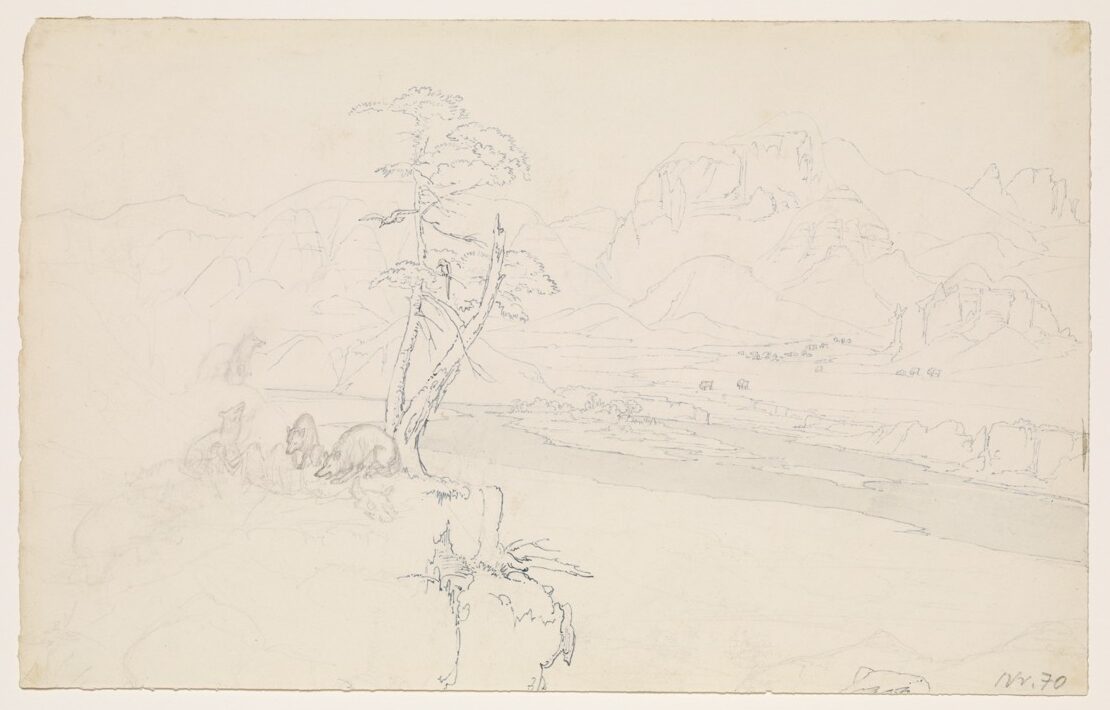
Not long after four o’clock, on a sandbar before willow thickets up ahead in the river, we saw a big bear, which went into the thickets after some time, and soon another one followed, which we observed very nicely with the telescope. When wounded, this dangerous animal usually attacks the hunter immediately in a fury. [Bears have] torn many whites and Indians to pieces. Also, if anyone suddenly comes too close to [a bear] in the thicket, it usually attacks; but if it scents someone earlier, it flees. Along the upper Missouri there is no wooded area of significant extent where one does not find these bears. They [grizzlies] are the only species of bear in this region, and the black bear (Ursus americanus) is not found here at all. Usually hunters do not like to shoot at [grizzlies], because they are afraid of them. For whoever is not an accurate marksman, able to hit the animal’s head or heart, must look around beforehand for a tree, so he can flee up it, for the grizzly bear does not climb, although the black bear does.
After a while we saw one of the bears galloping on the sandbar again. Mr. Mitchell, Dreidoppel, Bodmer, and Deschamps jumped into the dinghy and hurried over there. At this moment we saw a large bear coming out of the willows and going toward the shore, where a dead buffalo cow lay, on which it sat down and began to eat. With [a] loud splashing of the oars, the keelboat navigated in the middle of the river toward the bear; the dinghy went somewhat closer along the bank. Deschamps—a bold, experienced bear hunter—got out and crept low across the sand directly toward the bear. It stood up several times; we saw the huge head with pricked-up ears. Several times it glanced around and then went on eating. I did not think it the bear would hold out so long, and with tense anticipation, the entire crew watched this interesting scene. Deschamps was so bold as to creep, bent down to the ground, along the open level sandbar right up to within 80 paces of the bear, his gun always ready for the shot. This bear is said to have poor eyesight, and one can get very close to it if one has a favorable wind. The boat with the riflemen came to about 50 paces from the predatory beast without it being the least concerned. Suddenly the rifles were aimed, and Mr. Mitchell fired his own well-aimed [gun] at the forepart of the monster. The bullet hit; we saw the bear roll back [and] heard it uttering dreadful cries. When several more bullets struck, it tumbled forward about 10 paces, scratched the spots where it was wounded with its paws, and fell again and again. Deschamps went up and dealt it one and then a second fatal shot.
The majestic animal lay stretched out in its own blood. Ropes were fastened to its heavy body, and it was attached to the dinghy while lying in the water, whereupon the group returned to the keelboat with its catch. I was delighted to see this majestic animal stretched out; I took its measurements, and Mr. Bodmer made a sketch of it. This bear had a length of 6 feet 2 inches and 2 lines; its head was 15 inches 8 lines long; the tail with the protruding hair tips, 8 inches. (For closer measurements see my Natural History Diary.)
In the north a heavy thunderstorm was gathering; therefore, we hastened to find a good place for the night. This happened about seven o’clock behind a sandbar under the steep bank of a pretty prairie. The first thunderstorm had dispersed; on the other hand, a second, more powerful one appeared in the southwest. The bear was taken by means of ropes, on which several persons pulled, to the prairie and skinned there. It was rather thin, and nobody wanted to eat any of the meat. Scarcely were we finished with this work when the thunderstorm drew closer and closer. Thunder and lightning were intense, and at ten o’clock a heavy rain began pouring down that soon flowed into our beds and threatened papers, plants, and books, for we had little room on this small ship. The night was warm but very dark; the rain, however, subsided, and the night was calm and pleasant.