August 7, 1833
In the morning, overcast sky, cool; soon wind. We navigated past the thick, blackish brown tower of the left bank, which rose in the middle of the white sandstone walls. Its front side had quite collapsed; a mass of rocky debris lay at the base. (Mr. Bodmer has drawn this in sketch G.+.) From this tower it is approximately 600 to 800 paces to the place that, at a distance, looks like a narrow gate, because here the river turns left and both rocky walls seem to come quite close to each other. A little above the dark tower, on the right bank, a swift creek with a bed 60 paces wide empties. Now it had very little water, however. It serves as the boundary of the prairie (completely overgrown with Artemisia) on which three buffalo were killed yesterday. At the [creek’s] mouth its banks are covered with a small forest of old cottonwoods; here an eagle and big Muscicapa appeared. A cold wind blew toward us through the gate or at the bend of the river. Then, [at] about this spot on the right bank, we reached a second blackish brown towerlike rock, which, however, was not as thick and high as the dark tower. Yesterday it had appeared as background right inside the gate.
From here on, both stone walls diminish in height, continuity, and regularity. They are often interrupted [and] form the strangest figures, mixed with slender, pyramidal conifers. But they are already often interrupted by large gaps, become irregular, and soon seem to come to an end. All these cliffs are covered in the most unusual way with round holes or small basin-shaped hollows on their upright sections, the proper place for Muscicapa to attach their nests. Here the hills of the left bank are no longer high, yet we saw two bighorn on them. A prairie extends along the right bank. Behind [that], the hills on both sides of the valley have, in part, very unusual sandstone formations, like old castles, fortresses, or churches. [They] are surpassed, however, by the mountains or are located about halfway to the summit. Conifers, cedars, and juniper grow inside the white figures [and] on the hills around about and adorn the landscape. I do not wish to repeat the description of all the unusual formations we saw here; they correspond to those described earlier but are not as magnificent and distinctive as those of yesterday morning.
In this region we saw large numbers of bighorn in various places: on the right bank, a herd of at least fifty. In several places we saw two, three, or four old, very large rams together; they had huge horns. Many were sitting, others standing nearby. We watched them very closely with the telescope.
After eight o’clock it became very warm. 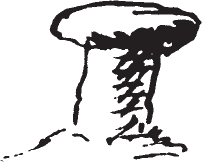 We went up the right bank—Mr. Mitchell, Bodmer, Dreidoppel, and I—to climb the hills. The brittle white limestone appeared everywhere, in the middle regions of the hills as well as deep in the valleys. The strangest figures surrounded us as soon as we reached the tops of the low hills. Mushrooms, tables of the most regular shape, old perforated fortresses, churches, organs, and all such figures surrounded us.
If one gazed down into the valleys, everything was spotted white and blackish gray; on the hills the ground was white or whitish gray, hard, and completely dry. Half-dried-out plants grew there only occasionally—practically all without blossoms [now], some already with seeds. [We] again saw here some of the plants mentioned earlier. We climbed higher and higher [and] saw beneath us the blackish valleys full of grotesque, snow-white sandstone figures, the substance of which was so brittle that I could not get any intact samples.
When we reached the highest summit above the Missouri, the view was splendid. We were on a high, dry plateau, which looked dried out and yellow, like a stubble field in Germany after the harvest. Individual old bison bulls on it looked like black dots. In the distance a high blue mountain, which is called the Bears Paw (la Main d’Ours), arose in the east-northeast, whereas Fort McKenzie lay more to the northwest. Bodmer and Dreidoppel were better off to the left; they saw many bighorn but did not shoot. On the prairie the grasshoppers were so profuse that the whole earth was alive with them. Four kinds of flying band-winged locusts were very numerous here: one with black wings enclosed with white on the end; a second one with white wings spotted black on the end; a third one with scarlet red wings, black on the end; and a fourth one with light yellow wings. They make more or less a clattering noise. Some stridulate very loudly, and the red-winged ones lived more in the small gorges of the valley, where it is moist and overgrown with vegetation. The big lark (Sturnella) was common; moreover, I also saw a bird the size of a sparrow, with which I was not familiar, [and] Lanius septentrionalis. In all the sandstone mountains, the common raven, as well as Falco sparverius, is not uncommon.
Beyond a ravine we saw two big bison bulls. [We] went down where the droppings and trails of full-grown bighorn rams were very often quite fresh, and wanted to climb up after the bulls, when one of them came down of its own accord. We immediately lay down on the ground. It would have come within shooting range, but at that moment Dreidoppel arrived and it caught wind of him, whereupon it lumbered back to the summit in a gallop. We [then] followed the valley downhill, where a small, almost entirely dry creek was located; rushes, which were not in bloom, grew along [it].
Having arrived below, we immediately came upon the keelboat, which had hoisted its sail and had fifteen men on the cordelle. In the sand we found rather fresh tracks from troops of bighorn, which go down to the Missouri to drink. As we advanced farther, the hills became low; the sandstone vanished and appeared only here and there. Tall, beautiful cottonwood forests covered the bank. The sun shown warmly. After eleven o’clock we saw two Indians on the left bank. As they came closer, we recognized them as husband and wife and, indeed, as Blood Indians, whom we had recently seen among the Gros Ventres des Prairies.
On the left bank we reached an island, which remained to our left. It was overgrown with old trees and some shrubs and had a broad, sandy shore. Beyond the island, old timber covered the bank, and behind this was a narrow strip of prairie, the close background of which were dry hills covered with grayish green grass. The right bank had bare, naked, grayish green hills. Here the Indian [and] his squaw approached us; we had navigated over to the left bank. He was a handsome man with [his] face painted red; [he had a] beautifully decorated buffalo hide, a gun in hand, and [a] powder horn placed over it. The woman was less handsome; she, too, had leather clothing decorated with many fringes and leggins embroidered with sky-blue glass beads. As our men on the cordelle were put ashore, they waded through the water to the ship.
At one o’clock we reached a nice broad island covered with tall cottonwood forest; at two o’clock, a second one. The region thus far had nothing distinctive. On the bare hills of the right bank were numerous small, grayish brown crags, probably graywacke or argillite. We ran aground on the tip of the last-mentioned island; here one had a fine view of the Bears Paw Mountain, which lay almost directly behind us in the northeast. The keelboat was again taking in much water. To the right we had seen several [more] troops of bighorn—today, surely more than 120 of these animals in all. To the left, where the channel turned off between the left bank and the island just mentioned, is a thick, roundish head on which sand and stone strata (undoubtedly sandstone) regularly alternate. Several bare mountains of this kind [can be] seen in this region. Their tops are a dingy and dark, blackish gray clay.
From the island we sailed upstream to the right. After half an hour, the sandstone hills on the left bank again had a different appearance. From below, the solid, narrow layers or stone strata on them were exposed in places, because the underlying sand had fallen away or been washed out, whereby strange hollows appeared; the rubble had slid down everywhere, forming pyramidal buttresses. To the right, behind the river in a narrow strip of surrounding old woodland, a narrow prairie extended as far as the hills. Also to the left, there was sometimes prairie with Artemisia and thorns with fleshy leaves ([— —]). Along the hills the whitish gray sandstone deposit still continued, on which there was an equally thick [deposit] of clay and sand with a turf cover. But what I call sandstone here is mostly only halfhardened sand, mixed with sandstone blocks and often clay [as well].
The wind was brisk and favorable; we sailed swiftly against the current. On the left bank lay an impressive elk antler that perhaps we will take with us on our way back. A flat, new sandy island in the river, on which short willows and cottonwoods grew; [it] was until now regarded more as a large sandbar. A half an hour farther on, in the south, we had our first view upstream of the first chain of the Rocky , or Oregon, Mountains. It appeared as a distant blue peak [and] soon vanished behind the banks of the river, which here were bare, lifeless, [and] barren, in only a few places animated by several old trees on the bank. The hills, too, are rather low, dry, and covered with dried-out, grayish green or grayish yellow grass, completely without enlivening vegetation. If we looked backward, almost east-northeast, we saw the beautiful blue Bears Paw Mountain, most picturesque with its many tall domes and summits.
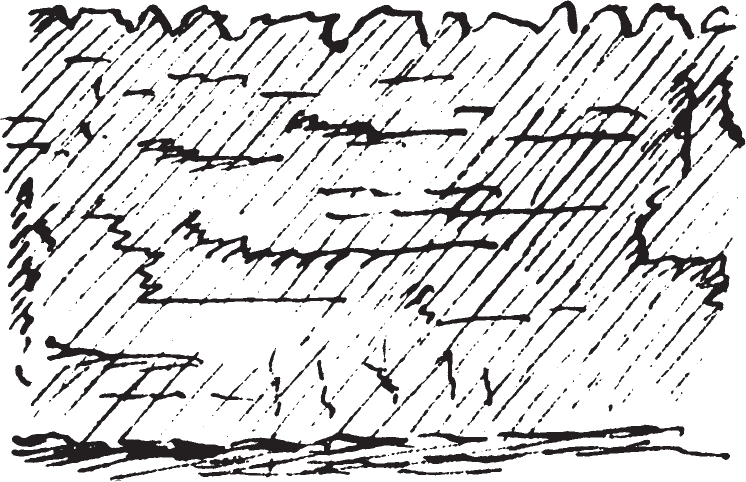 Somewhat farther upstream the left bank had a steep, vertical, approximately 60-foot-high wall of sandstone, or of the local mixture of sand and clay, jagged on top—that is, cleft with fissures. Ardea herodias flew slowly down the river, a rarity because marsh birds are generally very rare here. On the right bank, the prairie was densely overgrown with Artemisia columbiensis; [there was] an approximately 10-foot-high, steep bank along the river. Isolated old cottonwoods soon replaced the steep wall on the left bank; the trees are all cottonwoods, almost all of them stag-headed and less than 60 feet high. Much dry downed wood lies beneath their trunks.
Soon this border of timber became denser and broader; we put in here briefly and, at this moment, caught sight of a troop of fourteen to sixteen elk ahead of us, near an island located off the right bank. Here the men were put on the cordelle again. Bodmer and Dreidoppel went into the strip of forest, perhaps to shoot some interesting birds or the striped chipmunk. Deschamps and Doucette had likewise gone ashore. A quarter of an hour later, we saw in the same forest several Indian hunting huts constructed of poles placed together in a conical manner at the trunks.Roaming Piegans had undoubtedly built them. The forest came to an end; there was a promontory on the left bank where in the distance we saw a conically shaped hill, on the top of which an animal was standing. We made use of the telescope (spyglass or longue vue of the Canadians), which revealed a bison on top.
We turned away from the shore near a beautiful wooded island, which remained to our left. Dreidoppel brought in a large rattlesnake whose rattles, unfortunately, were somewhat damaged. Before the island [just] mentioned was a second one, with a stand of tall trees, surrounded by large sandbars. The hunters immediately went out again. On the right bank, opposite these islands, there were now rather high, steep bluffs or walls along the bank. Both Indians have left us to go to the fort; we watched them climbing up into the hills. We navigated upstream for several more hours along the now-wide prairie; thirteen antelope were moving there [and] were put to flight. The Indians came back again when we put in at the left bank.
Not far from the river, the forest continued with a long tip of individual, 30-feet-high box elder (Acer negundo) trees, which had thick, very crippled trunks. Hundreds of yellow troupials were in the thickets. When the ship put in, I went out and saw a flight of Lanius septentrionalis and, in the air, a large number of Caprimulgus americanus, which flew closely around my head. On the river the wild geese were calling, and in the tall trees along the bank, small falcons were extremely numerous. The evening was pleasant. The whole prairie was overgrown with Artemisia, and there was dense growth of the plant from the Syngenesia in between; [the] flower tops are boiled and drunk in this country as a remedy for venereal diseases. It has yellow flowers and very sticky leaves and is probably described under the name of Brachyous euthamiae. The evening was pleasant. Some mosquitoes in the thickets, and the tree frogs were chirring.