August 4, 1833
During the night, good weather. In the morning, somewhat windy and cool. At 7:30, 74°F [23.3°C]. The mountains continue in the same manner. Papin went out early in the foothills overgrown with conifers and shot a buck of the black-tailed deer species. As usual, its hair is thin and not attractive. It was not large and had about eight points. A stretch where the river has a rapid along the left bank delayed us a long time; the wind, too, was against us. On a tree to the right, two bald eagles. From the right bank, the song of Fringilla grammaca reached us, a short, flutelike strophe.
After eight o’clock we put in at the prairie covered with Artemisia (undoubtedly columbiensis) and relieved the men on the cordelle. Here Papin went hunting. Deschamps had not yet returned. The damp soil of the riverbanks was covered with a creeping Polygonum with rose-red blossoms, which was now in bloom. Solidago [— —] and the yellow flower with reflexed petals, very copious everywhere along these upper banks of the river, grew along [the] shore. I found a small violet flower with narrow little leaves [— —], which I did not yet have: a dainty plant.
Later, on the left bank in the mountains, we heard Papin’s shot, and Mr. Mitchell thought he saw him shooting a bighorn. It is very difficult to hunt them. One must climb terribly [high] in the steep mountains, and in addition [the mountains] are entirely without water, completely dry. The Alpine hunter in Switzerland everywhere finds cool springs and water; he has his brandy and good cheese. The mountain hunter here must endure great thirst, and if he wants to drink, he must descend to the Missouri. Furthermore, all these hunters wear only light Indian moccasins in which they can easily injure their feet; nor can they ever use nails or climbing irons. Not infrequently, however, one finds bighorn in the lower regions of the mountains and can kill them more readily and without such great difficulty. These animals run and jump along the steepest walls with extraordinary agility. Indeed, one occasionally sees them standing like ibexes, with all four feet on a small rock. Even the small young animals are difficult to catch in these mountains. Mr. McKenzie offered a horse to each hunter who would bring a young animal back alive but did not get any yet. In the Rocky Mountains, more toward the Columbia, in the region of the Kootenais, or Coutanais (as the French call them), the white mountain goat (Capra montana) is common and not hard to shoot. It is difficult for us to get, and only occasionally does one see their hides, obtained from those Indians, for which Mr. McKenzie placed orders with Mr. Mitchell this year.
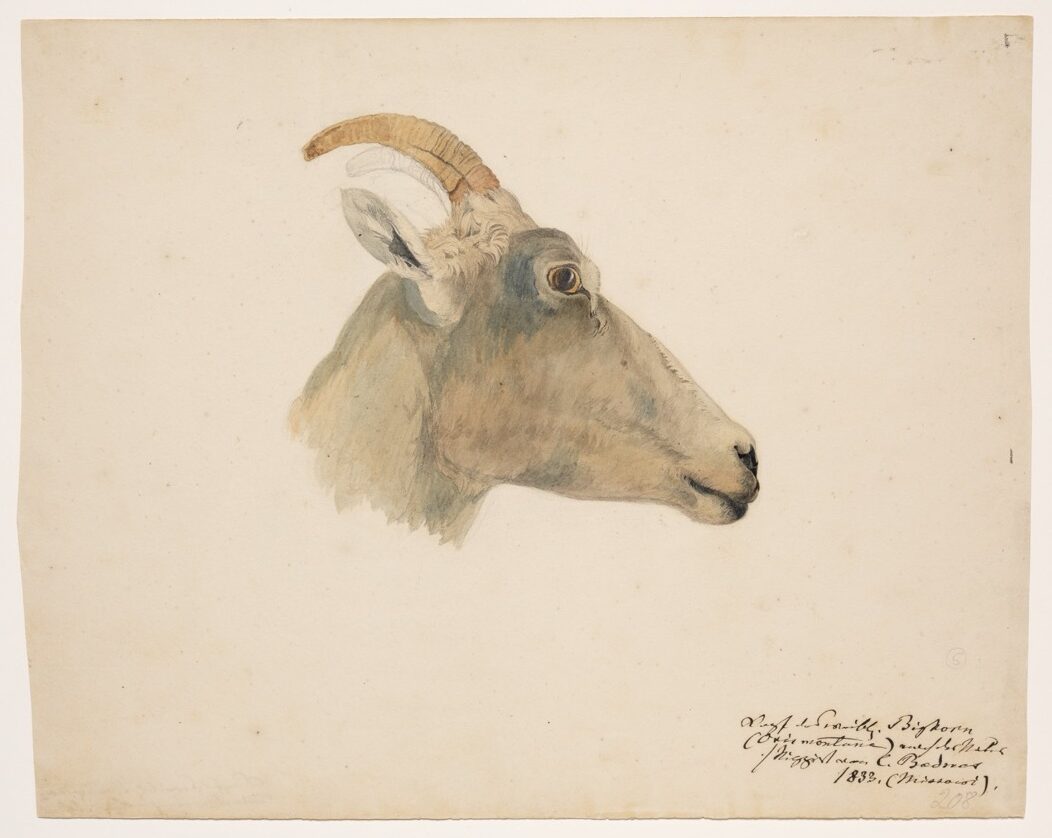
Today the hills did not seem quite as steep and high along the right bank as they were yesterday. At their base one also saw more bluish prairies covered with Artemisia columbiensis (called sage by the Americans and absinthe by the French). The river, on the other hand, has more rapids than yesterday. Papin had shot two female bighorn, which were brought on board intact. They were heavy, stocky animals (see Zoological Diary). Mr. Bodmer sketched the head of an old female animal.
At twelve o’clock, 78°F [25.6°C]. At this hour we reached an island overgrown with scattered old cottonwoods and some prairie, its banks rather flat. It remained to our right, and here there was a strong rapid that required skillful work. We gazed upon rather low mountains before us; here, too, there was again some forest along the right bank. Toward the upper end of the island, numerous rounded hills, 50 to 60 feet high, like molehills, were located before the mountains. On the left bank, in rubble mixed with rocks, we found round sandstone balls in various sizes, from the size of a cherry to bigger than a fist, and certainly even larger. [They were] just like the ones found along the Cannonball River—only there they were brownish yellow, here ash-gray. Thunderstorms were brewing in the north.
It was two o’clock. We had rested until then, because the crew had been eating lunch. They now were pulling again. We had rested opposite the aforementioned island. On the left bank, rugged hills with individual, partly dried-out, broken-down conifers, including juniper (Juniperus prostrata), creeping flat on the ground; sage (Artemisia); and very little sparse grass. The sky was getting darker and darker; the thunder was rumbling. It thundered and rained very little; a half hour later, the sun again shone brightly. We had halted about ten minutes. We pushed and pulled across a rapid up along the left bank. Deschamps returned; he had seen Thompson’s Creek not far ahead of us. Several small islands lay beside us off the right bank. Lewis and Clark also indicate several islands here. Including the one first mentioned, we have, it seems, seen three up to now. The third or the second of those, which now lies to our right, is densely and beautifully covered with forest. Beyond this island the prairie has a border of beautiful old timber. The forest indicates that we have passed the Mauvaises-Terres.
Suddenly, water came in under the cabin floor. Someone broke open a floorboard and [could] hear that the boat had sprung a leak. The men on the cordelle were called in, and they rowed and pushed ahead. Now the hills were no longer high; the region [was] open on both sides. We have passed the mountain chain of the Mauvaises-Terres. We rowed to the right bank, put in there to but the water was too shallow [for us to put in there]. We poled upstream for a stretch and then crossed straight back over the river again. Here, too, we could not reach land, were grounded, got loose, and with great exertion worked our way to the shore, [where] we put in to remove part of the cargo. It was five o’clock. Before us the river made a bend to the right. Beautiful, moderately high mountains lay before us. Before them, fresh green forests—a delightful view when one has seen nothing but bare, whitish, steep mountains on both sides for so long. After one and a half hours, the leak was located [and] closed, and the cargo loaded again. Then we navigated to the right bank and made a stop there for the night. Cool night.