September 22, 1833
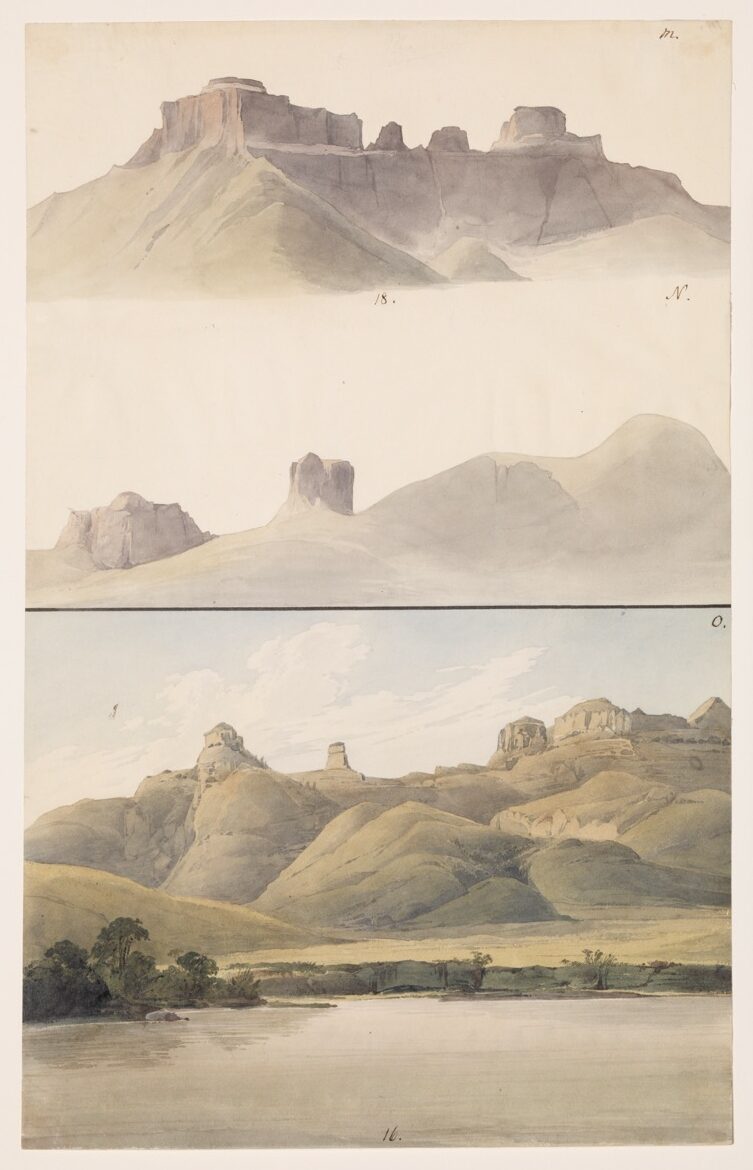
At daybreak, departure. When daylight arrived, [we saw] unusual domes right and left; individual buffalo on the prairies. In the distance we saw a herd moving hastily on the prairie; it spread much dust, and we were afraid it might have been put to flight by Indians. Magpies fluttered around the boat, because it hung full of meat. Kingfishers, which we had not noticed while navigating upward, were now on the riverbanks in great numbers here. At eight o’clock we put in at the left bank and made a fire directly opposite the strange dome that Mr. Bodmer had sketched (sketch M.) on the way up. On the prairie where we lay at anchor, sage (Artemisia) and the light-green thorn (perhaps Lewis and Clark’s pulpy thorn) grew. The small tree frogs chirred. Sage bloomed here. The entire bank along the water was covered with parallel trails of buffalo, elk, wolves, and other animals.
At nine o’clock we continued. Before us lay the halfway pyramid between the Musselshell and Milk River. Before we reached the height of the pyramid, we navigated close past a nice round island on a sandbar. In the strips of forest along the bank and on the wooded promontories, one frequently saw forts constructed from dry timber by Indian war parties; however, to our delight, we always found [these to be] empty. Whenever we passed them, we looked nervously to determine whether they might be occupied—especially our men, who were very frightened and betrayed great fear of the Indians. They were dissatisfied and loudly expressed their displeasure whenever we halted just for a moment. They did not speak loudly and looked about timidly. The river, to be sure, [was becoming] wider and wider, but to the same extent, the shoals and sandbars (battures) also began to grow more frequent and troublesome. In the clay hills and mountains, mica or isinglass-like fossils glistened here and there in the sun, like bright stars in the distance.
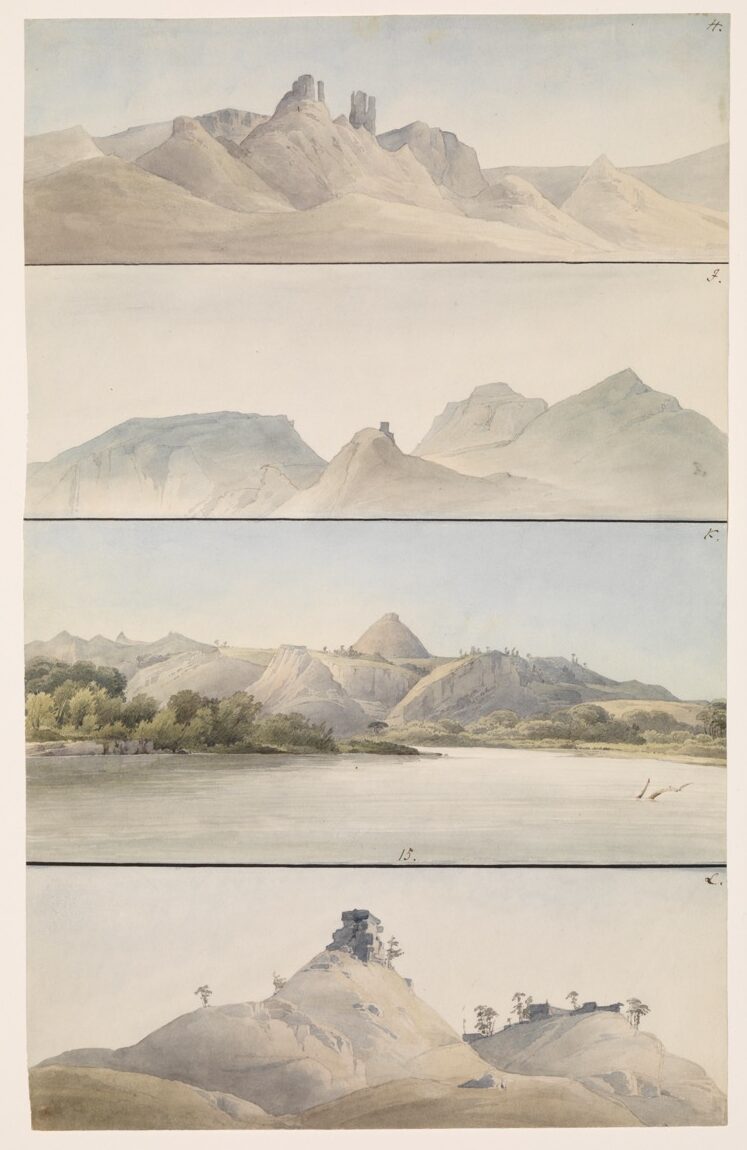
At 10:30 we found ourselves opposite the halfway pyramid, which lay in a southerly direction from us. Somewhat farther downstream we found large sandbars in the river, which delayed us greatly, since one must swerve right and left to avoid them. [There were] several very narrow, shallow channels between sandbars, where one had to get out into the river and push. [On] most wooded promontories, one saw old Indian huts and forts. A big white wolf was standing near four of these huts. Before us the buffalo were running away a half hour’s distance from us, because they had just got wind of us. Around twelve o’clock the mountain dome of sketch L. was located to our right. At 12:30 we found ourselves opposite the place where Dreidoppel and I had shot a buffalo. An hour later, buffalo were bellowing in the forest to the left. It was here where, on the way up, I had gotten out with Dreidoppel when we made that chase; the Monarda had then been blooming very beautifully in that forest. In the afternoon a strong wind blew, lifting the sand into the air.
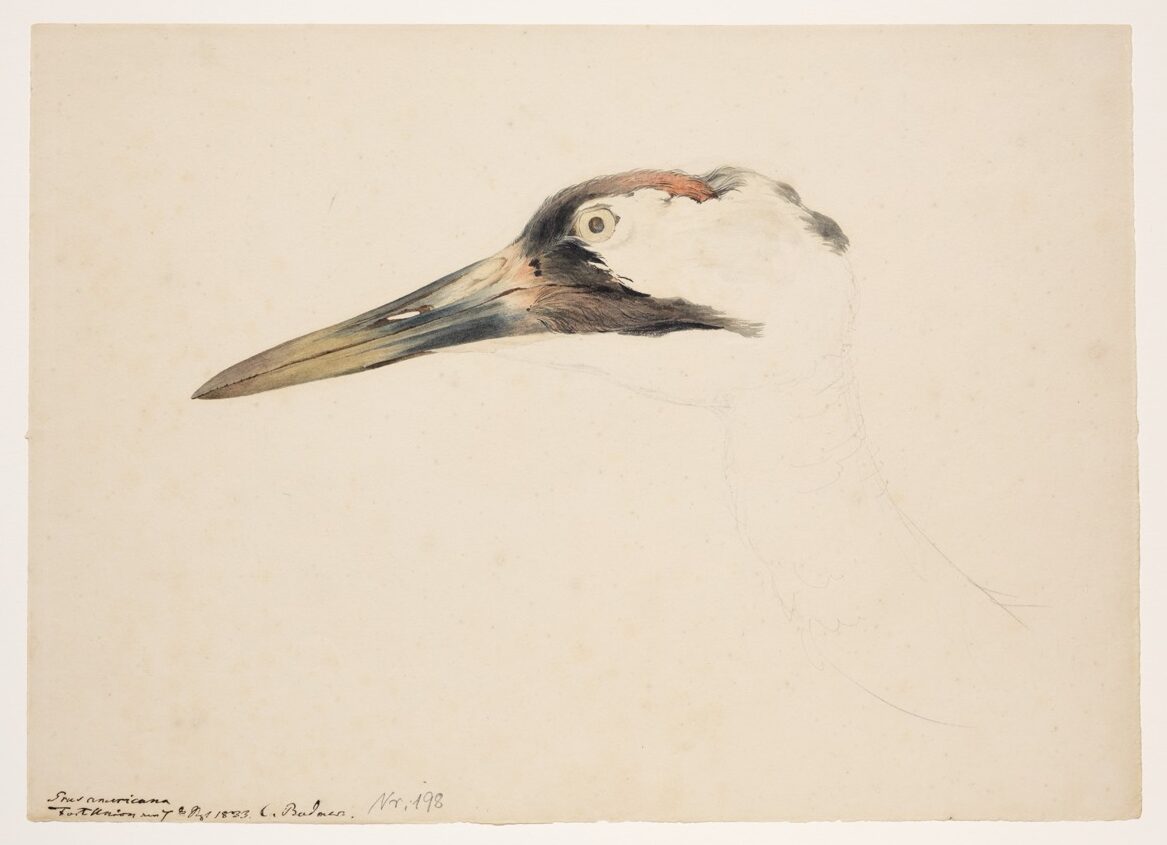
At 2:15 we reached a bend of the river with large, broad sandbars. A very large Indian fort stood to the left in the sparse forest here; to the right, a white wolf [was] near us on the bank. We navigated through a long stretch of completely bare brownish gray mountains [and] clay mountains without outstanding domes. The river made big bends and was extremely shallow. On a sandbar, five elk cows, which did not wait for us. On the left bank, which was steep, beaver tracks appeared everywhere; large sandbars in the river; numerous magpies in the bushes. The bare gray hills have small thickets of the light-green, perhaps pulpy thorn [but] only on their lower sections, in the furrows, and on the bank. Somewhat farther [on], near a long forest, a big white wolf stood on the bank; [he] did not move [even though we came] within 70 or 80 paces of him. At the next bend of the river on a sandbar [were] two magnificent snow-white cranes with black pinions (Grus americana), the whooping crane of the Americans, one of the most beautiful birds of this genus. Its plumage was dazzlingly white. I would have liked to possess it, but they were out of range. The hills still remained the same, bare and monotonous, but [there were] many beautiful woodlands along the bank, where we found many beaver tracks. A bull elk standing to the left near the forest emitted its cry. Sandbars in the river.
We landed to the right near a willow thicket and prepared a fresh bed for our two bears. The river is very wide here. Mr. Bodmer, who wanted to cut branches, came very close to a wolf in the thicket. It was now six o’clock; the sun soon set; a majestic bull elk appeared on the right bank. As we sailed past the steep edge of a prairie bank, a beautifully striped black-and-white skunk appeared [and] sat there, but no one shot at it. This animal, too, did not differ from the one obtained in Pennsylvania. To the right in the short willows stood a large bull elk, and on both sides one soon heard the cry, or bugling, of these stately animals. We continued on until it was very dusky and then halted at the right bank beneath steep hills at a narrow edge of a bank; on the opposite side [there were] woods and willow thickets, where the bull elk bugled and the wolves howled. Evening magnificent, warm, and moonlit. At 9:30 beautiful northern lights arose, which, [though] initially covered with clouds, later shot up flaring and flickering beautifully in tall streaks or columns of light. The night was not very cool.