June 28, 1833
Early in the morning, overcast sky, cool, windy. Quite early the Indians besieged the Indian store. They were ready to give up everything for whiskey. They were prepared to sell all their hides and belongings, and I did not neglect to purchase many an interesting Indian object. The interpreter sent us the Indian with the horn ornament on his head, whom we had selected yesterday for drawing.As already mentioned, [his name was] Noapeh (Troop of Soldiers), and [he] was a well-built Assiniboine. His face was yellowish, his eyelids painted red. On his chest and in back, his leather jacket or shirt had large rosettes embroidered with porcupine quills, 8 or 10 inches [in] diameter and colored as shown in the [adjacent] diagram. This man stood here a long time for the painter and was rather patient, even though his wife, child, and friends often came to call him away. I saw another Indian with this kind of head ornament, [for] which I traded with him. The Indian women are very skillful in selecting and matching colors for these ornaments. In this way the various ornaments are often very nicely colored, and even the weapons are ornamented.  Here, for example, [is] a small stick that they wear in their hair, though not all of them do, and that they also use as a pipe cleaner. It is stuck in back in a horizontal direction into their thick hair. The Indians also brought horses into the yard of the fort to trade. Most [had] already left this morning; nevertheless, a sizable number still remained. Another rather large band should arrive in a few days. We heard that the keelboat, which had recently been left behind, is quite close. At twelve o’ clock, 69°F [20.6°C].
In the afternoon we visited the Indian camp, where most foliage huts were already empty. In the distance one saw individual Indians moving off in three principal directions, and seldom were there more than two, at most three, together. Even in the heat, they always wear their fur cloaks. [These] would be exceptionally irksome and troublesome for anyone not used to this kind of dress, but the Indians hold them tight and carry their often-varied weapons at the same time. A large part of these people followed the course of the Missouri upstream, though not through the forest along the bank but rather on the open prairie to the west. Another group went north (slightly to the west), and a third group to the northeast. The latter, about one hundred in number, was leaving to unite [with others] as a war party and to undertake a foray against the Mandans and Hidatsas.
All the Indians leaving the fort here have to be very much on their guard, for the greatest danger is always in the area about 6 miles around it. In these regions the various enemies most often keep an eye out for each other, because they know that their enemies are going to the fort en masse to trade. Many of the Indians who left today were riding. If they [are] on horseback, they put only a cord through the horse’s mouth or around its lower lip; they let the cord trail behind when they let the animal out for grazing. With this rope, or strap, they can easily catch it again. Many had stirrups on their saddles; others did not. The whip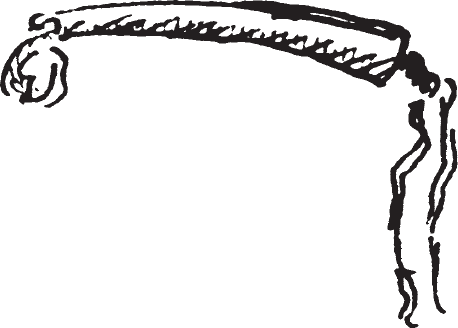 was usually made from the tine of an elk’s antler, polished quite smooth and white, colorfully decorated on top, and [with] several leather straps on it. Bow and arrows in hand, their heads with thick black hair uncovered, thus they often galloped away. Those on foot moved at a [quite] vigorous pace, and very quickly one saw these people covering a long stretch in the prairie. Several Indians (including an entire [tipi]) remained here, and thirty-one new [tipis] of the Assiniboines were announced [as coming] tonight or tomorrow.
In the evening between six and seven o’clock, a black storm with thunder and violent bolts of lightning came up in the south, whereby the wind remained very strong; occasionally it rained very heavily a little. During the night the thunderstorm was very severe and it rained exceptionally heavily.