August 3, 1833
During the night, some thunder and lightning; otherwise, beautiful moonlight. In the morning, slightly overcast sky, pleasant weather. We advanced barely a few hundred paces and then found ourselves in the so-called Elk Fawn Rapid of Lewis and Clark, which delayed us for a while. The boat was kedged across. Over along the left bank lay the island noted by Lewis and Clark; the channel dividing it from the left bank was nearly dry. The island itself is a flat prairie, overgrown with Artemisia and grass and, on its banks, with some other plants. Individual sandstone blocks of a yellowish red color lay scattered about on it, and before the island, along the left bank, there was a small prairie with a beautiful copse of tall old cottonwoods. The mountains are high, gray or whitish gray, strewn with yellowish brown sandstone boulders, and [showing] tall horizontal ledges or ridges where the currents have eroded unusual shapes. One sees hollows that look almost like half gates, rounded off on top and eroded by water, and round, basin-shaped indentations. Rubble lies around everywhere, and the totality is a picture of devastation and raw wilderness.
Early, the hunters saw two bison and were set out on the right bank. We hoped they [would] shoot some bighorn. Last evening, on the highest hills, Mr. Bodmer had seen a small ground squirrel (Tamias), which seemed to him to be of a species still unknown to us. On the sandstone rocks, we saw white patches, which came from a new short plant ([— —]) with white blossoms. To the left we now had high clay walls, completely barren, covered only with small patches of dry plants [— —]; here on the hills grows a grass on which the bighorn primarily feeds. With his rifle, Mr. Mitchell went out on the left bank with Culbertson. In this region one again sees brick-red tops on the whitish gray mountainous masses; I took a piece of this clay with me. On the right bank, isolated stone rods with big round tops: conical clusters and toothlike shapes stood on the tops. On the left [— —] before the mountains a promontory projected, at which the river is narrow, about 160 to 180 paces wide. 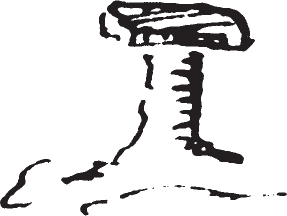 On the other side are steep, high, pale gray-brownish clay and sandstone masses, completely bare and dry. Farther on, along the left bank, we had large sandstone masses at the very edge of the river; [also] stone columns, one of which stood at most only 40 paces from us: a most unique formation.
Messrs. Mitchell and Culbertson came aboard without having seen anything, but hardly had the former set aside his rifle than he discovered [that] his powder horn made of buffalo horn was missing; he had to retrace his entire path once more. We saw mountains to the left; if one discounted their height, [they were] shaped exactly like the Mettenberg and the Eiger near Grindelwald in Switzerland. Conifers in spots on the walls and in the background of the ravines; ridges and peaks occasionally completely overgrown with conifers. On the opposite side of the river, our hunters appeared with meat. The skiff went over and fetched them. They had shot a bison bull. Fetching the hunters had cost us a full half hour. We had been lying at anchor before a hill that was marked at its lower end with abruptly descending sandstone strata (at an angle of 41°) and otherwise overgrown with individual scattered, slender, pyramidal conifers. 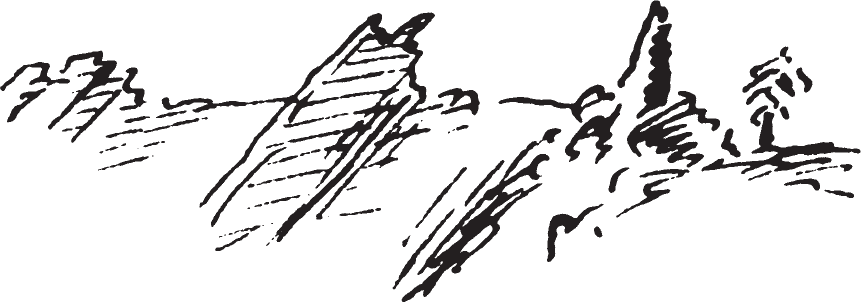 On the next hilltop stood the most unusual pyramids and thin, upright walls, like combs. Conifers and short, creeping junipers hereand here and there along the slopes, probably Juniperus prostrata. A thunderstorm arose in the north; it had been thundering already for about an hour.
Mr. Mitchell returned, but he had not found his beautiful powder horn. Deschamps had seen the small chipmunk but could not shoot it, because he had no bird shot with him. He did not see any bighorn but did find their tracks. Around noon a cool wind came up, which cooled off our cabin. At twelve o’clock, 80°F [26.7°C]. In the afternoon the mountains were about as high as the highest Rhenish hills, and in some places, if one discounts the shape of the mountains themselves, the whole valley, with its bends, illumination, shade, and blue distant backgrounds, is very similar to the Rhine Valley.
We are now approaching Dauphin Rapid, the most significant of the rapids, named after one of our crew, who last year fell into the water at this place. On the left bank, the lower section of the hills is now covered with rubble from the mountains; in this region one again finds the unusual stone spheres, usually double or often several together.
On a very high hilltop along the left bank, we saw two bighorn, the one in back a big ram. They were twice shot at, although far out of range. They went around the mountain. Bodmer and Dreidoppel got ready to attempt to scale the mountain. In shape, the bighorn is an animal similar to the antelope but much thicker, sturdier, and heavier, for when full-grown, the ram weighs more than a deer. Its head is thick and, with the huge horns, very heavy. A pair of full-grown horns weighs [——pounds. The [underbelly] and hindquarters of the animal are white, the upper parts reddish brown. Its hair is hard and, like that of the antelope, brittle. Its meat resembles mutton, since it obviously belongs to this genus.
Because the boat did not stop, my two marksmen did not pursue the bighorn but immediately turned left into the mountains. Saucier went farther ahead. Here there were small patches of meadow all around, like small Alpine meadows, on the ledges of the hills. They have short grass, while along the river below, luscious grass grew mingled with all kinds of other plants. The foothills rise by degrees and are covered with short grass. The common raven caws in these rugged deserts totally devoid of people, for here one almost never sees even Indians. It is much too difficult for them to travel through these steep mountains, since they mostly travel on horseback; thus, they move about more in the flat prairies beyond these steep Missouri mountains. The Mettenberg and Eiger near Grindelwald again appeared before me several times this afternoon.
We passed several rapids, that is, places where the river had more fall because of rocks or boulders and hence a stronger current. Here the many men on the cordelle had to pull with all their might; on the whole, however, these spots were insignificant. Especially interesting [at this place] in the Missouri Valley is the view up and down the river. One would think one were viewing Swiss mountains; [there], as here, large mountain masses constantly seem to erode the valley and give the river a gradual bend. The Missouri here no longer makes big bends as it did before, when it moved back and forth in serpentine fashion between two hill chains more distant from each other. Here it is confined and flows more straight ahead. The total character of this region, too, is most singular.
Bodmer returned with cactus thorns in his foot, not all of which could be extracted. Dreidoppel arrived later and brought a large number of rocks that were full of bivalve mussels. There were large blocks along shore, which consisted entirely of them; they were on the left bank and seemed to be lodged in limestone. Hence these mountains possibly contain limestone strata higher up.
About 5:30 we reached a rapid, which, as I have mentioned, was named after a certain Dauphin. Because there was much water in the river, one barely noticed this place, but the current was very powerful. Most men pulled; others pushed. Several junipers grow right on the hills; Juniperus prostrata seemed to be among them. The effort that was exerted to pass the rapid required the help of all hands; one man fell into the water, but he could swim and was helped aboard. Above the whirlpool [we] saw three buffalo on the right bank. Deschamps and Papin were sent over there, and from the boat one could watch their movements. The buffalo took flight and ran along the ledge of a high mountain.
The wind soon became strong and favorable, [so] we set the sail and moved swiftly. There was thunder and lightning, but it did not rain before nightfall. We halted at the left bank. A small prairie was located above the place where we lay at anchor; the plants there were dry and without flowers. Conifers grew on the hills somewhat farther back. For a long time we sat here on the hilltop and viewed the interesting region until it was veiled by night. Several men had started fires on shore to sleep near them.