Journey from Fort Pierre on the Teton River to Fort Union on the Yellowstone River
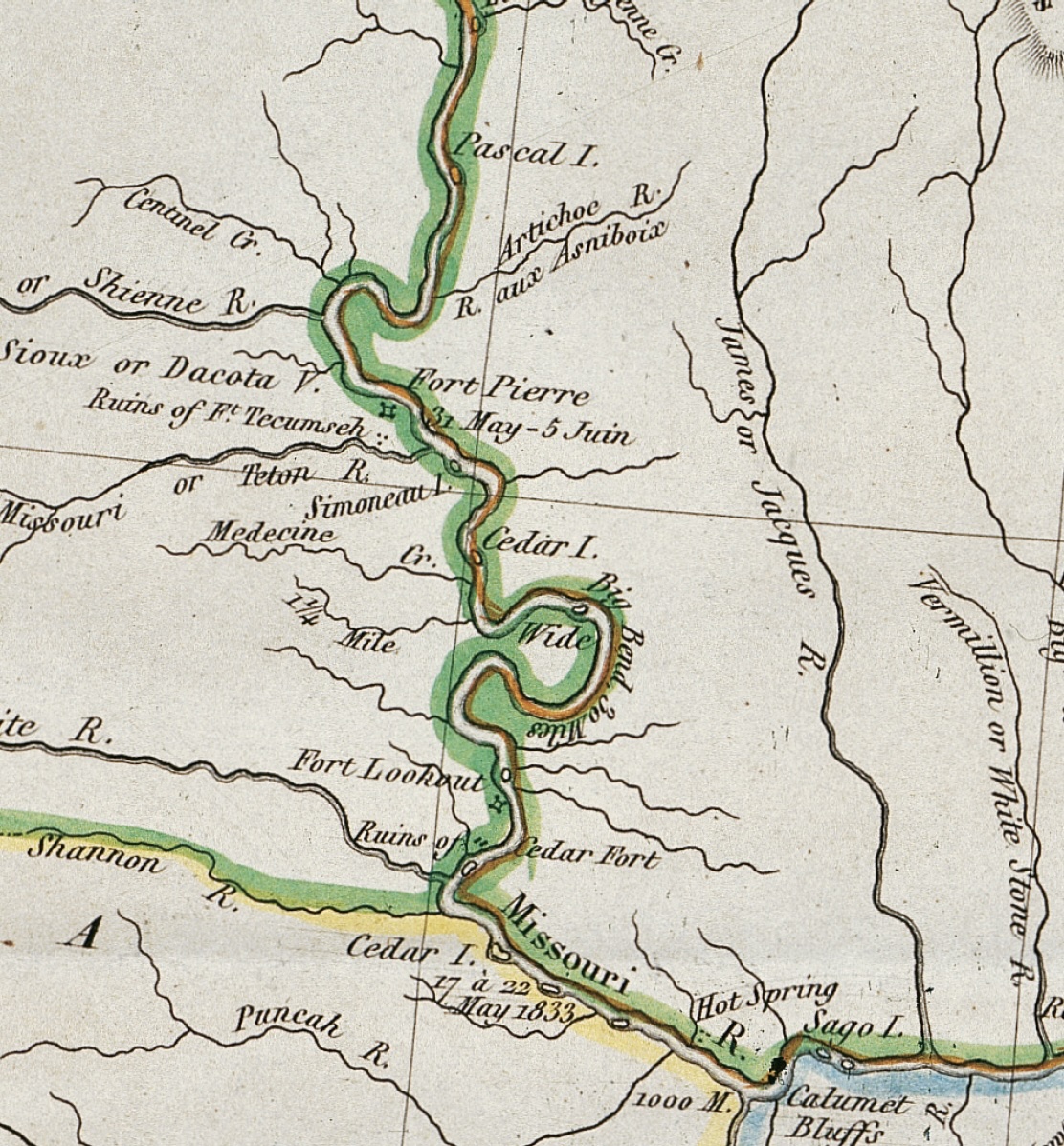
Stay at Fort Pierre – The Dacotas (Yanktons and Tetons) – The Yellow Stone returns; we travel on the Assiniboine – Difficult voyage – Cheyenne River – Cheyenne Indians – Antelope and elk – Little Cheyenne – Good day of hunting – Moreau’s River – Rivière du Rampart – Two Arikara villages – The Arikara Indians – Cannonball River – Old Mandan village – Heart River – Storms and bad weather delay us – Meeting with the Yanktonais (Dacotas) – Arrival at Fort Clark – The Mandan, Hidatsa, and Crow Indians – Five villages of the Mandans and Minitaris (Gros Ventres) [Hidatsas] – Meeting with the Hidatsas – Little Missouri – Difficult navigation around a promontory – Fire aboard ship – View of the first bears – Two Blackfoot Indians – Meeting with the Assiniboines – First glimpse of the bighorn – Muddy River – Second meeting with the Assiniboines – Yellowstone River – Fort Union
June 19, 1833
Departure at daybreak. The sky was overcast; a strong, very raw wind was blowing. The chiefs and several Indians had come on board very early. There was also a Blackfoot among them whom we wanted to take with us to the Yellowstone; the other Indians wanted to travel with us just beyond the Hidatsa villages. Also on board with them were Mr. Kipp and the interpreter Charbonneau. To the left the appearance of the region bore some resemblance to some regions of the Rhine. At the next bend of the river, beautiful hills directly ahead. We soon put in (at the right bank) to cut wood. Storm and rain overtook us. About an hour later, continuation of the journey. To the right, unusual hills like fortifications. At nine o’clock, 60 1/2°F [15.8°C].
At ten o’clock we reached the second Mandan village, called Ruhptare, likewise on an elevated plateau. The dark brown, black-haired inhabitants had all assembled on the bank and on top of their [lodges]. The entire prairie was full of people and horses; in the short willows on the bank [was] a crowd of naked brown children. Most of the men carried their [bird] wing [fans] in their hands and were wrapped in their buffalo blankets. The village is surrounded with a pole fence and reminded me of a New Zealand hippah. At the end of the village, [there] had been erected an as-yet-unfinished log house, which the Indians wanted to construct in the manner of the white man. The village is said to contain about forty lodges, which are large and comfortable. On the prairies herds of horses grazed; big dogs ran about like wolves. On tall poles next to the village, one saw various objects suspended; [they] are medicines (sacrificial or protective devices). Their dead lie on scaffolds like those of the Dacotas and Hidatsas. The Indians, the entire population of the village, accompanied us on foot and horseback along the high bank and on the shore below it.
The bluff along the bank consists of clay. On the opposite bank, low-lying land with willows. Big, wolflike dogs ran about with the Indians, especially with those on horseback. A vast, flat region and broad, beautiful river before us; in the distance one sees the first lowest Hidatsa (Gros Ventre) village, a reddish mass of huts along the left bank. We reach it after a half an hour; its name is Eláh-sá Awacháhwi. It is small; we count about eighteen lodges. The two other villages of this nation lie somewhat farther inland along Knife Creek. Here it empties into the Missouri, about one mile from the last Mandan village. The style of construction is entirely that of the Mandans. The interpreter Charbonneau, who accompanied Lewis and Clark on their journey to the Columbia, lives in the second, or middlemost village, the name of which is Awatichai (‘ch’ velar, ‘ai’ together), or Little Village. The third, or largest, village, somewhat farther upstream along the creek, is called Awacháhwi (Shoes) Eláh-Sá (Village of the Big Willows). The last two villages are located about 1 mile inland; later we got to see something of them.
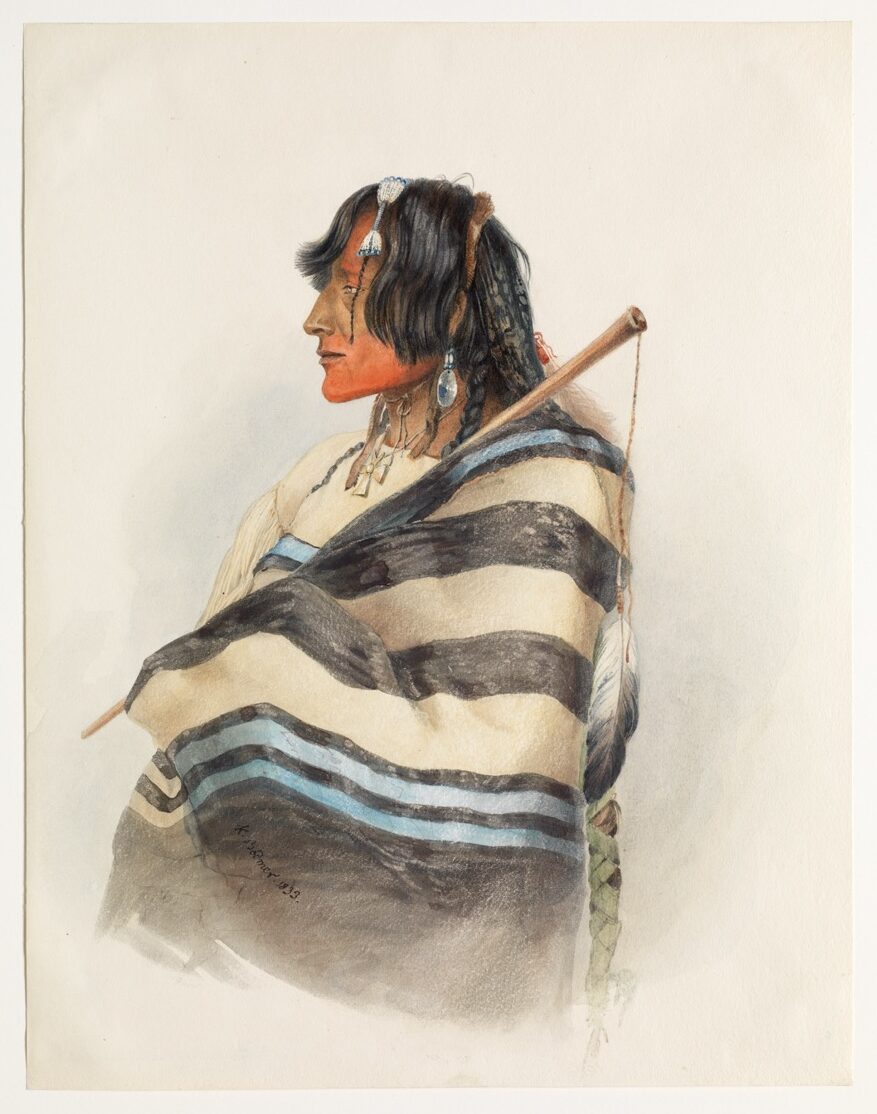
For us foreigners this trip was most interesting, whereas our Indians calmly continued to smoke their pipes by the fire. Among them was Dipäuch, a tall, heavy, strong man, with tremendous hair tied together in a thick queue hanging halfway down his back, who wore a silver ring necklace with a deer engraved on it. His hair was colored reddish brown, just as these people frequently paint themselves reddish brown, and the face red, which sometimes, however, is also reddish brown. Another Mandan with a grim expression, just as huge as the previous one, was nearly 6 feet tall; he had bound his hair together in a huge bundle on his head. I traded les Quatre Ours, that is, Four Bears, for his buffalo blanket and the big man with the necklace for a tobacco pouch. Several of them continually had their fingers in their great supply of hair and usually put their catch between their teeth. Our food greatly pleased them; they very much like to drink coffee, and sugar is a dainty morsel for them.
If one turned one’s glance from these interesting persons of this continent to the landscape, one saw on the bank to the right gray bluffs to the left, prairie, sometimes willows and low bluffs, the entire region rather flat. Noteworthy ranges of hills, completely smooth on top with steep bluffs, along the river before us and to the right and left; the river wide and majestic. At twelve o’clock, sunshine and rather warm, 79°F [26.1°C], with much wind. To the left along the bank, we now saw a large number of Hidatsa Indians making their appearance before the willows. They were on foot and on horseback and wanted to see the steamboat. The sight of this reddish brown throng—for their hide blankets, too, often had this color—was most interesting. We had already seen more than one hundred of them, with many dogs, some of which pulled travois, a wooden frame for dragging wood or other loads home. 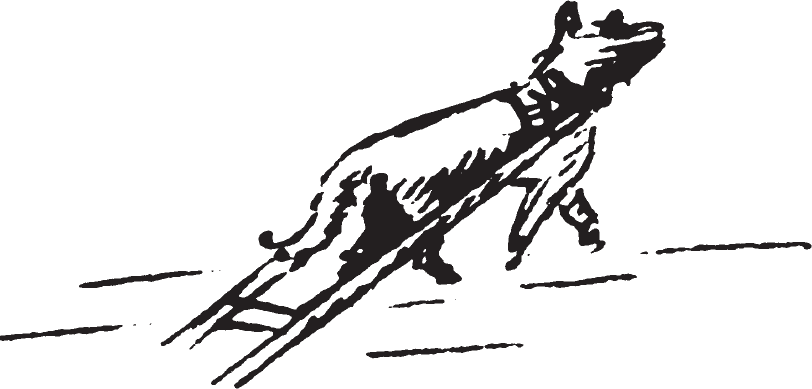 The Indians now hastened through the willow thicket on shore to the left, and soon they all stood near us on the opposite steep, low, sandy bank, where they crowded so closely around the willows that one anticipated a cave-in of the bank [at] any moment.
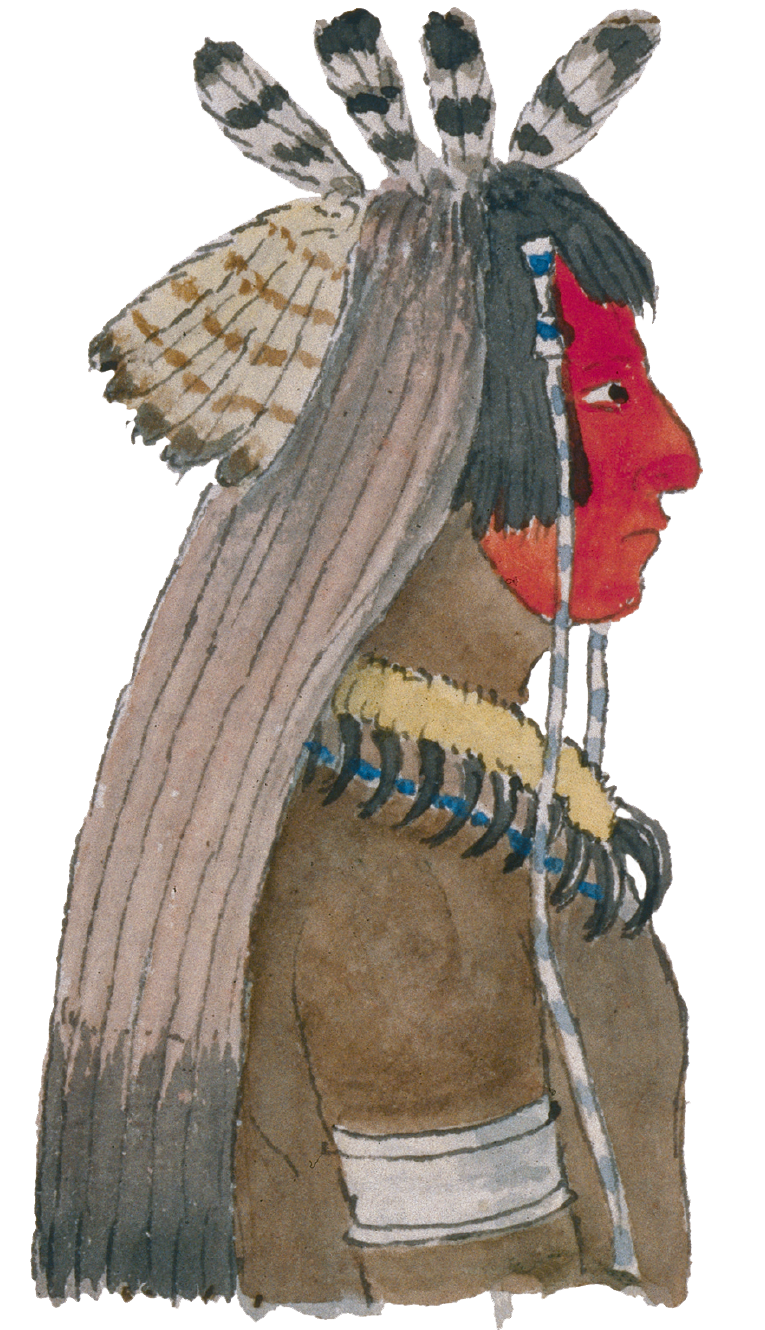
We now witnessed the most interesting sight that we thus far had [seen] on the Missouri: all ages and sexes, and the most handsome, powerful men we had seen, in the most attractive, highly imaginative, and characteristic costumes! Their faces painted red, the long braids hanging down their backs. On their heads [they wore] several feathers hanging down [beside] each eye with long azure and white strings of beads. We saw these characteristic faces staring with amazement and with wild and varied facial expressions. Their upper bodies were mostly naked. The beautiful brown skin on the arms was partly adorned with broad, shiny, white metal bracelets. With their guns, bows, or battle-axes in hand [and] their quivers (partly made from otter skin and most gracefully decorated) on their backs, with their leggins covered with strands of human hair or long leather fringes, all of them embroidered in the most beautiful manner in vermilion, azure, or yellow with feather quills and glass beads, these energetic men, laughing, with their ivory teeth, give free rein to their feelings. We could not take our eyes off them. Many were still more interesting, for their entire leather costumes, even the sleeves with those fringes of human hair and the entire shoulder and chest, were embroidered in the most vivid colors with glass beads and porcupine quills. Those with naked trunks had wrapped their beautiful bison hides around their hips; on horseback they buckle them with a strap. They had beautifully ornamented and bedecked themselves in their finest, and they had not failed to achieve their ultimate purpose: we could not stop admiring them. It is well known here along the Missouri that the Hidatsas, with the Crows (who perhaps even surpass them in this respect), create the most beautiful objects of this kind, and together with the Mandans, they are probably the strongest, most handsome Indians I have seen here. The Dacotas are, to be sure, also tall, but they are more slender. Among the girls we saw very pretty ones, some of whose faces were painted vermilion, [against] which white and black eyes flashed quite strikingly.
 It is impossible to describe the variety of people, costumes, and facial expressions we saw concentrated here. Among the mounted Indians were very interesting men, almost all of them without stirrups, who drove their horses (which shied at the frightening hissing of the steamboat) forward with whips. They sat very firmly. With the bridle fastened to the
horse’s lower jaw, they maneuvered the horses, some of them very beautiful good ones, through the dense willow thickets down to the water. One saw magnificent Circassian and Bashkir horsemen with savage vermilion faces, guns, bows, quivers, and all manner of weapons wrapped around them, with whips in hand. With the singular Indian costume, a noteworthy and interesting sight. Mr. Bodmer drew one of the nice bows. Here one could see the most beautiful garments, [and] one can purchase a necklace made from the claws of the grizzly bear only [in exchange] for a horse or a good gun. Here a painter would have found the richest opportunity for his art. Unfortunately, there was no time for drawing.
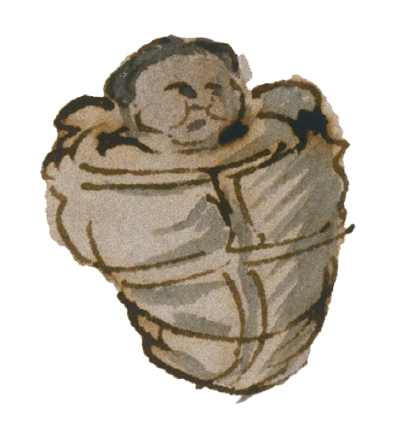 The chiefs made a brief visit to the ship; with them was a Blackfoot (Piegan) Indian with his wife (a Hidatsa) and a very small child wrapped only in a piece of leather. The Blackfoot who had been with us also stayed on board. The man wanted to travel with us to his people, and the woman was very distressed and wept much. It was interesting to witness this scene. The chiefs had scarcely been on board for a quarter of an hour when we took leave. Mr. Kipp, Charbonneau, and the Hidatsas left the Assiniboine, and with regret we parted from these interesting people. Among the others on shore was an Indian with a long willow switch who drove the others aside when they blocked the way for our working people. He enthusiastically thrashed away among the children and young people with his willow branch.
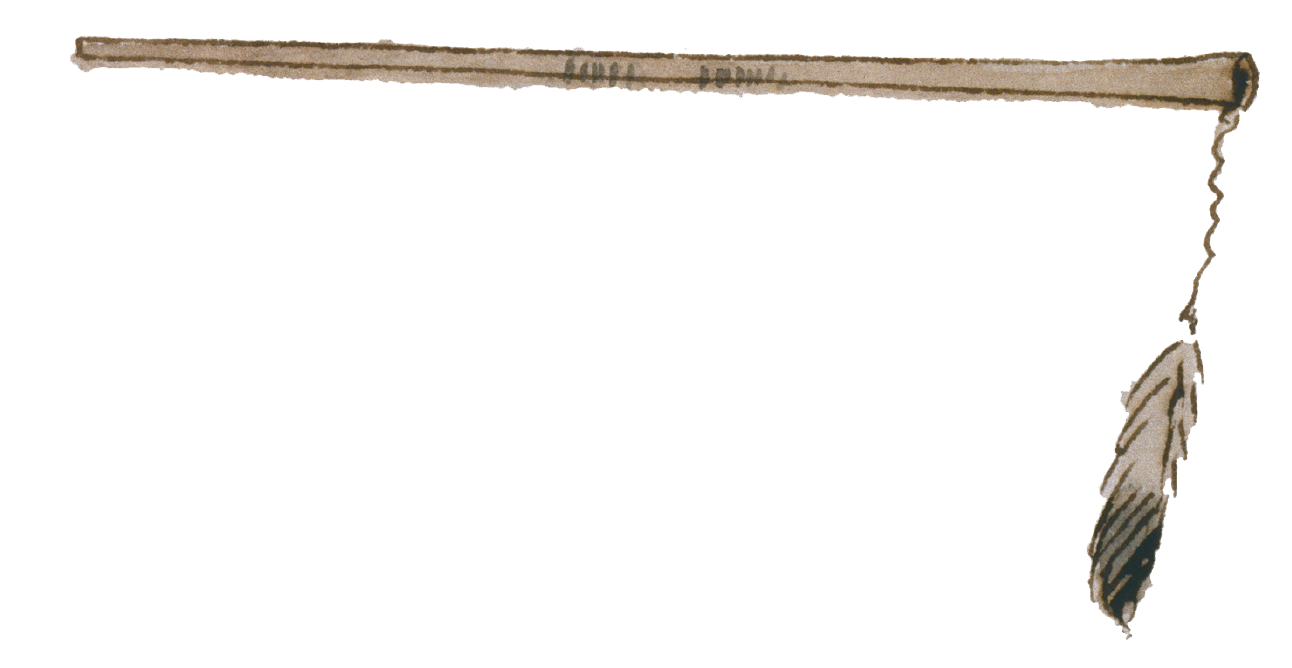
For a long time they gazed with astonishment at the roaring Assiniboine as we departed, and then this whole population followed us for a stretch along the bank. At least thirty Indians, forming an interesting cavalry detachment, occasionally two to a horse, rode along with the ship. Because the willow thicket had come to an end, we had an interesting, unobstructed view of the whole animated prairie. Bunches of colorful horses, a few with hobbled forelegs, hastily fled from our loud noise. The manifold figures of the Indians on horseback and on foot enlivened the green plain: some turned back to their villages in a gallop; others just now came riding at full speed. Here one saw handsome manly figures riding naturally, without stirrups, in saddles resembling [the] Hungarian light cavalry saddle. They called farewell to their friends, the two Blackfoot [men] on our ship, [and] waved to them. One of our Indians played on his pipe, from which he produced genuine children’s music as he opened or closed a small opening with two of his fingers. His pipe, of the kind many Indians of the upper Missouri now own, is a long, hollow stick, widened somewhat at the bottom, with an opening on the upper side into which one blows. For ornamentation, a single eagle feather hangs on a string at the end of the instrument. The whole instrument is about 2 1/2 to 3 feet long, and the Indian does not let go of it all day long.
Because a threatening storm cloud was approaching, most of the Indians turned back; the young riders, however, paid no heed to the heavy rain pouring down and turned back only after the severe storm and rain had passed over. Before us, unique, beautiful mountains. The severe storm forced us to tie up at the left bank for ten minutes. At this spot on the prairie, to the left, there are steep bluffs partially overgrown with thickets.
Before us we had a beautiful, vast view: picturesque gradations of the promontories, unusual domes, and conical peaks in front of the latter. To the left, in the middle of a high wall, stood an Indian, a relative of our Blackfoot, to whom he continually called. They were on the deck. The Indian had tethered his horse at the highest eminence, where one saw it grazing, silhouetted against the sky. To the right, lowlands with dense cottonwood and willow thickets.
After the rain, the Indian climbed up to his horse and followed us along the bank; his big whitish wolfhound accompanied him. The bluffs here to the left are quite high; in these gray hills or mountains there are completely regular coal-black layers, coal or coal-slate, running parallel like ribbons. Beyond a wide valley meadow [there are] high quadrangular hills, completely flat on top and very similar to ramparts, as though they had been artificially artfully created; on them, too, there are black layers. Some of the Indians have followed us. Before the strange hills there is meadowland on which Artemisia [— —] grows abundantly. The Indian on horseback talks with us. The hills continue for a long time; they usually do not have such regular angles but are in part rounded off. Everywhere individual round cones stand before the main range of hills, some like pastries, with one or two ledges at medium height. [These] look exactly like volcanic elevations; others seem to have been eroded by water. They seem to consist of clay or argillite and sometimes have black horizontal strata.
Before us the view is now wide and flat; to the right, flat prairie hills spotted with greenish and yellow patches of grass; to the left, broad sandbars before the hills. On the [sandbars], much driftwood and a green forest thicket, which forms an island during periods of high water. Here the sand has been shaped like ocean waves into round beds. Before the hill range are now also four-sided hill-pyramids, which alternate with round cones. At the location of the above-mentioned island, the valley widens. The river seems to have eroded the valley in a strange way among the numerous pyramids. Lowlands with willows appear before the hills. Also to the right, they become most singular; the chain has jutting domes that are connected with each other. Their front section is angular and pyramidal. The evening sun
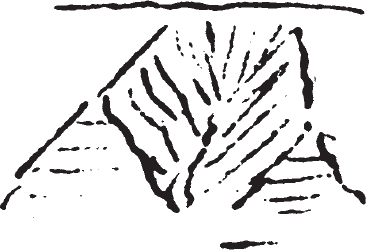 illuminates them in a marvelously beautiful way and, through their shadows, enables one to discern the formation clearly. The northern slope of the hills is overgrown with brush; the southern one, bare and naked.

To the left we now reach a point of land with prairie on a high bank. Here stood several frameworks of Indian lodges; one [frame] was that of a skin [tipi]. Before the hills to the right are cottonwoods and willow thickets. Toward evening the wind abated a little. To the right, in the patch of willows on the bank, [is] a Hidatsa winter village, with low, rather flat huts around them; many trees have been cut down. The sky is becoming more overcast, and a cold wind is blowing again. To the right on the hill, a place with tall dry grass, which looks like a ripe grainfield. To the right, a high cape or bluff where, on a warm day in April, Mr. Sanford once found an enormous tangle of snakes. He estimated them to be many thousands. They consisted of two species: one striped, one yellow-bellied. [In] the holes, of which there are a large number here in the layers of the cliffs, [one saw] their heads, and underneath, especially in a small ravine, they lay coiled together, probably engaged in mating. Many hundreds [were] killed. From a distance several coal-black strata in this wall looked very much like coal. Much Artemisia beneath the hill. A small creek, called Snake Creek, emptied behind this spot. After we followed the bluffs a half mile, another small river, called Miry Creek, emptied from a somewhat flat, meadowy valley opening. On its hills we saw two antelope. The evening was very cool and windy, as was the night.