Journey from New Harmony on the Wabash to St. Louis on the Mississippi and Stay There
Mount Vernon – Shawneetown – Cave-in-Rock – Mouth of the Wabash – Cumberland and Tennessee River – Mouth of Ohio – Mississippi – Commerce – Cape Girardeau – Grand Tower – Devil’s Bake Oven – Kaskaskia River and Indians – Ste. Genevieve – Selma – Herculaneum – Merrimac River – Jefferson Barracks – Vide Poche – St. Louis – The Sauk (Sac) and Meskwaki Indians1 – Black Hawk – Meeting with the prisoners – Preparations for continuing journey

March 20, 1833
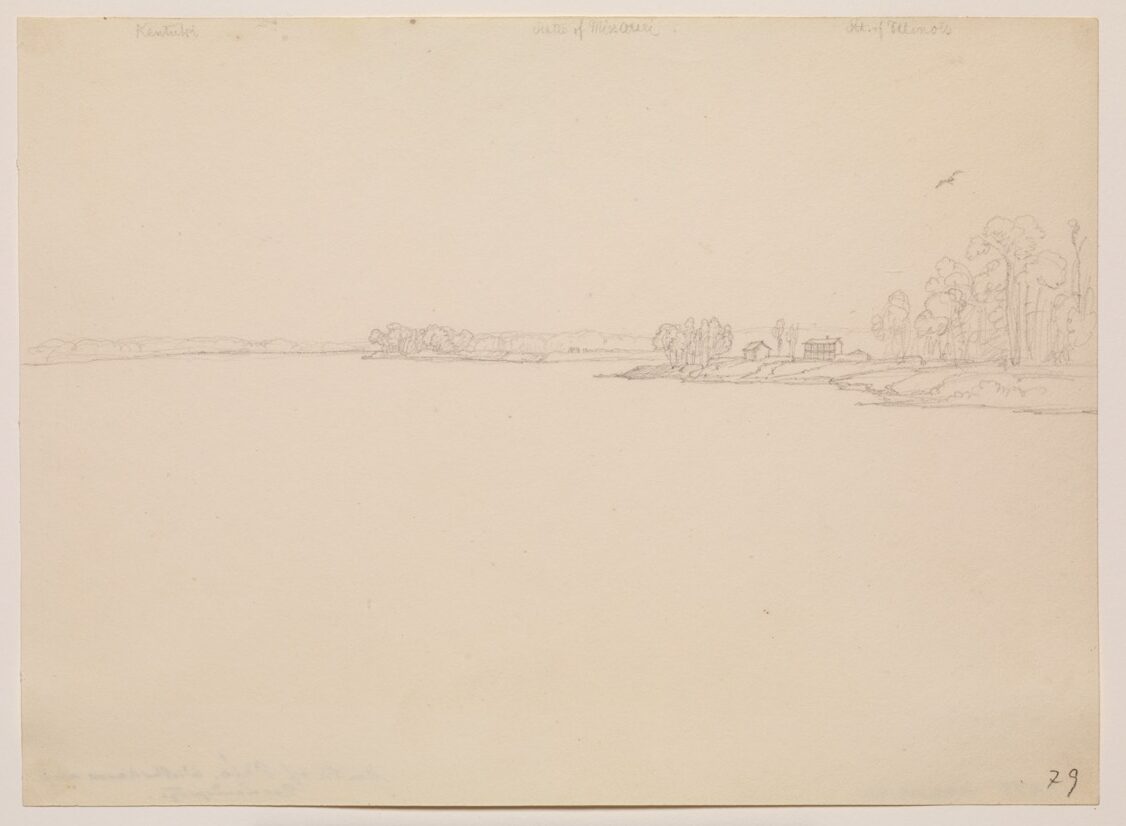
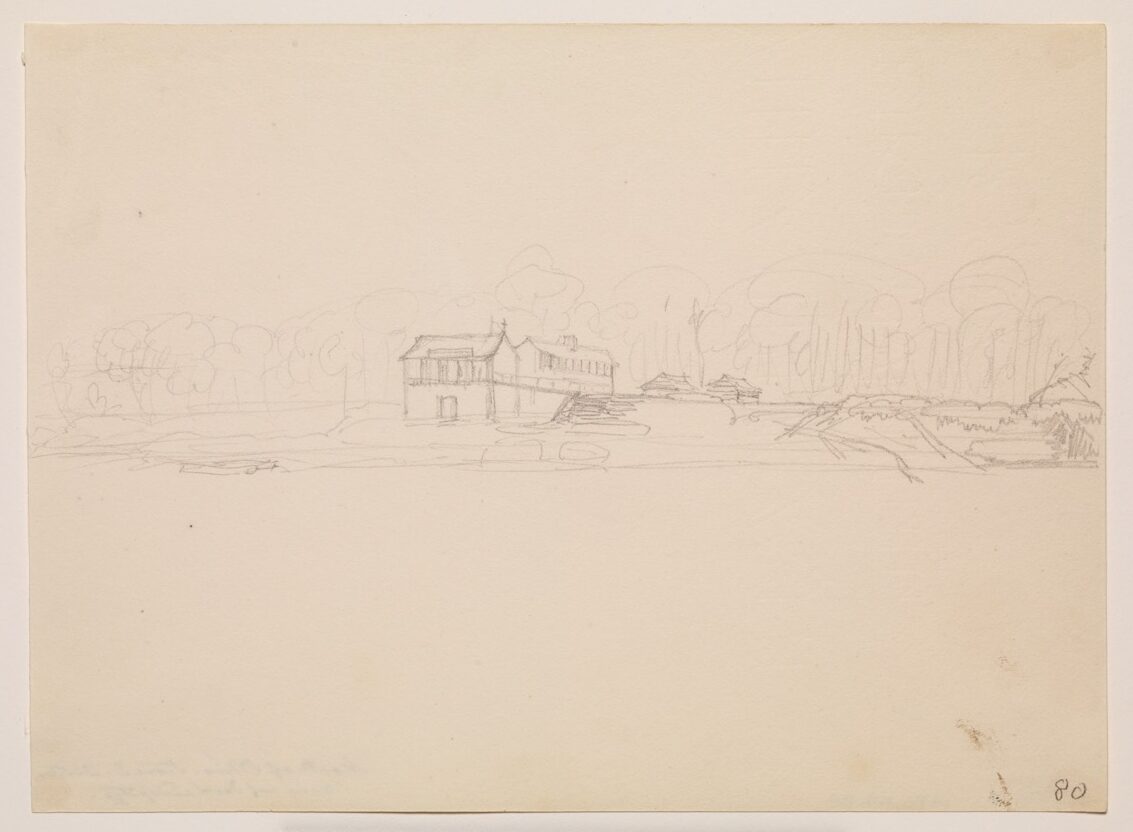
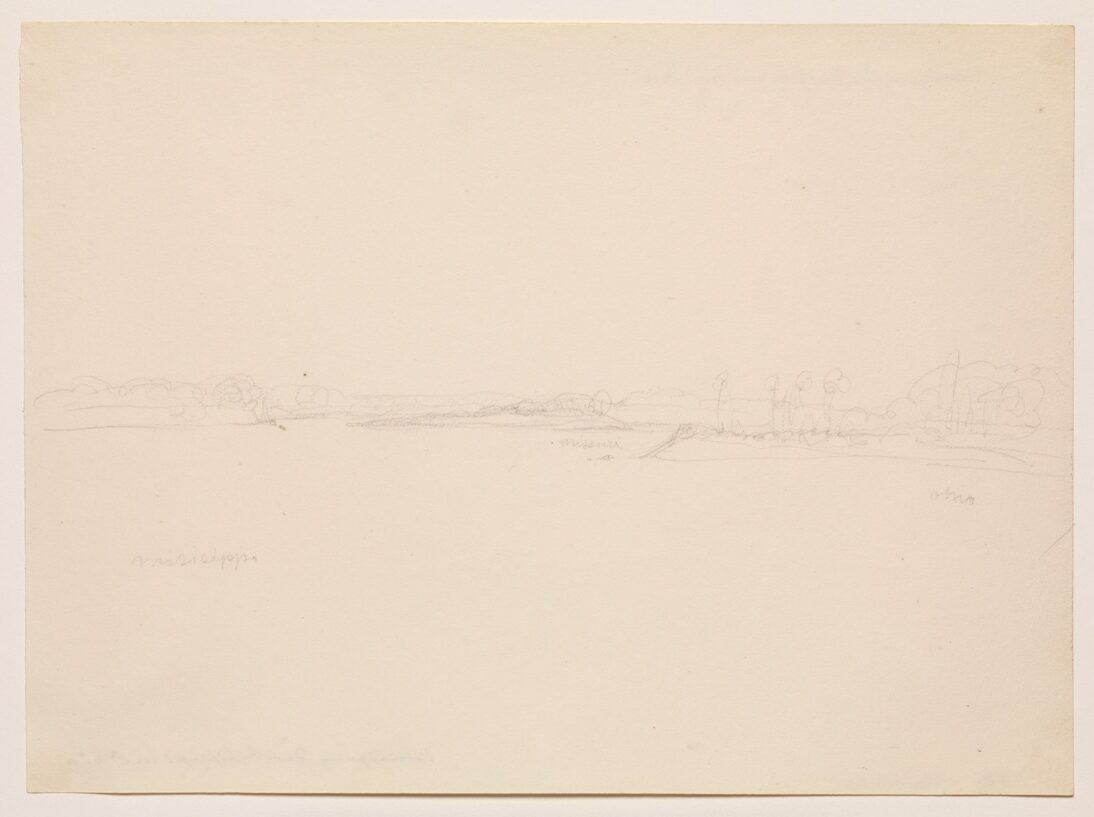
At daybreak this same region; monotonous; very broad river. At seven o’clock we are close to the mouth of the Ohio. During the night three or four steamships, moving upand downstream, passed us. Weather pleasant; sky overcast; the brisk wind, contrary. At seven thirty, temperature of 8°R [50°F, 10°C]. Point of land to the right between the Mississippi and the Ohio with several houses on it. A settlement of four or five houses over on the other side of the Mississippi. The point of land, even the forest, [is] eroded, with a fringe of lone cottonwoods. Here an open space with a tavern, store, and a farmer’s habitation. We stopped and loaded wood.
We visited the store, where many animal skins were piled up, and I bought a fine black bearskin for two dollars. This bear had been killed in the vicinity just recently and her three cubs captured. We saw one of them here at the farmer’s place. It was still very small, and its movements closely resembled those of a monkey. Had no teeth. Its claws (were) powerful and sharply pressed together. They fed it milk, and it was not for sale. The two other cubs were in the neighborhood. The large antlers of an elk (Cervus canadensis) hung outside on the store; they asked too much for them. Both kinds of animals are found in the vicinity. This settlement has no name other than Mouth of the Ohio.
At night twilight we passed Trinity (6 miles from here). We sailed into the Mississippi and followed its left bank upstream. Here it is as wide as the Ohio. Its water is the same color. The bank is steeply eroded and covered with fallen timber; on the top, overgrown with tall cottonwoods, rather young and slender. Low banks with tall, slender trees all around; strips of cottonwoods and willows in front. To the right, wild forest scenes, destruction of the timber; all of it lying crisscross like an abatis.
On the bank to the right, the dried-up woodlands are entwined with vines into tangles. Ahead, marvelous gradations of the picturesquely wooded banks. Small, green, round clusters of Viscum [are] all over the tree branches to the right. Snags in the water; here one can navigate only by day because the river is now low.
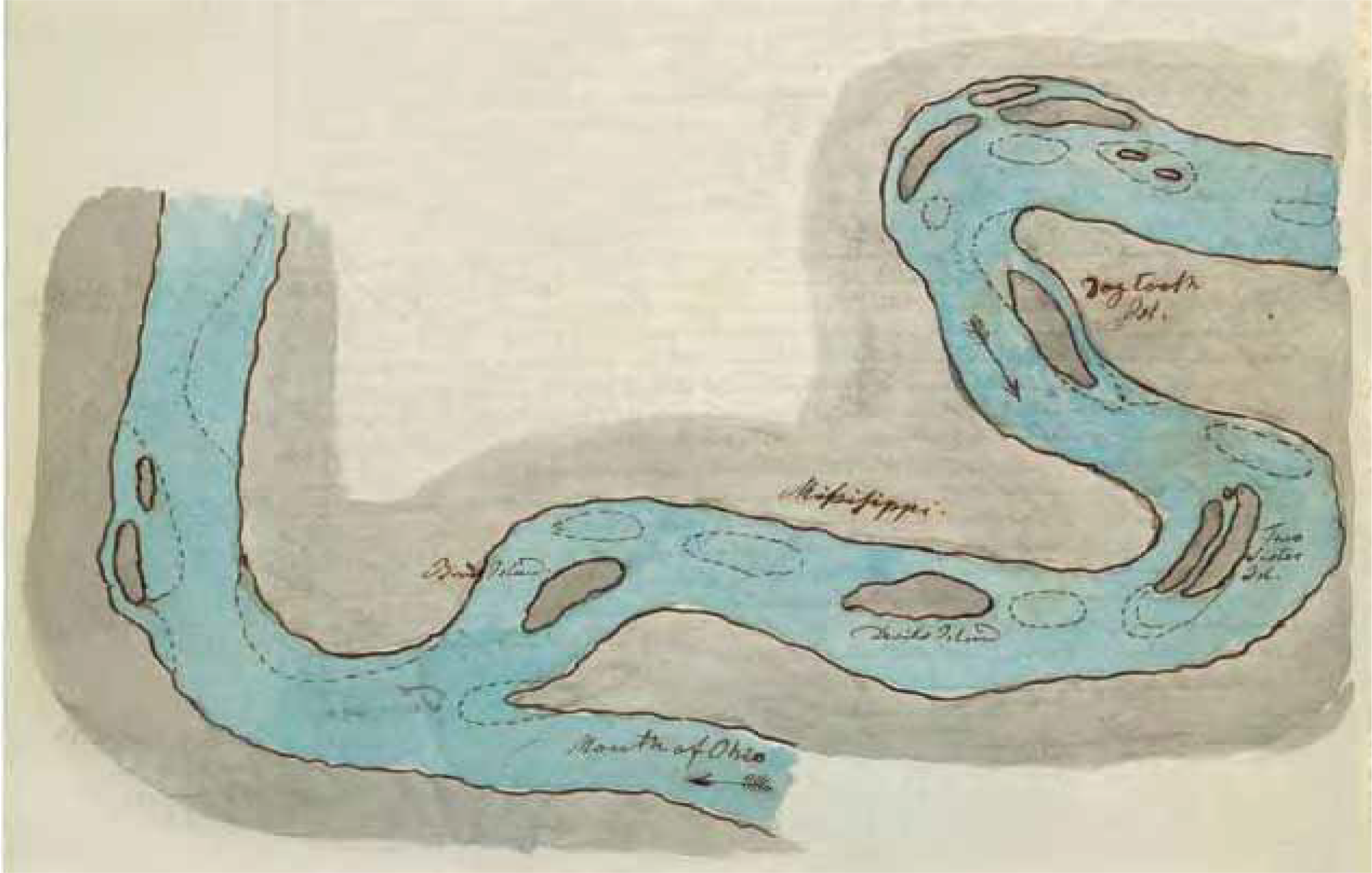
To the right, a new wooden house on the bank. Then Birds Island follows. Ducks fly off ahead of us. All these islands have tall cottonwoods and willows on the bank, often with willows before them, all of them still without a trace of green. Also before the forest on the mainland, a fringe of cottonwoods and willows. Birds Island remains to our left. To the right, sandbars and yellowish-reddish willows on the bank. To the left, cottonwoods with wildly destroyed timber. Devils Island [is] undoubtedly the Elk Island of The Western Pilot, for these islands are often given various names.
Beautiful view of the river. Water very shallow. The lead is tossed out continually. In an hour the ship covers 5 to 6 miles against the current. Tip of Sister Island overgrown with fiery yellowish-reddish willows; here the river makes a big bend to the left. To the left, low sandbars along the point of land; logs and snags before them in the river. This whole large spit is exposed white sand on which there are extensive deposits of large tree trunks and wood fragments, some of them piled up high; behind them, willow thickets and forest. This area of sand is usually covered by the river. Sunrays very beautifully illuminate the orange-yellow willow thickets on the bank.
At eleven o’clock, luncheon. We reach Dog Tooth Island to the right, with a white sandy beach before it. To our left is the steamboat O’Connell, which has firmly run aground and has unloaded its cargo on the flat sandy shore. There seems to be lead lying on the bank.
On all the banks, densely compact fringes of cottonwood trees, an absolutely dense stand of pole-timber, which grow together with tall, slender trunks; they are all of the same height and in a novel manner determine the character of this river. Some of the large islands are completely covered by them. The steamboat Companion was coming toward us. Wind very strong; sand blowing around in the air. Extensive sandbars at Dog Tooth Island. Wild prospect of broken timber on the spit to the right. Large uprooted trunks lie about pell-mell. At twelve o’clock, temperature of 14 1/2°R [64. 6°F, 18.1°C].
After lunch, soon after we had rounded the tip, we put in at the right bank to take on wood, for which we paid five dollars (two cords). Here there were high, steep, sandy banks. A small, pitiful planter’ s hut, open on every side, made of beams; the sides of the hut were made of upright boards that let the wind blow through everywhere. Two miserable beds inside, the wife with a pipe in her mouth busy by the fire, a miserable wooden fireplace. The husband was just coming out of the forest with a boy. Both of the other children looked pale and sickly. One of these girls was occupied planting onions in a small, freshly prepared garden plot. A few cattle, five or six young pigs, and a pair of Turkish ducks (Anas moschata) were walking beside the house. Several ears of corn lay in a small wooden container.
We went into the tall, dense, beautiful forest beginning immediately behind the house [and] became keenly aware of spring. It was very hot here, since the wind did not penetrate this far. There was undergrowth throughout the forest, 10–15-foot-tall spicewood (Laurus [— —]) everywhere, covered with yellow blossoms, like Cornus mascula in Europe. Even from a distance one could already see the yellowish-greenish trees. The cut wood has a very aromatic fragrance, like Myrica cerifera. In the forest there were tall, sturdy trees, densely compact, and very many vines. On the ground, pretty Fumaria bloomed everywhere with beautiful yellow blossoms and delicately tattered leaves. In front of the house, which was right on the bank, stood a tree around which a beautiful Bignonia radicans wildly entwined.
After a half-hour stop, we continued right along the bank. The wind was very strong; the boat was tilted somewhat; the river made waves. Three-quarters of an hour later, we found large sandy areas ahead of us along the bank to the right. We steered completely to the left. Urubus hovered above the tall forest to the right. There were individual, small log houses in the forest; cordwood [piled] here and there. Curious view to the rear. Here, too, the sand from the bank was lifted into the air like dense dust clouds. The left bank was steeply eroded, [with] wildly broken-down, rotten wood: branches and huge trunks.
The river soon forms several branches and surrounds several islands. The center one, Powers Island, according to my Pilot, remained to our right. To the left, a high bank with wildly toppled trees. The island has its fringe of cottonwoods. Soon afterward, tilled fields and dwellings, with numerous piles of cordwood for the steamboats. Spicewood blooms in the forest. Near the bank a wild goose, which someone shot at. To the right on shore, urubus; to the right we still have the same island. At a certain place it reveals how islands are sometimes formed in these rivers. At one place the bank had caved in and revealed piled-up layers of huge tree trunks with their crowns peering out. On such accumulations sand is deposited and, gradually, earth, on which willows grow first, then cottonwoods, and finally hardwoods.
We sailed close to the banks, terribly eroded and mistreated by the current. The wind drove the ship still more to the side, and suddenly we were aground, even though the Paragon had a draft of only five feet. The engine stopped. A sounding was taken. They pushed with poles, let [the ship] drift backward, finally let it swing sideways, and ten minutes later we were afloat. At last the large island came to an end; instead, there was a small one to the left and another one to the right. 50 Cottonwoods on the bank, like brush bristles. Otherwise everything is forest.
As soon as we passed these islands, we reached a small village to the left called Commerce, which is situated on a rocky hill. As [is the case] here generally, and especially to the left, rows of hills begin that are very interesting. Pieces of limestone lie on the bank like ruins, and cedars immediately appear again, though not as numerous as they are near Cave-in-Rock on the Ohio. In the bedrock one frequently finds individual limestone boulders like pulpits. The forest now seems to be diminishing somewhat in height, especially the Platanus, which are quite enormous in Indiana. Several miles farther to the left, there is a settlement where one can even see attractive green grainfields.
Twilight [presently] fell, and we took shelter from the raw night air below deck in our Paragon. At nightfall we lay to at the Missouri bank near a recently built house. A stairway of roughly hewn wood led up to the top of the steep, 50- to 60-foot-high bank. A big fire was kindled on top, and we warmed ourselves by it. The captain sat on the steps. The tall forest trees, especially Platanus, [were] splendidly brightened and reddened by the flames. Afterward we entered the small but clean hut, which was well caulked on all sides, and conversed with the lady of the house. Their previous hut had burned down, whereupon they built this one. In this region bears are not numerous; on the other hand, deer (Cervus virginianus) are.