June 30, 1833
Early in the morning, rain; fierce, cold wind. The fireplaces were lit in the rooms. It is horrible to watch the Indians, with their completely bare legs, wading around in deep mud in this cold weather. In such weather one cannot leave the house and suffers from the cold in one’s room. At this time of year it is unusual to have such weather here, for usually this season is very dry; in the spring, however, it is wet. Fall is usually beautiful; winter [is] severe and long lasting. One makes use then of dog sleds, but the snow is often too deep (four, five, six feet) for traveling. The past winter was unusually mild along the upper Missouri; the river was frozen for scarcely three days. In general the climate is exceptionally healthful here. There are few diseases, and the good drinking water of the Missouri, which is cool and easy to digest, contributes not a little to this situation. This cannot be begrudged the inhabitants of this region, since there are absolutely no doctors here. Various persons whom I asked about this matter remarked, “We don’t need doctors here, because there is no sickness.” Last spring, however, there was said to be more sickness than usual here along the Missouri. In some years head colds occur not infrequently, but one must bear in mind that people here often expose themselves to the elements [and] do not take care of themselves at all, and their habitations are usually poor.
At 7:30, 54°F [12.2°C]. Today Mr. McKenzie gave me some information about the fur trade of the American Fur Company. Along the Missouri itself, the game and fur-bearing animals have decreased to an extraordinary degree in a few years, and in ten years this business will no longer be significant along this river. To the extent that the number of animals here [has] decreased, the American Fur Company has extended its activity more and more and thereby improved increased its profit. They now employ about four to five hundred persons—primarily engagés, French Canadians, but also individuals from all nations—who are distributed in various places. At each fort and with every Indian nation, they keep interpreters, mostly half-breeds, most of whom speak French. Besides the company’s paid employees, there are trappers (who catch beaver and otters in traps) in the Rocky Mountains and the other regions of the interior and hunters who hunt and catch animals on their own initiative. They deliver their beaver, buffalo, and other hides to the company, [in return] for which they are provided with all their essential needs. Such persons, often highly enterprising [and] carrying out their tasks at the risk of their lives, are stationed everywhere. In summer, parties of well-armed men on horseback, sufficiently strong to be able to face hostile Indians, are sent out to take supplies on packhorses to the various stations. Such a group, led by Mr. Fontenelle, was mentioned earlier on the Little Missouri, or Teton, [Bad] River. [I] have occasionally referred to the forts and trading posts that the company has maintained as permanently established trading posts along the Missouri. It has many other smaller ones, however, [each post] manned only in winter [in] a poor log house set up just for this period of time. The neighboring Indians then bring [in] their hides for sale. At present, twenty-three trading posts in all, including the forts, are occupied along the Missouri and in the interior, including the Rocky Mountains, wherever trappers and hunters roam about. All these people are hunters, because they earn their livelihood from hunting exclusively and live entirely on meat.
Here is a list of the various species of animals according to the value of their skins, as well as the number of hides obtained in the course of one year.
- Beaver: about 25, 000 hides.
- Otter: about 2,000–3,000 hides.
- Bison hides: about 40,000–50,000 hides.
- Fishers: about 500–600.
- Marten: (stone marten) about as many.
- Lynxes (the northern): about 1,000 to 2,000.
- Wildcats (Felix canadensis): about as many.
- Red foxes: about 2,000 hides.
- Cross foxes: about 200–300 hides.
- Silver foxes: about 20–30 hides (these often bring 60 dollars a hide).
- Mink: several thousand.
- Muskrats: about from 1,000 to 100,000.
- Deer (Cervus virginianus and [C.]macrotis): from 20,000–30,000. From Council Bluff on down, almost nothing else is bartered by the Indians (particularly the Iowas, Kansa, and Osages), except large numbers of hides of Cervus virginianus, but game is decreasing rapidly there, too. One obtains almost as much for them as for bison hides.
- Elk (Cervus canadensis): Its skin is too thick and heavy, [so] it is used more for personal use than for export and sale.
- Buffalo hides are taken entirely from cows, because those from bulls provide leather that is too thick and heavy.
- Antelope and bighorn play little part in trade; the hides are used for clothing, and the meat is eaten.
A very profitable business is anticipated for the year 1833, because the Blackfoot nation is bringing in all its hides, and even the Indians near the Fort des Prairies, an English trading post, want to sell their furs here. Wolf hides are not in demand by the company, that is, no hunters are sent out to procure them; on the other hand, those that the Indians bring are accepted to keep them in a good mood, and then they are sold rather cheaply, about a dollar a pelt. Frequently the Indians have nothing to trade except their leather shirts and blankets. These, too, are accepted in large numbers in exchange for merchandise, but there is little profit in this.
The five members of the Fur Company are Messrs. Astor in New York, Chouteau, Cabanné, Pratte, and McKenzie, [as well as] Laidlaw and Lamont. Messrs. McKenzie, Lamont, and Laidlaw have a share in the fur trade on the upper Missouri above Council Bluff. Today I received the hide of a buffalo calf or cow with painted hieroglyphs from the Blackfoot Indians. Here is a precise copy.
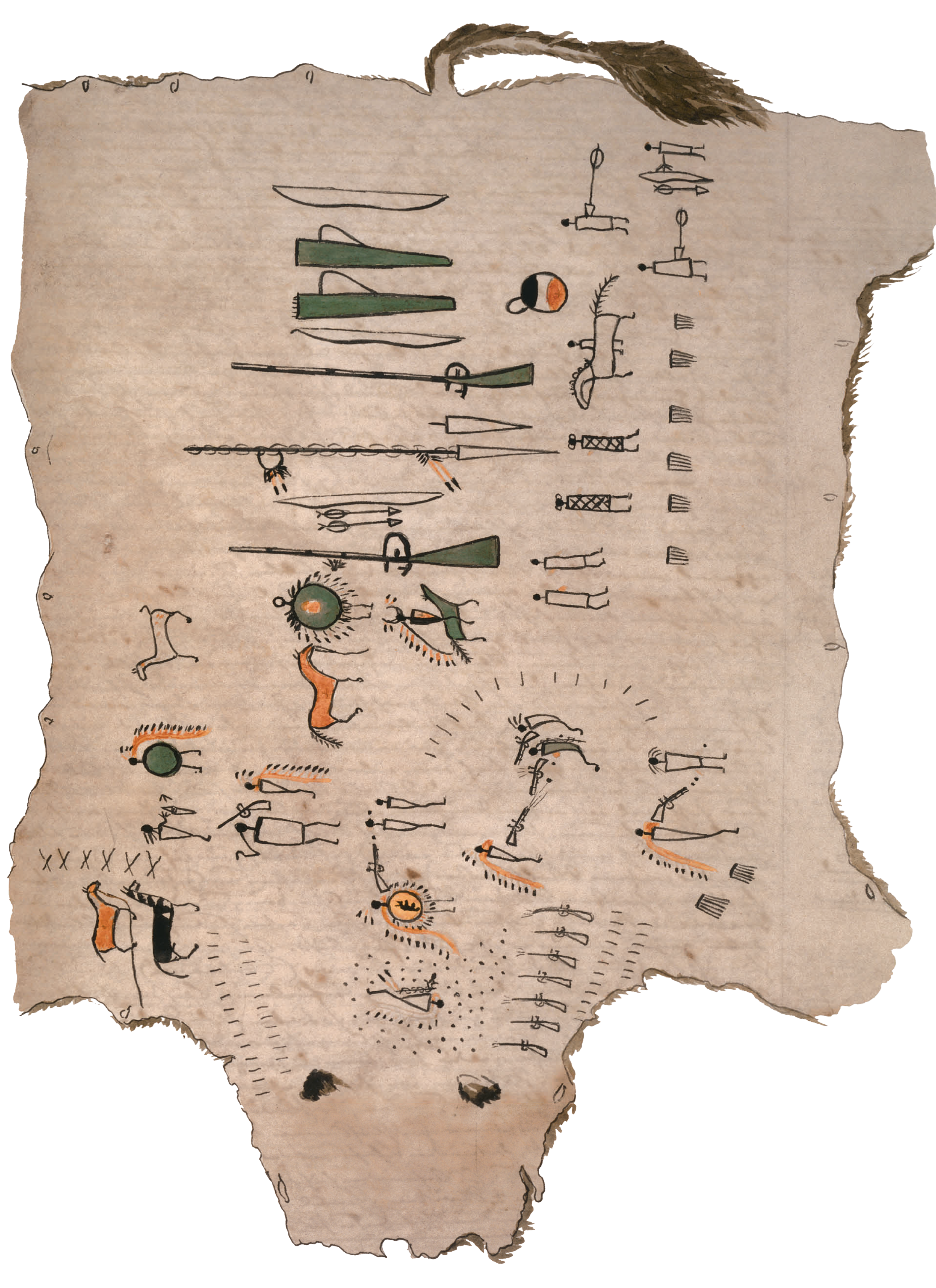
From the red horse on top, one sees how the Indians let the ropes on their horses drag along the ground. Represented here are the deeds of an outstanding warrior, who wears the long feather bonnet by which he can be recognized [in] all the individual deeds represented here. In several places one sees illustrations of the bullets that flew around him and which he shot through the body and head of others. Wherever he wounded other persons, blood from the wounds is indicated. The painter (undoubtedly a woman) did not, however, have a good red dye but used a yellowish red earth for this purpose on the buffalo hide instead. The captured guns, bows and arrows, scalps, and stolen horses are all indicated. The women are drawn differently than the men; their bodies are not pointed beneath but quadrangular. The hero has also killed several women; each is portrayed with an arrow sticking into her body. Below the green illuminated bows he had taken, a tricolored shield (parflèche) is depicted.
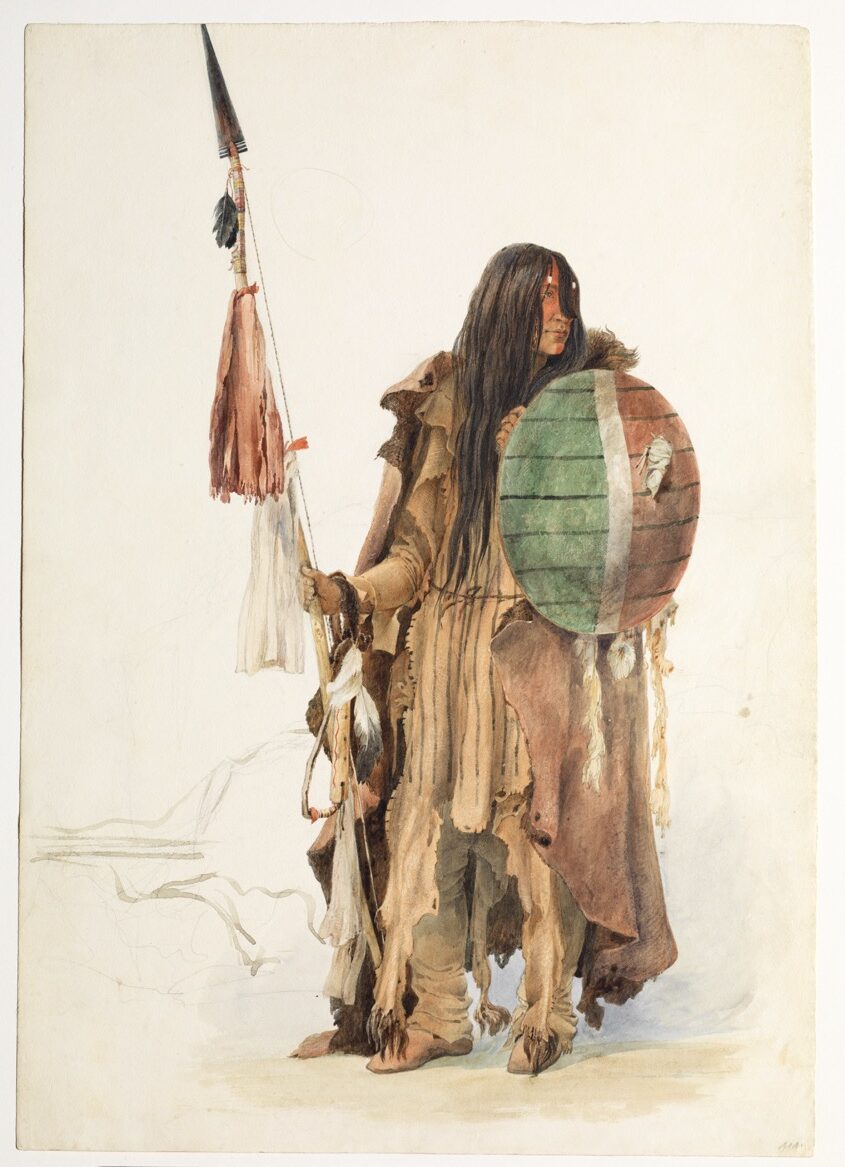
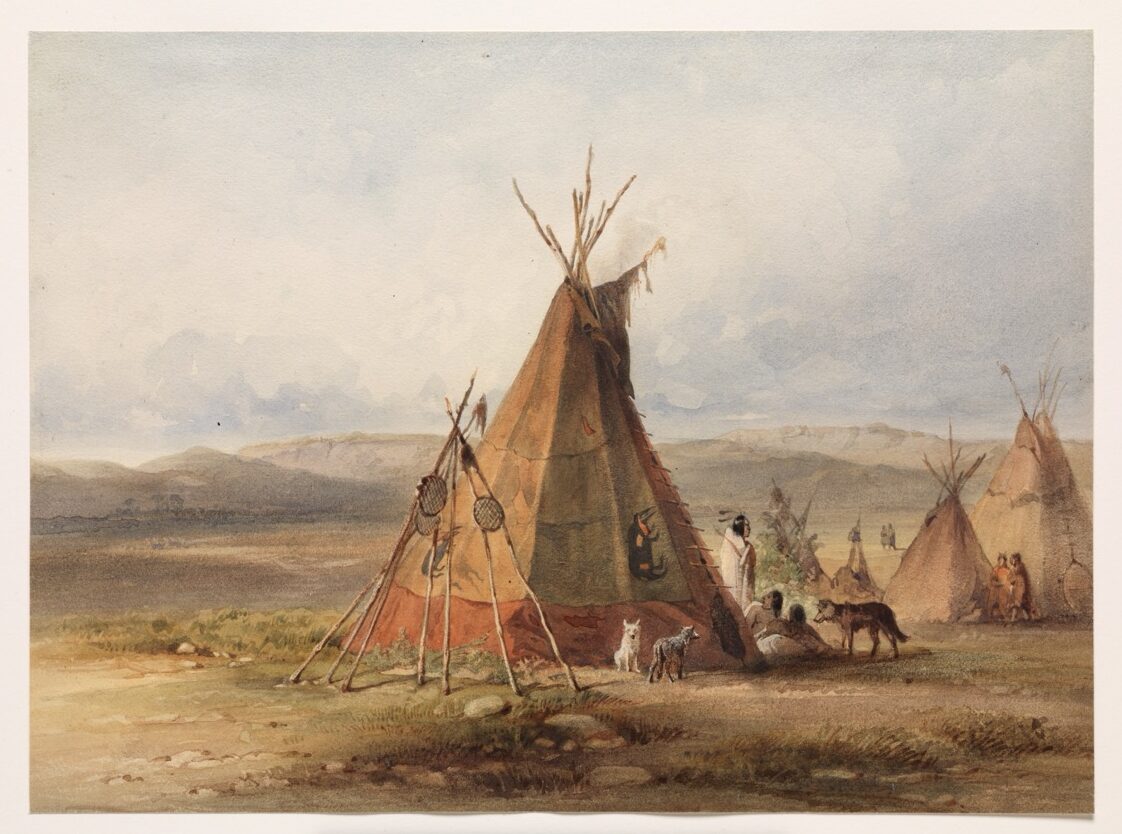
The Indians sat in our room all day, while Mr. Bodmer sketched the young man with long hair. They smoked all day, while it rained and stormed. About noon the weather cleared up somewhat. At twelve o’clock, 56°F [13.3°C]. Even before noon individual Indians arrived. While we were at lunch, a handsome man in an especially fine costume came riding up to our house. Mr. McKenzie gave the order to barter for his costume. After lunch we went out and, near the fort in an easterly direction, found a camp of twenty-five Assiniboine [tipis]. They had completed this work in half an hour, and the women—all of them small, some of them not ugly, with vermilion-painted faces—were very busy. One saw them beside all the [tipis] with a special tool, digging sod, which they placed in large pieces along the bottom edges of the [tipis] so that neither air nor water could penetrate. A [tipi] like this does not last longer than a year. Beside [them] they always place poles together, in a conical form, on which they suspend the equipment for their dogs. Travois trailing shafts function as poles of this kind because they have this shape: 
One [tipi] stood out: it was probably that of the chief. It was painted ochre-yellow and had a broad, reddish brown [band] at the bottom. On each side a big grizzly bear was painted in black; on the head above the nose, a small, scarlet-red scrap of cloth always fluttered in the wind, probably a talisman, or medicine, as the English call it, a magical or protective device that these people highly prize and always carry on their person. They never wanted to surrender such things to us unless [we] made them a very generous offer. Our young, long-haired Indian who was painted today (as already mentioned, his name is Pitätapiú) stated that a small package fastened on the outside of his shield (parflèche) was his medicine. When he goes to steal horses, it protects him and brings him luck.
In the camp we were visiting, we saw women returning from the nearby forest with large loads of dry wood and green foliage. They were so heavily laden that they panted, deeply bent over. All these heavy tasks must be performed by the women, who, despite their small stature, can accomplish very much. Dogs lay around in packs outside the huts; they looked just like wolves, of all kinds of colors but mostly spotted black and white, completely white, or of the genuine wolfcolor. As emaciated as skeletons, they could scarcely stretch out their sharp backbones, and they all picked up old bones scattered in great number on the prairie; at the same time, they bared their wolves’ teeth at each other. They were not as bad toward strangers as the dogs of the Crows (Corbeaux), which had attacked us so violently at the Mandan village. If they wished to attack our legs, then the Indians kicked them back very ungently.
We had not been in the camp very long when, from the west along the woods on shore, we saw the whole prairie covered with Indians. Most of them came individually, with their loaded dogs creeping along, scattered about. Yet we soon saw the men, about sixty in number, advancing in a closed column. They advanced without music, both chiefs at their head, and came as far as the gate of the fort. There were many old people among them, including one who moved along rapidly with two canes. I also saw several with one eye; recently a cripple, who was no taller than 3 or 4 feet, visited us in the fort. His legs were short, crippled, and crooked; his head was perfect, as was his upper body, and his face was lively and witty, as is usually the case with crippled people. He had a fine, complete costume, beautifully embroidered with porcupine quills, and rode a good horse swiftly and skillfully.
The chief of the newly arrived band (his name is Pitätapiú General Jackson) was a handsome, well-built man of very dark color and ornately dressed. Over his beautifully embroidered black leather shirt, he wore a new red wool blanket. A medal hung on his chest; he had earlier been in Washington. This entire column marched into the fort and there smoked their pipes, whereupon whiskey was again distributed to them.
At seven o’clock we went before the fort and viewed the new camp of forty-two pitched [tipis]. The view was very nice. The [tipis] lay in a crescent; all the fires gave off smoke; life and activity everywhere. We saw extremely entertaining scenes. Here, boys were shooting their arrows high into the air; there, a small, brown, monkeylike child was set on the ground, and a circle of hungry dogs stood around. In one of the huts lay a very sick man; the medicine men were inside and chanted with all their might. A crowd of people peeked in through small openings, and we did the same. Afterward the men, side by side in groups of three, went away, the middle one a little ahead of the others, and chanted until [they reached] their [tipis]. From here we went to the other camp and there bought a most attractively made cradleboard in which the women carry their children on their backs. It was very neatly decorated with colored porcupine quills and embellished with long, colorful strings; [it had] fur on the inside, and only the child’ s head could be seen. Soon the fort was [going to be] closed, and we turned back.