July 26, 1833
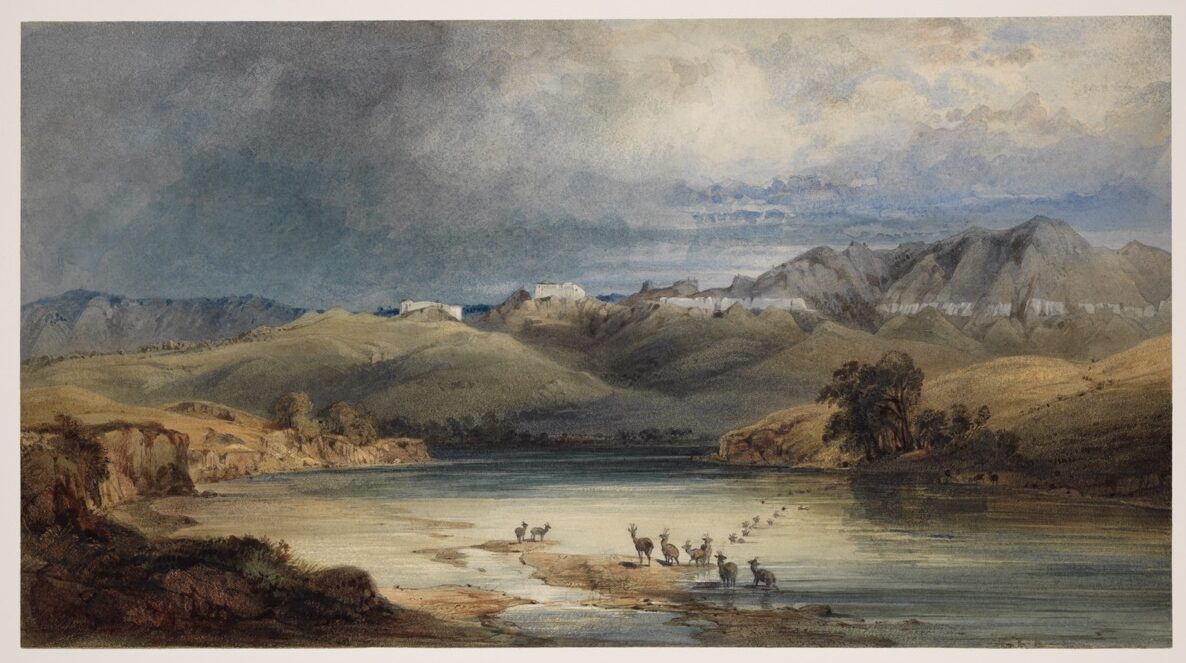
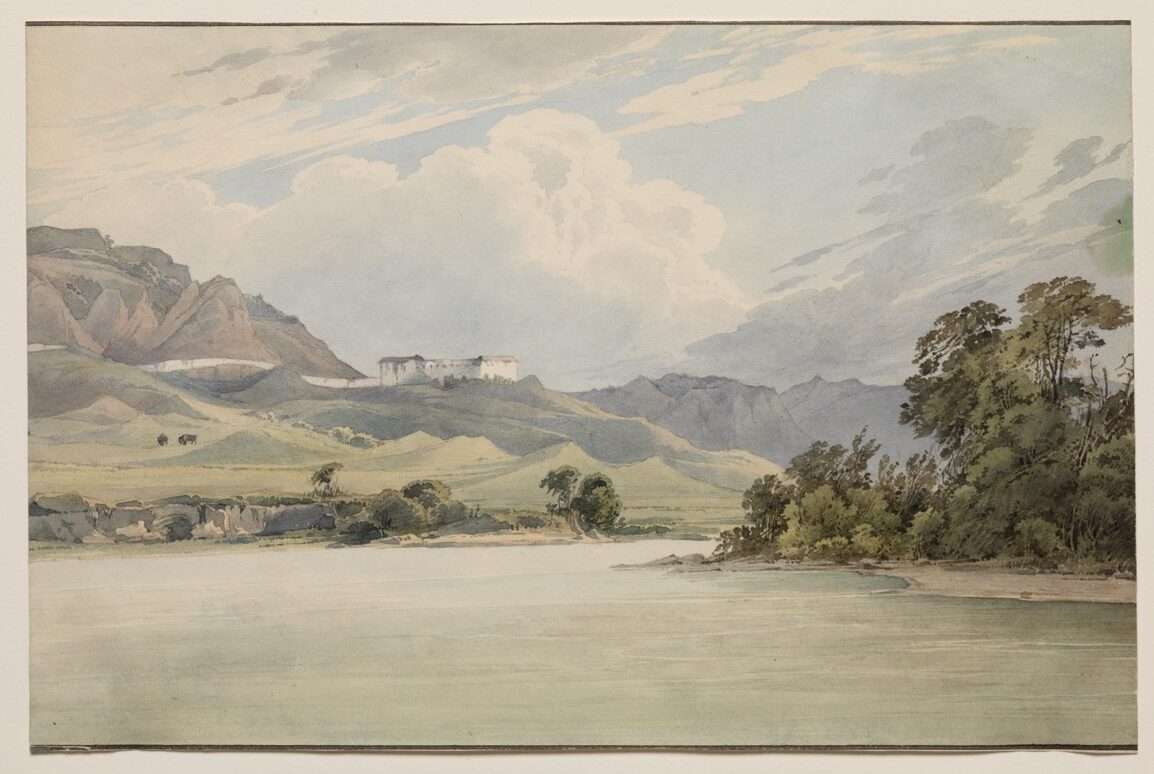
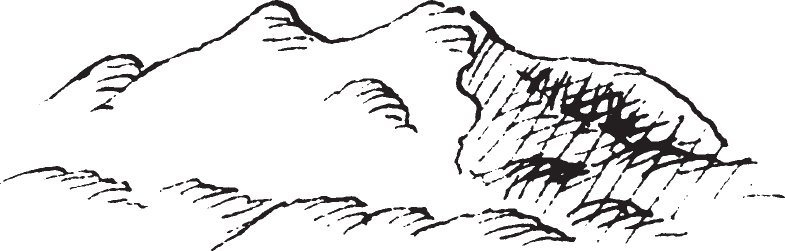 Beautiful, clear morning. We cast off early, and to the right alongshore we had the dark gray, forked mountain of medium height. Six hundred to 800 paces beyond our night quarters, on the left bank, a [dry] creek joined the river. Here we ran aground, took in the men on the cordelle, and then went back to the other side of the river and had them pull the cordelle again. The river now turned right; on the left bank on top of the hills was the formation referred to yesterday, similar to the mountain castles, which today we called the White Castle. Although closer examination somewhat reduces the similarity, we can still regard this strange mountain dome as a wall. To the right of it, the white earth layer extends along the entire mountain, and the so-called castle is a remnant of the layer at the place where it was interrupted. The castle looked like this:

To the right on the bank, a wolf was howling, [and] we soon saw [it] sitting on a hill; it, too, was of the white variety. When we had navigated around the promontory to the right, we saw several Indian hunting huts on the bank, one of them built with thick pieces of wood around the trunk of an old cottonwood.
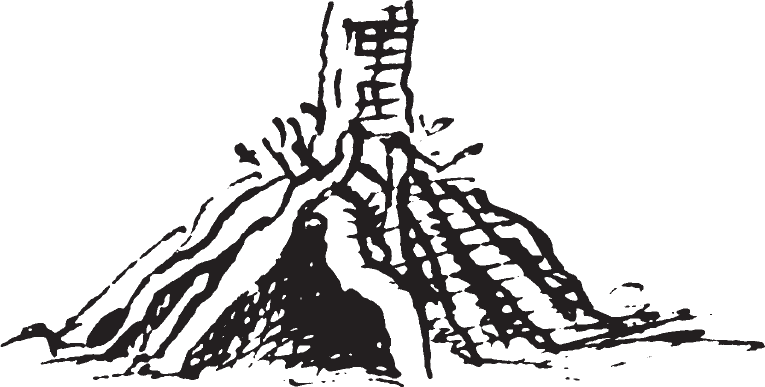 To the left we had a distant rugged, lofty view into the lateral valleys surrounded by tall jagged domes. They bear a resemblance to the Alpine valleys of Switzerland. The wolf was still howling; it probably had an empty stomach. Someone brought me a most delightful live ground squirrel (called écureuil suisse) with five long dark stripes on its back and lighter ones between them. I tried to keep it alive.
At 7:30, 73°F [22.8°C]. Mr. Mitchell, Culbertson, and the hunters went hunting after breakfast. On the ship there was repeated shooting at wild geese. Lowlands again appeared before the mountains, [and] the region seemed flatter to us. On the right bank, we had a prairie before the elevations, with steep, torn clay banks along the river; hills opposite, before which lay a border of cottonwood and willow along the bank. At ten o’clock Mr. Mitchell returned; he had not seen anything. On the hill chain to the left, which is now flattening out, stood several strange pyramids like some of those we drew in the sketches. The mountains receded from the river, and the region is flatter again. A beautiful wooded area on the left bank, where Messrs. Mitchell and Bodmer went to hunt.
At twelve o’clock, 82°F [27.8°C]. We were aground for a while. When we were afloat again, we pushed upstream with poles in the middle of the river, then manned the oars and rowed to the left bank, where we halted under the willow thicket. To the right and left the mountains appeared lower than yesterday but with several high, outstanding domes nevertheless. The mass of hills, pale brownish gray; the domes, now generally whitish. We continued by pulling on the cordelle. On the right riverbank before the hill chain there was a level prairie, before which the riverbank, 10 to 18 feet high, was steeply cut off and streaked with parallel strata. The strata were grayish brown with a lighter and darker whitish color: all clay, perhaps some sand, which is rare there. About one o’clock Mr. Mitchell returned; [and] the helmsman Morrin had shot a doe (Cervus virginianus). We navigated upstream along the left bank and, to the right, soon had a beautiful wooded floor again, on which were our remaining hunters: Deschamps, Papin, and Culbertson.  Here in [these] clay mountains, one [comes across] odd sandstone balls, very heavy, which occasionally, like one we found today, are double; often they are large, like ordinary case shot. Soon we [were to] find more and larger ones. In the left bank of the river, which consisted of oddly eroded, dry, crumbly clay, and on which one saw conic notches and other points, there were numerous landslides, some very deep, so that one runs the danger of breaking in and falling far down.
On the prairies the Gryllus species are now so numerous that the ground teems with them. They and their young ones hop around in every direction, and one can hear a continual rattling and rustling noise where dry foliage is still on the ground. A rather large grasshopper that emits a whirring sound in flight is common here. Their wings are whitish or greenish with a large black spot, the tibia a lovely orange-red, their wing-covers a dirty whitish color with three transverse bands. Dreidoppel, who was on land for a while in the afternoon, found fragments of stones and pieces of rock everywhere, as I had already observed yesterday, proof that we are approaching the stony, or rocky, regions, which soon will completely displace the clay hills.
The river became very narrow and made an extremely sharp, abrupt bend to the right. [The] left bank, which had to sustain the thrust of the water, was so strikingly eroded that all the clay walls had been split and torn into thousands of fragments, cones, pegs, and pyramids, which our men on the cordelle could struggle across only with the greatest difficulty. The entire tract is completely bare and grayish brown, the pieces of clay high and extremely steep and always on the verge of caving in. The heat was very great; the men had to drink, and they lay down, with danger to themselves, heads down and legs up in the air. On the opposite side the nearby point [of] land was overgrown with dense cottonwood and willow thickets and [had] a flat sand spit before it. Before one gets around [that], the river is at most 100 paces wide; beyond the bend it measures about 180 paces. Behind us [were] tall, striking clay mountains with strange domes, and before us, a similar, not so high, hill chain, with two higher whitish domes, between which lay several smaller ones. To the left there [was] forest along the bank.
In the steep bank to the left, just in the bend, nest swarms of swallows, which my hunters shot at. Dreidoppel brought down the first one, and Mr. Mitchell was kind enough to send the boat, or dinghy, for it right away. Bodmer went along underneath the steep wall and bank but did not bring anything back. The killed swallow was probably a young bird (see my Zoological Diary page [— —]) of the species Hirundo fulva. We navigated upstream along the right wooded riverbank. Here Mr. Culbertson came to us, but not yet the other hunters, who at that time still had not shot anything but two great horned owls (Strix virginiana); they had not seen anything but a deer. We reached an island [at] the left and traveled to the right along it. On the bank above we met Deschamps and Papin, who had not shot anything but a deer. Deschamps had skinned and hung up his great horned owl. Dreidoppel and Bodmer went out on the right alongshore, Bourbonnais and another man a little farther, to hunt.
Soon the river turns left again, and to the right is prairie with a high, steep clay bank; forest opposite with [a] sandy point. After a hot day, the sun set; the swallows flew low above the river, looking for mosquitoes, only to make room soon for the night swallows, which here are rightly called mangeurs de maringouins [mosquito eaters]. The men coming from land brought big cicadas (locusts) with them. They caused [these insects] to buzz at will. The [locusts] produce a strong, whizzing sound. In some places the right bank was hanging over quite far, and the keelboat passed perilously enough just beneath it. At other places [the bank] had collapsed terribly and lay in piles of debris, steep as a wall and about 30 to 40 feet high. In some places the men [found] it very difficult to climb over. We had passed a rather dry creek to the right.
We crossed over to the left bank; here I got out with Mr. Mitchell, and we went along the bank through a sparse forest, where I did not see any animals except blackbirds and wild pigeons. The thorny [— —] shrubs were blooming here; they were tall and large, and my clothes were full of [their] yellow pollen. I saw very few interesting plants. After about half an hour, we found a nearly dry creek with steep, high clay banks, at the mouth of which we waited for the keelboat. The four hunters on the opposite side were taken aboard; Dreidoppel and Papin had each shot a common deer. The mosquitoes and flies had greatly tormented us during our walk. The evening was splendid; the sky completely clear and calm.