Four-and-a-Half Months’ Stay in New Harmony
Description of the region – Natural history – Messrs. Say, Lesueur, and Owen – Hunting excursions in Indiana and Illinois – Wabash, Fox River – Illinois prairies – Albion – Black River – Mr. Bodmer’s trip to New Orleans
December 26, 1832
In the morning, dreary, hazy, and damp weather. At seven thirty, temperature of 10°R [54.5°F, 12.5°C]. The ice on the Wabash (that is, on the Cutoff River) was already completely broken up yesterday. Toward noon, a visit at the homes of Messrs. Say and Lesueur. The latter has been occupied the whole winter identifying and classifying his Ohio, Wabash, and Mississippi fishes according to Cuvier’s Règne animal (2nd ed.), which I lent him. He works in his museum or cabinet, where many stuffed animals, some of them very interesting though poorly preserved, are arranged. He has accumulated many interesting objects here.
At twelve o’clock, 13 1/2°R [62.4°F, 16.9°C]; in addition, windy and damp. In the afternoon, a walk to the Wabash. Far and wide there is no longer any ice; only in a few spots were small pieces still lying along sandbars and banks. In a few days this extraordinary change of temperature was [very] detrimental to the ice. The sunshine was so warm that one perspired even while walking at a slow pace. On the Cutoff I saw a duck that seemed to be the [Anas] clangula. The ground was very soft and muddy to walk on, but the young of the various grazing domestic animals felt very well in this unusual warmth, which today, the 26th, was 13 1/2° to 14°R [62.4° to 63.5°F, 16.9° to 17.5°C] in the shade, whereas on the 21st we still had −11°R [7.3°F, −13.8°C], and on the 23rd, −8°R [14°F, −10°C]. Under the tall trees on the Wabash, I found twigs of mistletoe (Viscum purpureum?), torn down by the wind; it is green evergreen like European Viscum album but has far broader, rounder, and shorter leaves. Nuttall (The Genera of N. Amer. Plants, vol. 2, p. 235) lists only Viscum album as an American species, but this variety growing along the Wabash and the Ohio is very different from the European one.
After the dance many planters rode home again. Some of their horses stand tied for days without fodder. All the riders use bridles without curb, just snaffle bits, and most of them have good English saddles, which are made in the cities or towns. With their large, four-horse wagons they are now bringing big loads of Indian corn to Harmony. Then they tie their horses to the wagon for feeding and give them several ears of corn.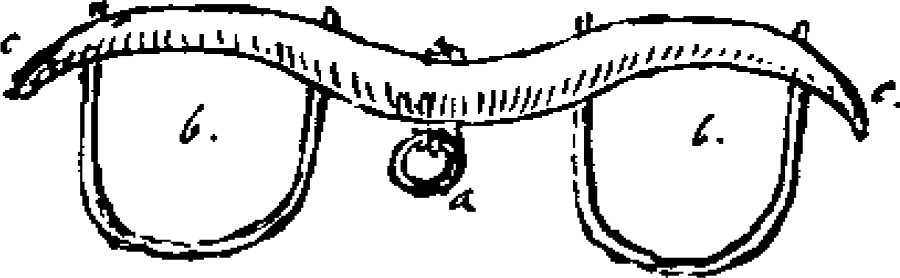 Often, too, they use four or six oxen, which here, however, are yoked in a very inappropriate way. The yoke is a long, thick, curved piece of wood through which two metal hoops are so inserted underneath that they encircle the necks of the oxen. Hence they do not pull with their foreheads, but with their necks where they have far less strength. I have often observed their powerful exertions in order to pull a heavy load through deep mud, whereby the wagon drivers exhort them in a peculiar way and produce all kinds of strange sounds.
Mr. Bodmer, who up to now had been sketching, went out after I did. He found prairie hens and partridges, one of which was brought to me. In the evening we went to visit Mr. Say.