Journey from New Harmony on the Wabash to St. Louis on the Mississippi and Stay There
Mount Vernon – Shawneetown – Cave-in-Rock – Mouth of the Wabash – Cumberland and Tennessee River – Mouth of Ohio – Mississippi – Commerce – Cape Girardeau – Grand Tower – Devil’s Bake Oven – Kaskaskia River and Indians – Ste. Genevieve – Selma – Herculaneum – Merrimac River – Jefferson Barracks – Vide Poche – St. Louis – The Sauk (Sac) and Meskwaki Indians1 – Black Hawk – Meeting with the prisoners – Preparations for continuing journey

March 25, 1833
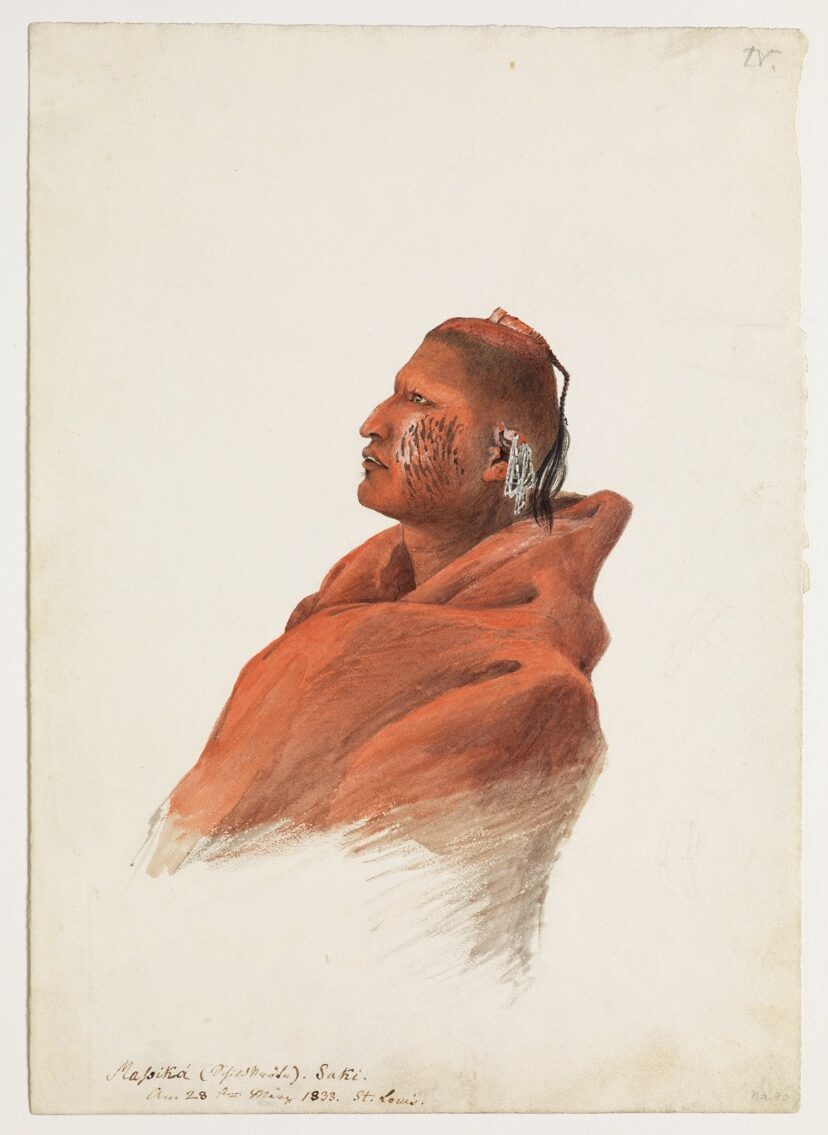
In the morning a steamboat arrived with many Indians from the two tribes of Sauk (Sac) and Meskwaki (Fox). They have come to appeal for the release of Black Hawk and their compatriots in the barracks. We hurried into the building near the water that had been assigned to them as temporary quarters. On the riverbank we saw a crowd of people, and among the Europeans, strange-looking figures wrapped in red, white, and green blankets. When we reached them, they were already in the building. My first view of them, which, to be sure, astonished me greatly, nevertheless revealed to me their great similarity with the Brazilians and that they are absolutely of the same race.
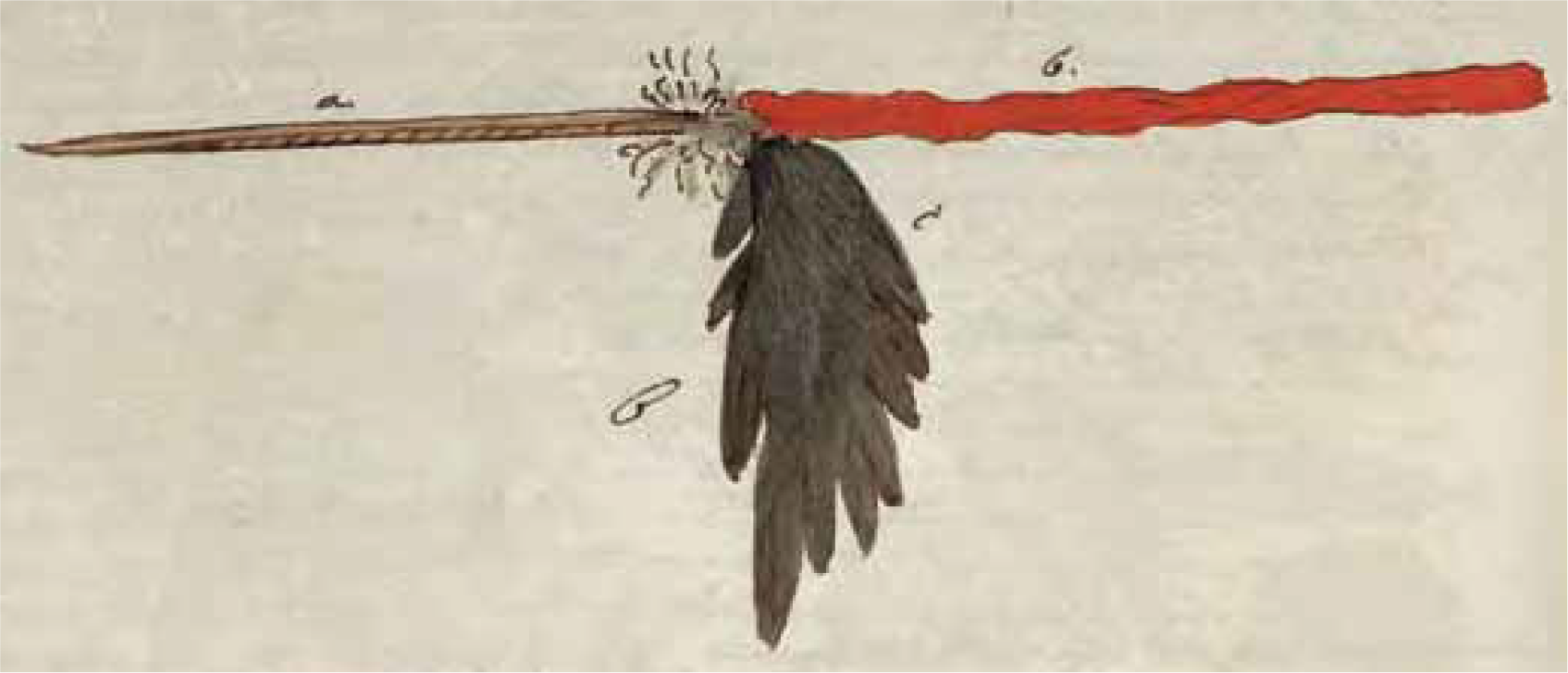
They are strong, well-built men, some of them at least ten inches [approximately 6′] tall. Most of them have broad faces and sturdy bones and features. Some of them, though by far not the majority, have somewhat aquiline noses. Hair and eyes black, teeth mostly very white and strong, their arms not thick, their calves usually thin. As in the case of the Brazilians, skin often dark brown [and] extraordinarily heavily smeared with paints. Their heads are mostly shaven; only on the back of the head [do they have] a tuft of hair with a lock, which they braid in order to fasten to it an ornament of red and black horsehair, which in the Meskwaki language is Wauah-peuan (pronounced through the nose, shortly and indistinctly).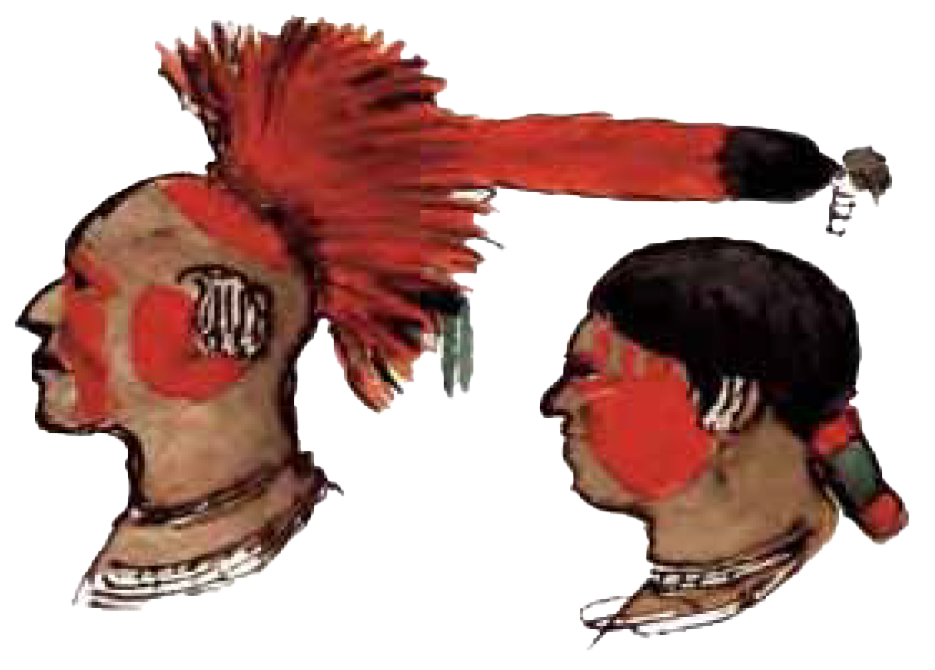 In the middle of this red lock of hair they fasten individual long feathers, black at the tips or completely black, with the white section often dyed red, too. Their ears are pierced along the upper edge with three or four holes, and from them hang short strings of blue and white wampum, like tassels. They wear similar strings of many strands around their necks. They differ from the Brazilians in that they often have coarser features, and their eyes are less often drawn down in front. Many of them bear an extraordinary resemblance to Chinese.
The women have large, [undecipherable] heads; their hair in back is wrapped in a thick, short tuft in green material, red on the end and on top. Some of them had not completely shaved their hair, which is often let grow in the winter since they would otherwise be cold. A robust young fellow wore his hair pomaded straight up on all sides. In the case of a few, the rim of the ear had been cut loose; this resembled the earlobe of the Botocudos [of Brazil], except that instead of a plug there were rings and wampum strings hanging from it.
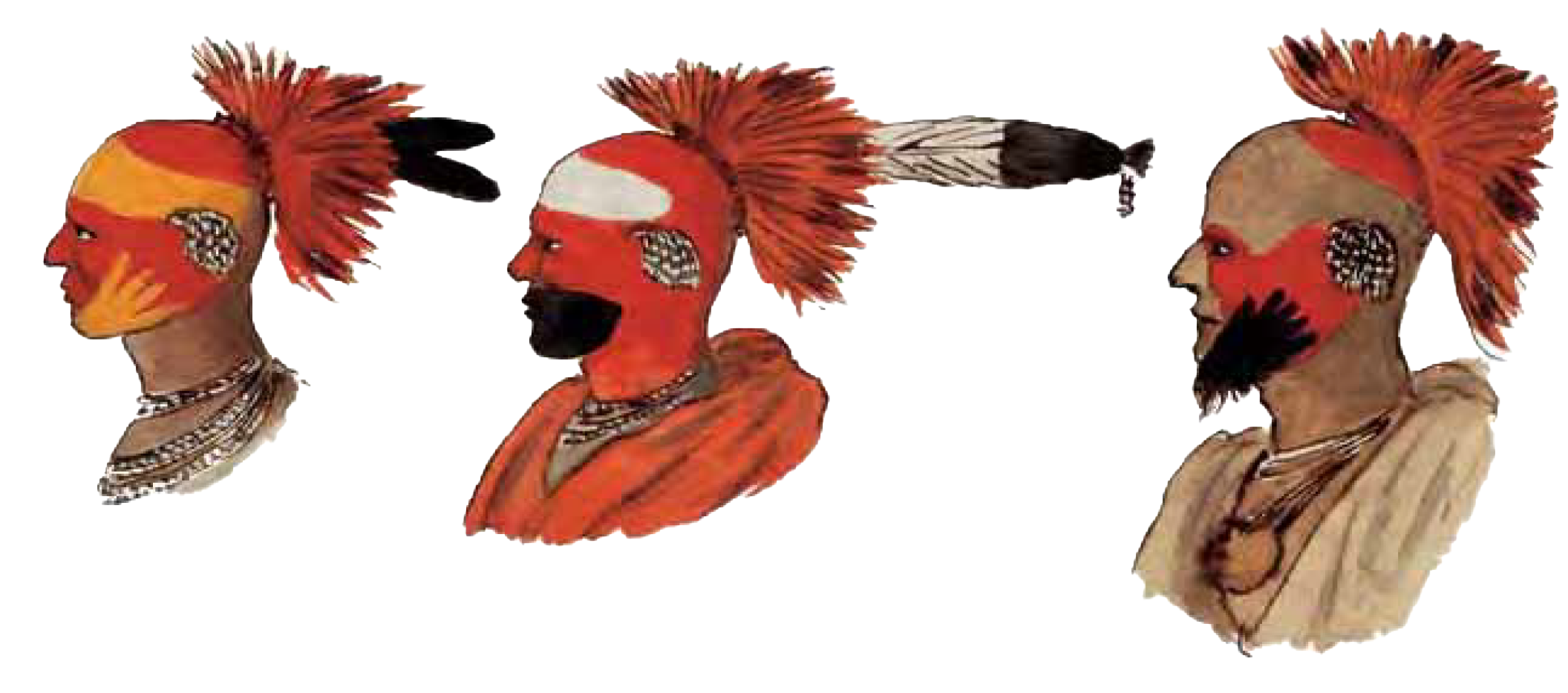
All of them had painted their faces more or less red, mostly in the following manner; but they differ in this according to individual taste. In the case of most of them, the area surrounding the eyes and ears is red, often also the cheeks. With others, the entire head is completely red, except for a white spot on the forehead and a black one around mouth and chin; this gives them a fearsome appearance. Some had the face painted red and the lower part of the face black, or on each side of the chin, a black or yellow hand with outstretched fingers. In the case of most of them, the top of the head was red.
The Meskwakis painted themselves red and yellow: [the] upper part of the head and face, as well as the area around their ears, red; band around the forehead and [painted] hand on the cheeks, yellow. In the case of several, the long feather was white and black, as it really is since it is from an eagle. In the case of others, the white part was colored red. The horsehair crest is always red, now and then with several black tips or side tufts. Within it, along the back of their heads, they carry a long perforated instrument of bone or wood with this shape with part ‘a’ hanging down.
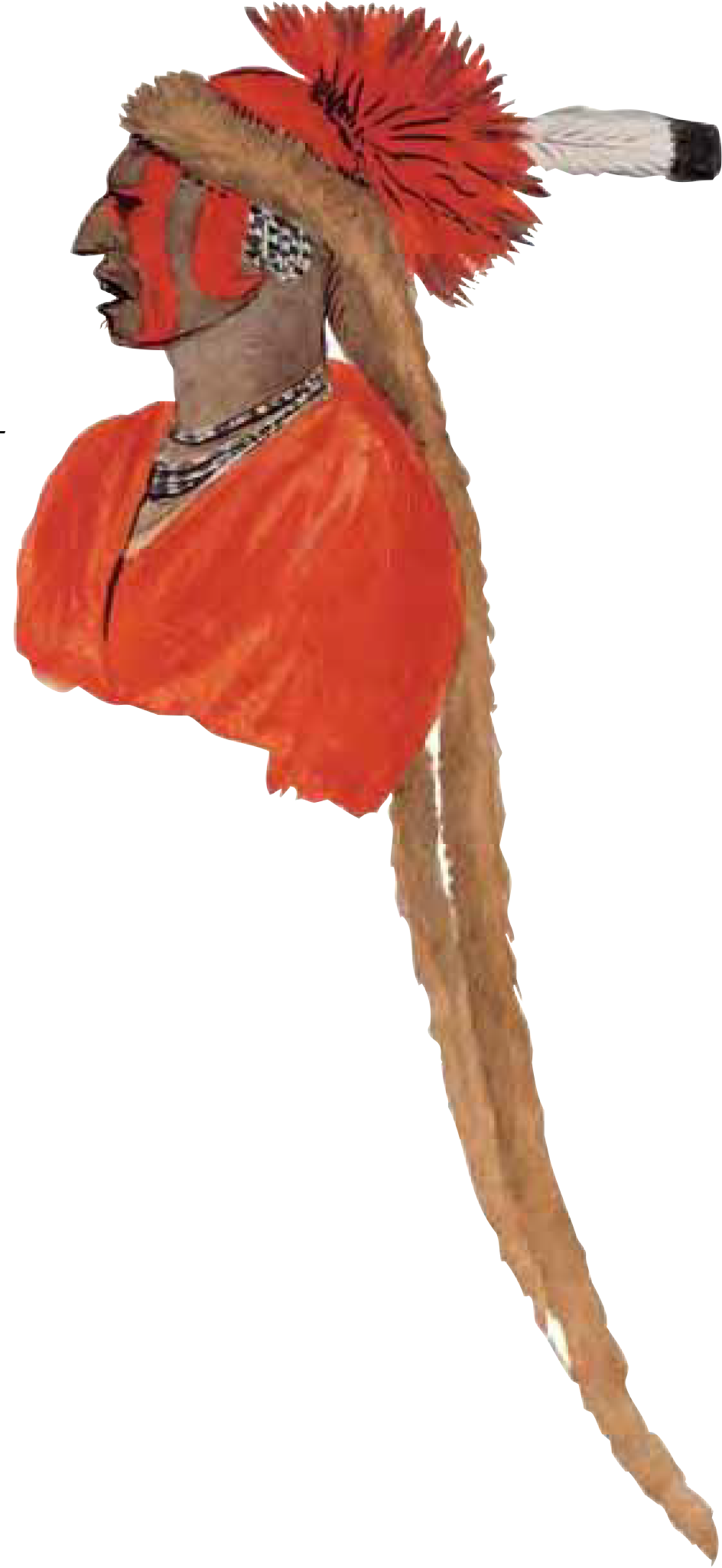 A tall, handsome man of the Sauk had a height of ten inches [approximately 6′] and a nice bold face, sometimes wild, sometimes very expressively friendly. His black eyes sparkled and his snow-white teeth gleamed in the dark brown face, which was partly painted red. On his forehead he wore a long, beautiful band of otter skin with ornaments that hung in double strands over his shoulders down to his heels. His long feather was white and black, his woolen blanket red.
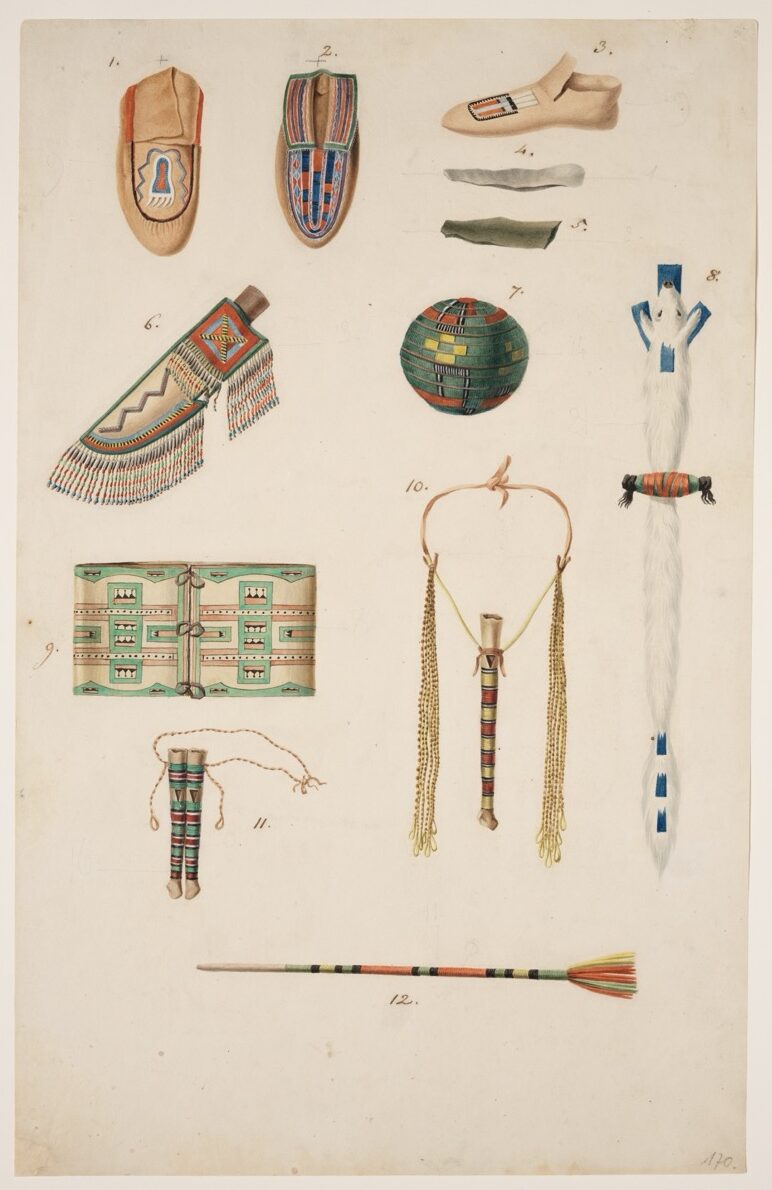
Others [were painted] yellow on top of their skulls, and one of them [had] light-green spots on his red face. All of them were wrapped in woolen blankets, mostly red; others had green and white ones. When they took off their blankets, some had clothing of green or multicolored calico, the sleeves with a kind of ruffle [on] the wrist, neck, and chest. The belt, decorated with glass beads and often nicely wrought; in [this] a knife in a sheath is fastened.
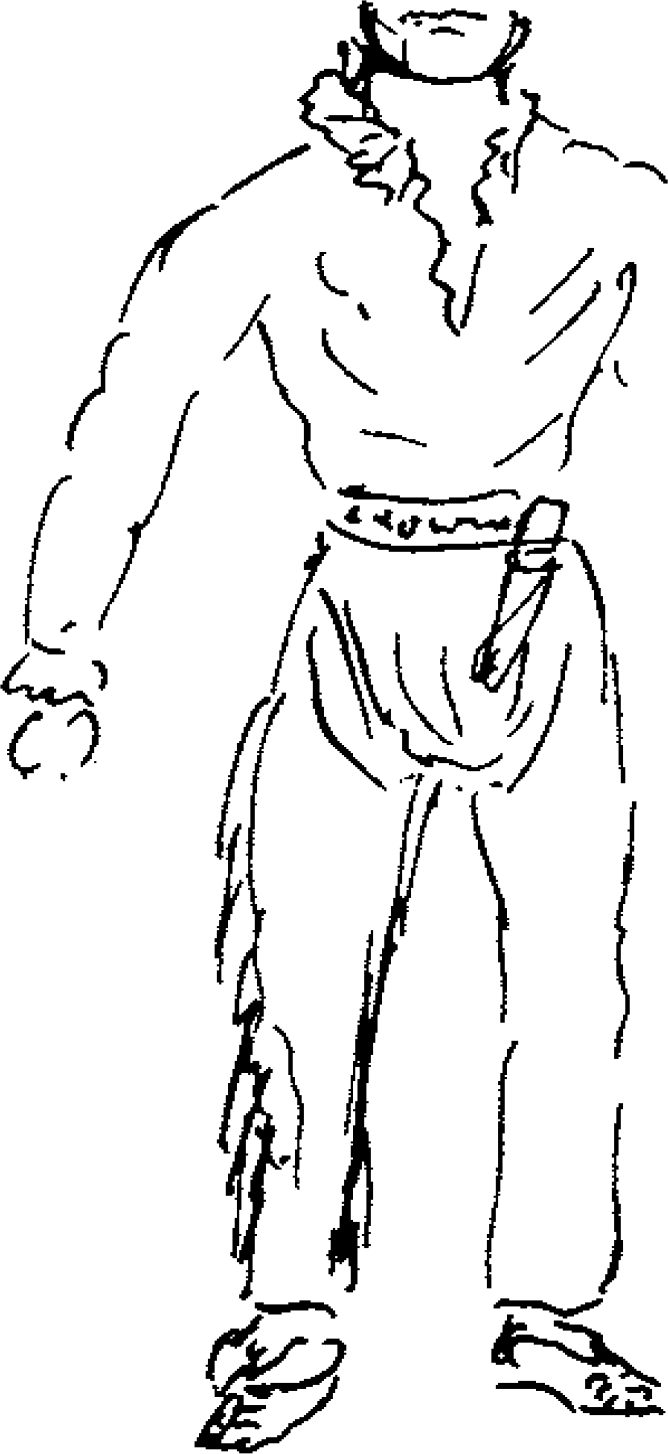 The pants (leggins) [are] made of leather, as well as the shoes (made in the Indian manner, folded over at the edge below the ankle). They are often artistically adorned with needlework on the instep; they are, furthermore, like the pants, made of deerskin.
Underneath their woolen blankets, however, many of these Indians were naked above the waist. Most wore brass necklaces and arm rings. Several bore a striking resemblance to the Botocudo I had seen along the Belmonte in Brazil, such that I could have mistaken them for the latter. They also have the same coloring as most Brazilians.
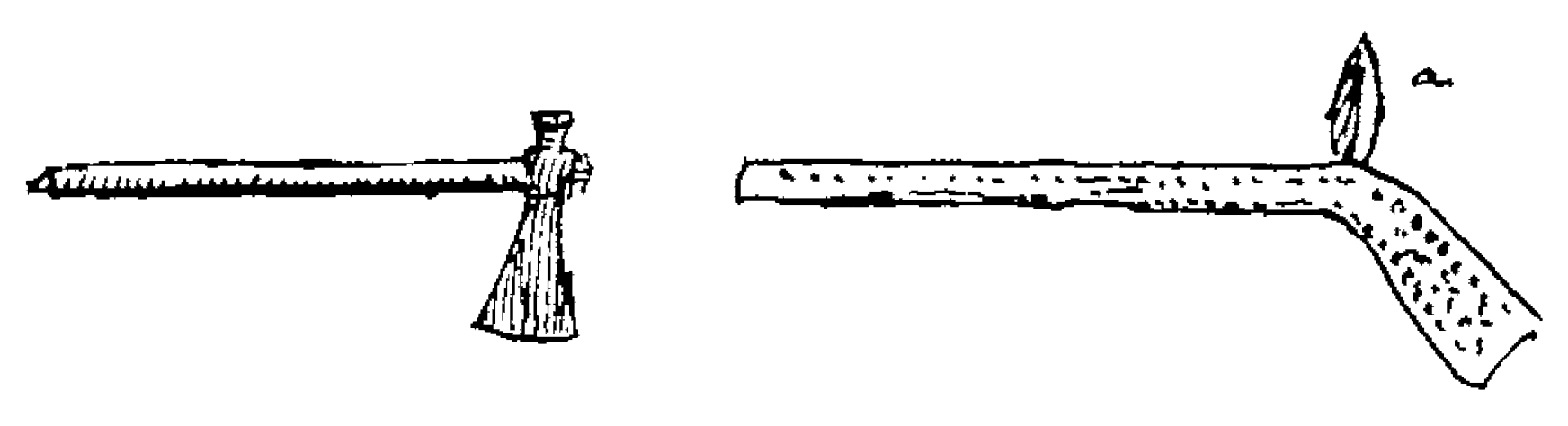
In their hands, the 30 to 40 men all carried their weapons, such as tomahawks, iron battle-axes made of steel manufactured by Europeans (or, rather, by the whites), on which a pipe [is] attached in back, while the stem also serves as a handle. Another weapon is a kind of battle club made of wood, with a spear-shaped, pointed iron [blade] at the angle [and] decorated primarily with bright nails in various positions. We saw no bows and arrows in this group; on the other hand, [there was] a kind of lance, a long sword blade [attached to] a pole covered with red woolen material, with feathers and other ornaments, and often [also] decorated with little bells and animal hides. They constantly carry this instrument, like the others, in their hands wherever they may go.
The women part their hair and tie it behind, as mentioned, in a thick queue, or braid, which is usually wrapped in cloth. They are also heavily painted red. Like the Brazilians, they carry their bundles on their backs on a leather strap [that is] usually [stretched] over their foreheads. Their cradles are quite practical and nicely made. The child inside them is strapped in a frame and carried on the back; more about this below.
Their mats, which they all carried with them for the purpose of sleeping on them, as well as [their] bear hides, were very neatly decorated, as were their traveling sacks and baskets. In these sacks they carry all their utensils. Usually when the men are not dressed up, they remove the red horsehair ornament (Kateüikunn of the Meskwakis) and wrap it together in the shape of a turnip with leather straps.
Their principal chief is Keokuk (chief of the Sauks), a good-looking man of medium height with features differing little from those of Europeans, though of a darker color, and an intelligent, pleasant expression. He had a jacket of calico with reddish colorful figures of the type described above, a large medallion hanging on his chest, a multicolored ornamented cloth around his head, and was wrapped in a green woolen blanket. In his hand he carried a peace pipe decorated with feathers and other objects to which, among other things, a woodpecker’s beak was attached, though not one from a Picus principalis, which I saw on another Indian. His face was not painted; his ears had their natural shape. He wore brass rings around his neck and arms.
The languages of these two tribes differ little from one another and do not sound very barbaric. They have no velar sounds or any real nasal sounds. The words, however, are often pronounced somewhat indistinctly, so that sometimes it is not easy to record them, yet less difficult, as I have discovered, than in the case of many [other] Indian nations. Smith Barton, Duponceau, and other authors write some of them according to English pronunciation; I recorded them on the following page directly according to the Indian pronunciation while the interpreter, a French-Canadian and half Indian, stood by and assisted me. I shall list the word samples side by side on the following page.
| Language Samples of the Meskwaki (Fox) Language | |
|---|---|
| WORDS | INDIAN WORDS [MESKWAKI] |
| God | Kasché-Manité (this is the good spirit) |
| Spirit | (evil) Matsché-Manito (Mallato) |
| Sun | Kisches |
| Moon | [——] |
| Stars | [——] |
| Fire | Ascutä´ |
| Water | Napch |
| Earth | [——] |
| Man | Nini |
| Woman | Ikuá |
| Child | Apannó |
| Head | Uesche (e somewhat short) |
| Arm | Neneck |
| Hand | Nalake (e very short) |
| Hair | Minasse (e short) |
| Eye | Naskisseko (my eyes) |
| Mouth | Nattole (e barely audible) |
| Bow | Matak (palatalized) |
| Arrow | Onué |
| Pipe | Poakan |
| Tomahawk | Papakehüit (hüit short) |
| WORDS | SAUK (SAC) LANGUAGE |
| God | (good spirit) Bake Manito |
| Spirit | (evil) Mdji-Mnito |
| Sun | [——] |
| Moon | [——] |
| Stars | [——] |
| Fire | [——] |
| Water | [——] |
| Earth | [——] |
| Man | Nänní |
| Woman | Schaskesé (first e short) |
| Child | Nännitschones (es main stress) |
| Head | Utab |
| Arm | [——] |
| Hand | Nanätsch (ä between ä and a, ch soft) |
| Hair | Minesai (ai together) |
| Eye | Pokekua |
| Mouth | Tätoon |
| Bow | Matä´ |
| Arrow | Anó |
| Pipe | Poakan |
| Tomahawk | Popokiä´ |
These languages are easiest for a German to record because there are sounds and syllables in them that are difficult for English and French speakers, such as the German ch, as in the word ich and others like it. It was most interesting to observe such large numbers of these Indians together. They are or were anything but quiet and serious; on the contrary, one often witnessed hearty laughter and loudly, vigorously expressed merriment.
On the steamship, where they received enough to eat, they often sang. Frequently their singing was vibrato in its ascent and descent to higher and lower pitches, though in general not entirely unharmonious. (And although it had a certain similarity with that of the Botocudo, it was not as wild and barbaric.) They often shouted for joy and uttered shrill cries while singing.
If one approached and addressed them in a sincere manner, they usually had very cordial, friendly expressions, especially several of them. They were pleased to provide words of their language and were also very willing to be sketched, something that they even seemed to enjoy. At first it was easy to bargain some of their personal belongings away from them, but the throng of people increased so greatly that in the end it was no longer possible to obtain anything without paying a high price. They had much money and bought all kinds of luxury articles, but only after they had tested the money given them to determine whether it was genuine. There were several men of graver temperament among them, especially Watapinat (Eagle’s Nest), a Meskwaki whom Mr. Bodmer portrayed well. He usually sat, serious and still, and observed everything.
These Indians live on the western bank of the Mississippi opposite Rock Island, which is located between the mouth of the Missouri and Prairie du Chien, a journey of about two days north of St. Louis. Some already live along the bank, [but] the main group lives about 20 miles inland, where they have herds of bison that they hunt during fall and winter. Their lodges are said to be not very large and [are] rounded on top.
They are rather numerous. The Sauks can put 1,600 warriors in the field. Their main chief [is] now Keokuk, who demonstrated his loyalty to the Americans during the last war. Some of the Sauks, Meskwakis, and Winnebagoes sided with the Americans and fought against the enemy chief Black Hawk ([——]), who is also a Sauk. After the latter had been totally defeated, he fled to another nation, but there he was discovered, and Keokuk delivered him into the hands of the Americans. I hope to visit these tribes in their own lodges, and therefore I will save this information for another time.
Our dealings with the Indians during the morning had been very interesting. Toward noon I went to several of the outstanding persons of St. Louis who were acquainted with Indians and the regions in which they lived. I had letters from Prince Bernhard of Weimar to General Clark and Mr. Chouteau, who was one of the principal traders of the Northwest Company but [is] now retired. General Clark (called “the Redhead” by the Indians) is head of the Indian Department (Superintendent of Indian Affairs) and [is] a fine man whom they respect. He owns a most interesting collection of all kinds of Indian utensils, weapons, and the like, most of which he collected during his journey with Captain Lewis across the entire breadth of America to the Pacific Ocean. He told me that he would hold a small council in the afternoon with the Indians present here; the chief will deliver a speech, and he invited us to it.
At two o’clock we went there. The Indians, about 30 in number, were sitting around in several rows along the wall, their chiefs on the right side. General Clark sat in the middle, Mr. Bodmer and I at his side. Behind the general stood a table [at] which the secretary recorded the topics of the parley. All [the] Indians were painted and adorned to the utmost. General Clark first had them told why he had called them together. The interpreter, a heavy man with a very brown face, translated his address.
Then the Indians’ leading chieftain stood up, stood before the general, his peace pipe in his hand. While he gesticulated with his right hand and moved it in accordance with his various thoughts, he spoke very loudly and briefly, each sentence followed by a pause. His statements were always translated and written down, so that the discussion lasted over half an hour.
The general had first made them acquainted with us strangers [and told them] that we had come from far across the sea. The entire Indian assembly expressed their approval after each speech by both sides through a general utterance: he-ä or hä (drawn out). Before and after the ceremony, all the Indians passed along the row, and each one shook hands as he looked us straight in the eye. Then, with their chief at their head, they withdrew.
They had been told that they should continue to persevere [in] their good attitudes as in the past. They had wished to see their captured brothers soon freed, since at home the [prisoners’] wives and children had to suffer hunger. They were also requested to keep a watchful eye on the captives when they were released. In return the general would also intercede for them with General Atkinson, the troop commander, about this matter and ask for his approval. Later we were with the Indians and sought to study them, and Mr. Bodmer looked for models for his brush.
Later that afternoon I looked up Mr. McKenzie, who is the principal associate of the Northwest Fur Company, and made his acquaintance, since he was an important man for our journey up the Missouri. He is expecting his steamboat, the Yellow Stone, which is supposed to arrive from New Orleans, in order to travel up the Missouri on it, and we hoped to be able to go along. General Clark invited us to accompany him the following morning on the steamboat Warrior to Jefferson Barracks, where all [the] Indians were to see their captive friends.