July 3, 1833
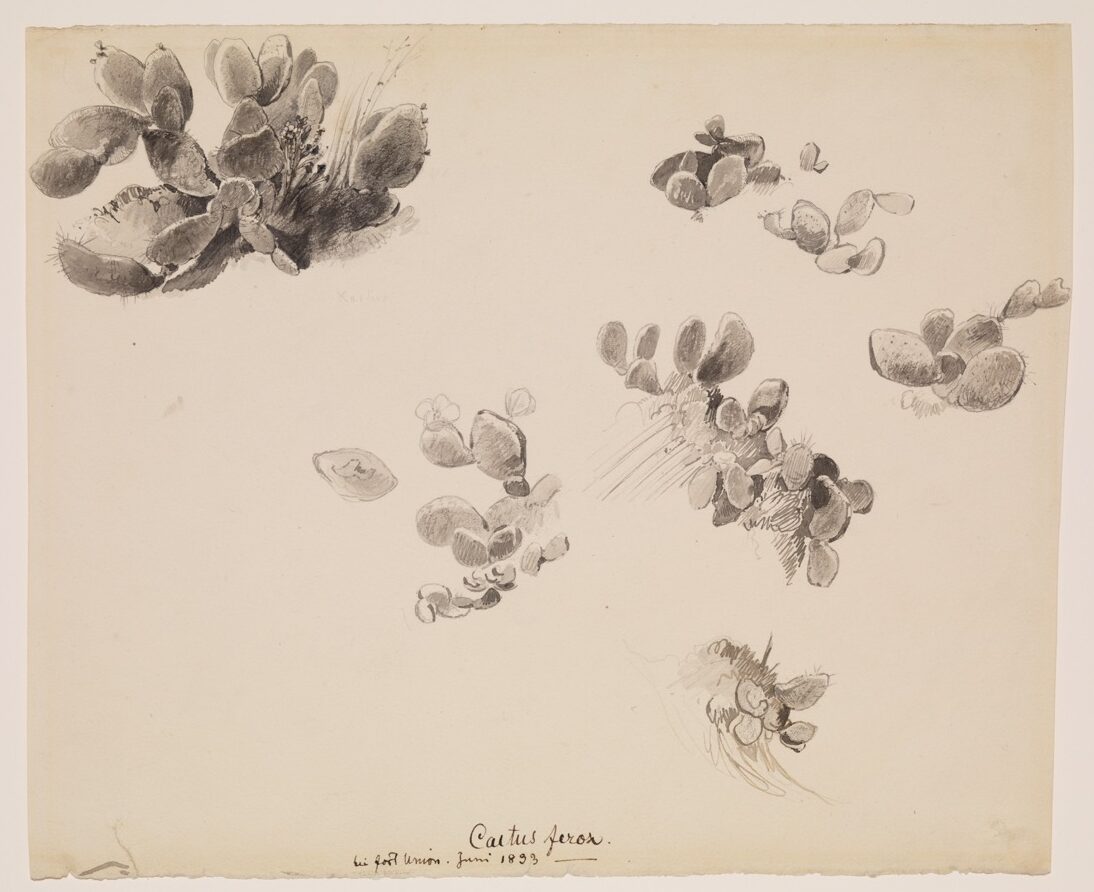
Early in the morning, a clear, beautiful day, warm sunshine. At eight o’clock, 66°F [18.9°C]. The chief of the Assiniboines (General Jackson) came early to take leave; most of these people will leave today. Since they have no food here, they will follow the buffalo. Yesterday Mr. Bodmer had sketched the chief’s [tipi]; it was mentioned earlier because of the bears painted on it. I bartered for several more minor items, including several feather fans, [and] bought a decorated buffalo hide and the like. Mr. Bodmer went out to draw the fort, of which he brought back a very nice sketch; unfortunately, there were no longer many Assiniboine [tipis] here. The Indians went about in the fort all day, and we [continued to] exchange many things with them. Mr. Bodmer brought back numerous cactus flowers, among which were some whose filaments were not brownish blood-red, as is usually the case, but pale greenish yellow, like the entire flower. At twelve o’clock noon, 74°F [23.3°C]. From the cactus I obtained a large number of flowers, myriads of which are now blooming around the fort; and after more exact observation, it appears that what I hitherto called Cactus opuntia is Cactus ferox, something that the fruit will indicate if it has thorns. As pointed out in the note, however, these plants include two color varieties (possibly two species). In the last days of June, this beautiful plant often begins to bloom.
This afternoon a large band of hunters on horseback left again for the bison hunt. Each of them has a packhorse. Tonight they will sleep not far beyond the Missouri, where there is an enclosure into which the horses are brought for the night. Tomorrow morning they will ride over the hills, search for the buffalo, ride after them, and shoot them from horseback. During the last hunt, they killed nineteen bison, including twelve bulls, which are now beginning to turn [inedible], since they are entering a state of rut. There are several hunters here who are very experienced and skilled in this kind of hunting. They put the bullets into their mouths, pour the powder into the barrel while riding, do not put a wad on it but immediately let the bullet out of their mouths to run down to the powder, and in this manner shoot a large number of bison from a herd. The meat is loaded onto the packhorses, which carry pack saddles. We now have to feed a large number of persons in the fort, and because there is nothing here but meat, one can imagine how many bison are consumed. In one year three hundred are sometimes killed here just for food. The hunters do not keep the hides, which are not good now.
There are some very good horses here for this kind of hunt, although several are very skittish, badly ridden and bridled. There are some very colorfully decorated saddles of red, blue, yellow, and green cloth with various kinds of embroidering, little tassels, and the like, which the Indians also very much like. This taste of the Indians for colorful things is known prevalent in so many ways, and the whites frequently imitate it. Most of the whites in the inland wilderness of the Missouri and the rest of North America wear Indian shoes and assert that they are far better in the arid prairies than European ones, in that they do not become so smooth underneath as our soles. Such shoes are soled with elk leather when they have been worn for a while and have acquired the shape of the foot. The name that one usually gives them is “makkassin” or “mokassin,” which is derived from one of the northern Indian languages, Ojibwe. The other Indian tribes have different names for them. Moccasins are delicate, light, made of deerskin, and on the upper side often very delicately embroidered with various figures with colored porcupine quills and feather quills.
Today I had received a very beautiful bow of the Crow Indians, which on its outer surface is covered with the skin of a rattlesnake (Crotalus tergeminus). These Indians do excellent work; they make beautiful bows, covered with the horn of the elk and bighorn, which are very strong. They visit the trading post, Fort Cass, on the Yellowstone River about 200 or 300 miles from here. The Crows are proud Indians. They are said to treat the whites very haughtily, and some of them despise [the whites].
Today the evening was calm and superbly pleasant; sheet lightning in the east. In the evening light, the Missouri gleamed calmly and beautifully, like a mirror, and in the vicinity of the fort, the mosquitoes were quite insignificant; during this season they are often said to be most annoying. After the gate of the fort had been closed, several young people entertained themselves with a kind of rustic music by torturing the drum and clarinet for a long time. Nowhere in America is music at home; the music is mostly bad, and in the regions I have seen, there is little appreciation for it.