July 24, 1833
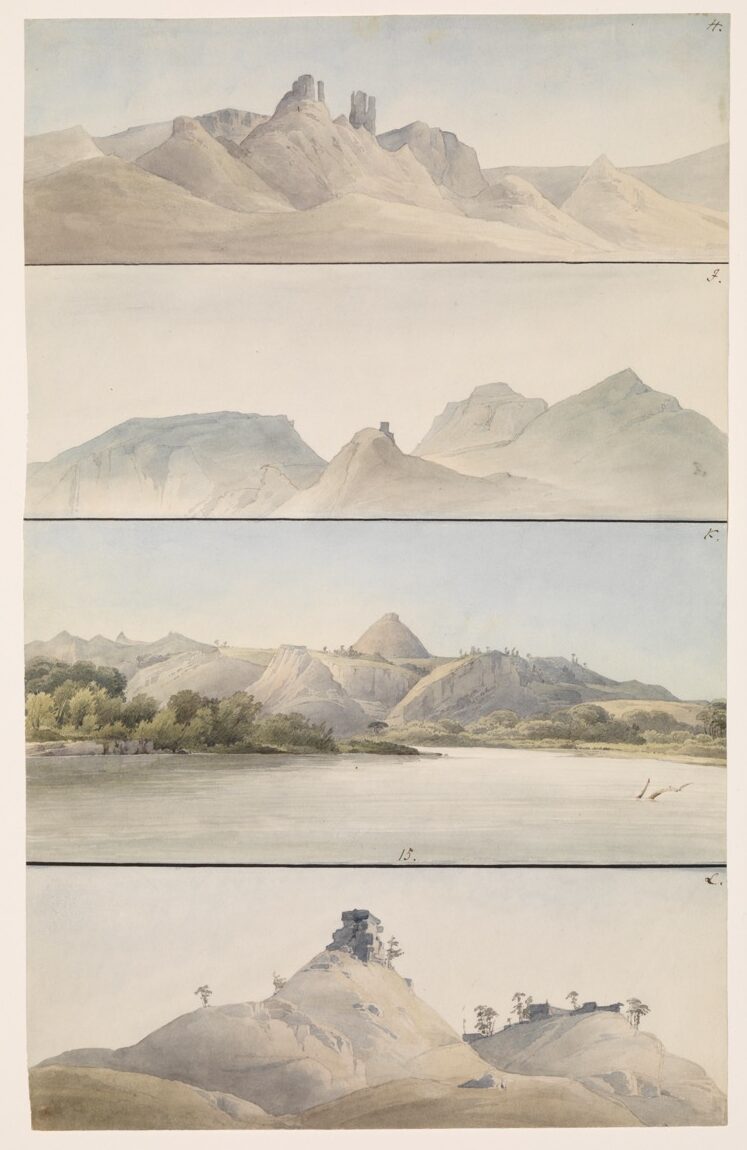
Early in the morning, pleasant weather, slightly overcast sky. Today we had very unusual clay mountains around us; those on the left bank were close to us. Their nipple-shaped, hemispherical, rounded foothills were blackish gray clay; behind them rose high, gray, partly whitish-spotted walls and hills with isolated conifers on their tops. Before the foothills lay rough, dry, wild prairies overgrown with bluish Artemisia and the thorny, bright green [— —] shrubs with fleshy leaves; clay banks, broken in various ways; on the riverbank, individual old, half-dry cottonwoods, and here and there the yellow aster ([— —]) or other already mentioned plants with slight variety. On these prairies one saw Fringilla grammaca [and] big Muscicapa [but] very few other birds on the old trees or shrubs. For the most part, our men saw the orange-red feathers of a woodpecker that looks like a new species to me. The left bank of the river consists of a tall, vertical clay wall divided into cubes, rent by various small gorges, and, in part, split into overhanging fragments like pillars or chimneys that threaten to collapse. A creek with little water and swampy soil, perhaps Lewis and Clark’s Stick Lodge Creek, issued here.
At 7:30, 72°F [22.2°C]. Before us we had very strange clay mountains, including a pointed pyramid, which is estimated to be the halfway point between the Milk and the Musselshell rivers. Throughout this region [the] right bank is covered with an old, half-gray cottonwood forest behind which unusual clay hills rise. We navigated across the river to the forest, where our hunters, who had shot a cow elk and a buck, were sitting. I got out here with Dreidoppel to go hunting. The old cottonwood forest was not large. We found [a place] where buffalo had just wallowed, [and we] saw beautiful plants: a purple monarda (Monarda [— —]) and a beautiful shrub with vermilion berries ([— —]), etc. A beautiful blue finch (Fringilla amoena) was shot [but] unfortunately [was] not useable; we also found the redwinged woodpecker, without getting it.
Behind the forest a vast prairie extended as far as the eye could see, beside which high, very odd clay hills rose. The prairie itself had a bare, whitish gray, completely hard, dried-out clay soil on which three kinds of bushes grew: the bluish Artemisia; the thorny, flesh-leaved shrub ([— —]); and another one with narrow leaves. Here and there, Cactus ferox. Wind alleviated the heat a little. We found the entire prairie filled with bones of buffalo and deer [and] large elk antlers with twelve points. Several sparrow hawks and a small bird resembling a lark were the only living creatures we saw here, but somewhat farther on we found a gaggle of wild geese on this elevated plain. Some of the foothills of the clay hills were covered with banks of sand or argillite; I found rock fragments that had broken loose covered with the most beautiful orange, yellow, bluish white, and blackish lichens. Several deep gorges or hollows, full of deep landslips and cavities in their upper, narrow sections, were all dry; [they] opened on the Missouri. At certain accessible spots [in] these gorges, the buffalo had cleared trails, or broad, frequently traveled paths, which turned before the clay hills on the prairie and extended through all the ravines.
Dreidoppel felt very sick and exhausted [and] sat down by the side of a bare clay hill. I went down to the high, steep bank of the river to look for the keelboat, which had [a] sailing wind, when suddenly he shouted something to me. A bison bull appeared at a great distance and came toward us. We went into a deep ravine to get closer to it and hid behind bushes at the edge of a deep ditch. It came along the trail, as we had assumed it would. The enormous animal, with long hair on its forequarters and a long beard, looked most splendid. [Its] forward motion was slow, yet [its] feet created much noise. Finally it went through the ravine below us; the wind was in our favor. As it climbed the opposite bank, I fired a well-aimed rifle shot, and Dreidoppel then shot twice with his gun, whereupon [the bull] stopped, faltered, and lay down. And then I gave it the coup de grace to put [it] out of [its] misery. While I was busy cutting off several trophies for souvenirs, Dreidoppel saw a second, younger bull and crept up on it. He stood beneath a steep bank and shot it. Meanwhile the dinghy had shoved off from the ship. I led the men up the ravine; the tongues were removed and very little meat, which we took along to the ship, where we arrived under great heat at two o’clock. The ship had been waiting a long time for us.
Meanwhile the ship had navigated upstream along the left bank past the indescribably strange clay mountains. [There were] several distinctive rounded tops, which Mr. Bodmer sketched (see sketches I., K., L.). This entire chain had thousands of elevations, domes, gorges, [and] small hollows; [was] a gray-greenish color, and [was] overgrown here and there with single blackish [conifers]. A sculptor would often have been unable to reproduce [any such] domes with greater singularity; the whole region, with its fresh green forest and willow lowlands alongshore, has a completely unique, interesting character. About three o’clock we found ourselves opposite an isolated conical peak on top of the mountain on the left bank (see sketch K., which is preceded by sketch L.), and this peak is estimated to be equidistant from the Milk and the Musselshell rivers. Before we were directly opposite this dome, we passed a small island overgrown with willows and cottonwoods. Many of the odd mountain domes nearby were flattened on top; various kinds of roundish and conical hills stood before them, all extremely barren. During our absence an eagle had been shot from the boat.
The sailing wind soon ceased; we went from the left to the right riverbank and there pushed the boat with poles and pulled it upstream with the cordelle. About three o’clock Bodmer went on land to hunt. The thermometer had been forgotten at twelve o’clock; at 3:45, in the open cabin door, it registered 84 1/2°F [ 29.2°C]. The hunters Papin and Deschamps had also gone hunting; at the willow thicket on the right bank, we found meat on hand. It was that of a bison bull, which Deschamps had shot; otherwise we did not get any game today. We moved upstream along the right bank, where steep clay walls, split asunder in various ways, formed the bank of the prairie. The heat was intense. Toward sunset we navigated to the left bank, where rough, rugged hills with the strange clay mountains behind them arose, and at dusk [we] halted before several small green islands. Our men cooled off in the river. In the distance, [from] where the river descended, there was severe lightning and the sky was covered with dark clouds.