Four-and-a-Half Months’ Stay in New Harmony
Description of the region – Natural history – Messrs. Say, Lesueur, and Owen – Hunting excursions in Indiana and Illinois – Wabash, Fox River – Illinois prairies – Albion – Black River – Mr. Bodmer’s trip to New Orleans
December 5, 1832
Early in the morning, frost, hoarfrost, completely clear sky. At seven thirty, -4 2/3°R [21.5°F, -5.8°C]. It is cold in our room; the open fire from green wood cannot keep the room warm. Because of the heavy smoke, Dreidoppel is having his stove taken care of; he could not endure it in his room. Mr. Bodmer and I left the house early to hunt along the Fox River. In the morning the weather was cool but very clear and nice. At noon it became very warm. We went out on the Wabash in a boat but had to do the work ourselves, because in our haste we could not find a boatman.
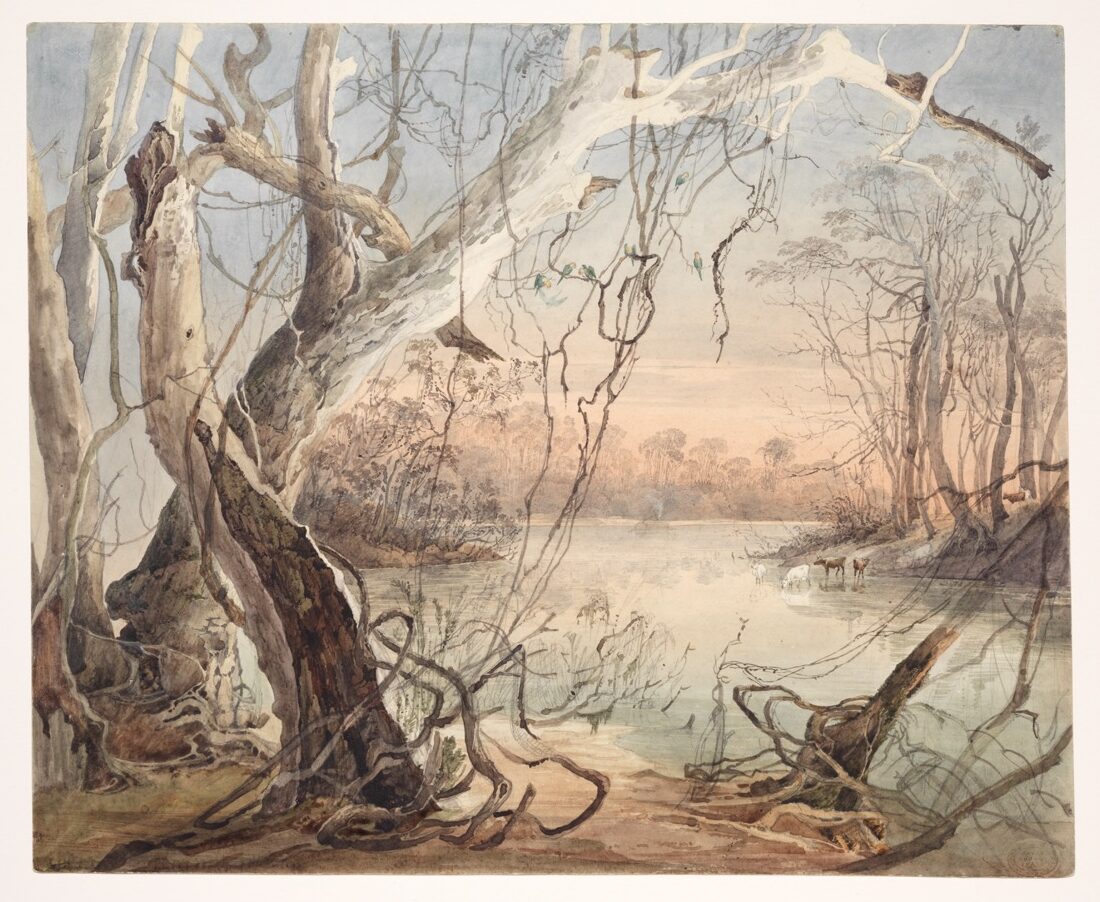
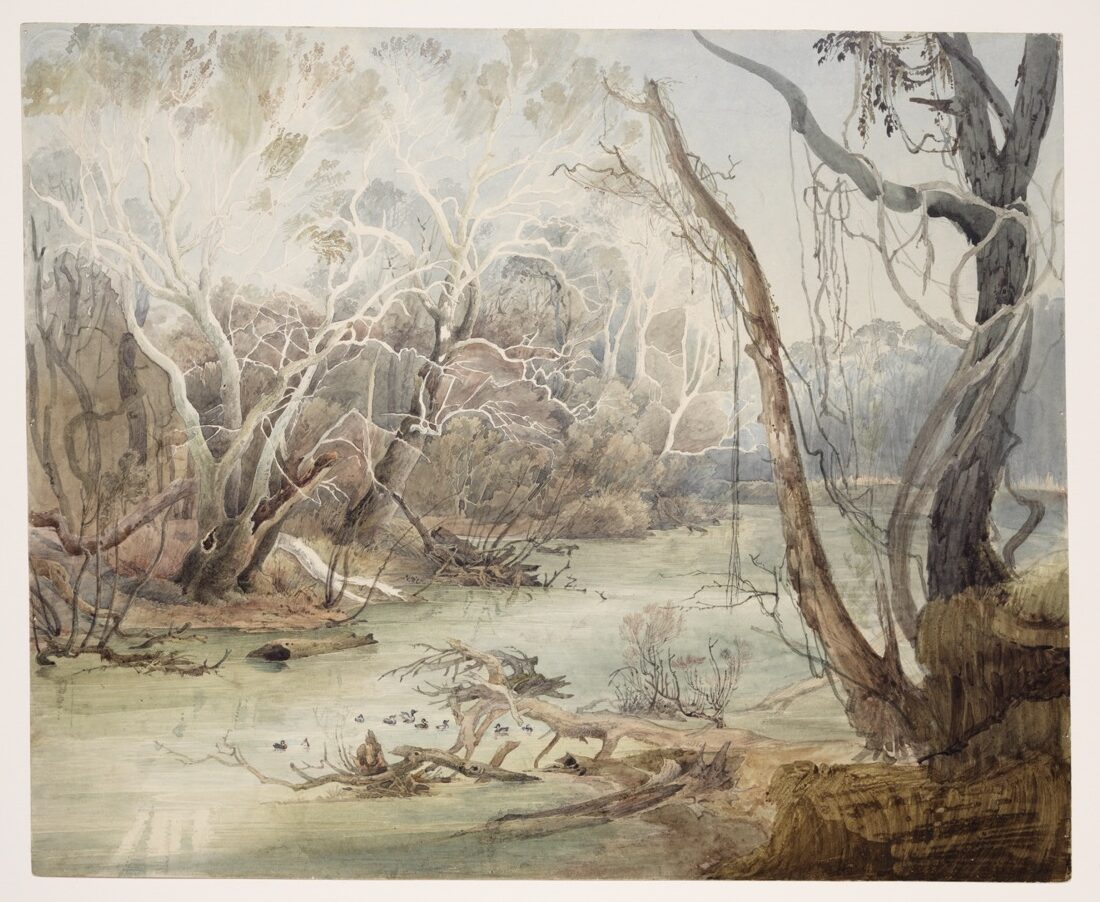
At the place where we set out, the Wabash immediately divides into two branches. It comes from the northeast but separates near Harmony, where the main branch makes a bend to the west and later again turns more to the south. This is the main, or northern, branch; the southern one, however, flows past behind the orchards and meadows of Harmony and bears the name Cutoff River, and the island between the two branches is called Cutoff Island. We passed Cutoff Island to our left and followed the main branch of the Wabash with Fox Island to our right. The river had risen considerably, its water clear and dark green; the visible bed was completely covered with mussels. The banks were covered with lofty, beautiful forest in which tall, huge Platanus, with their broad branches, gleamed snow-white in the densely entangled thicket. In several places there are sandbars along the banks; in others the banks are steep and ten to twenty feet high. Ducks appeared in large numbers, especially the wood duck (Anas sponsa). [We saw also] another white-and-black variety, the common wild duck (mallard), and the hooded merganser (Mergus cucullatus); but here there could be no thought of shooting.
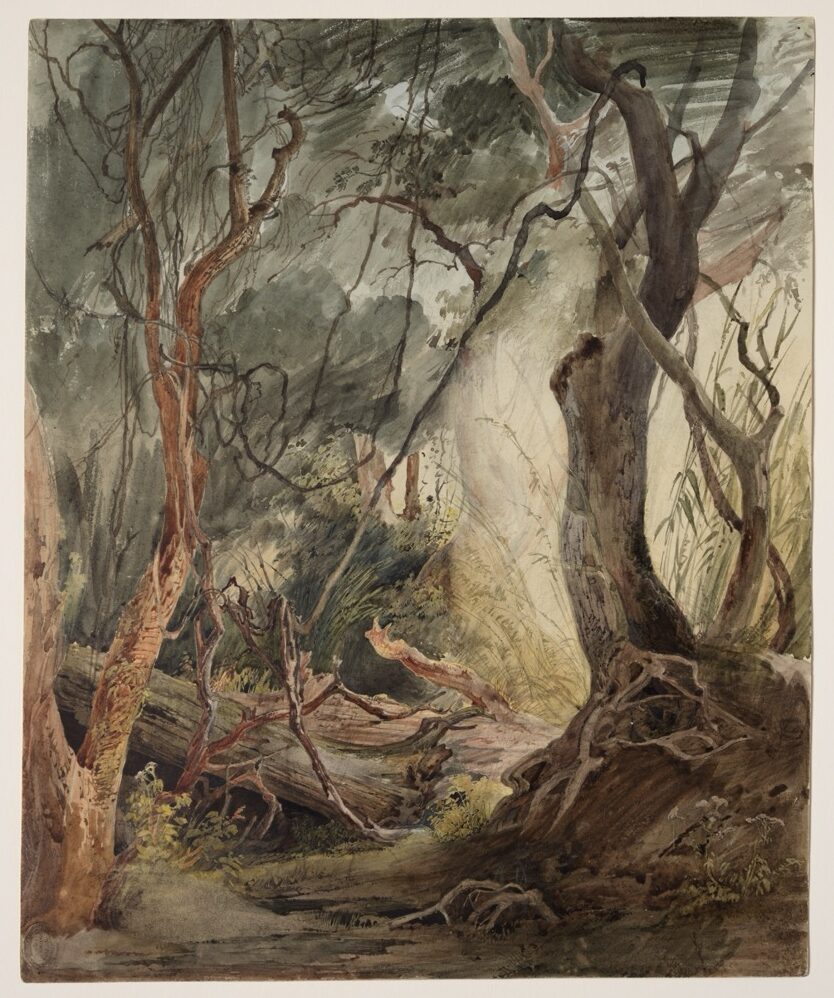
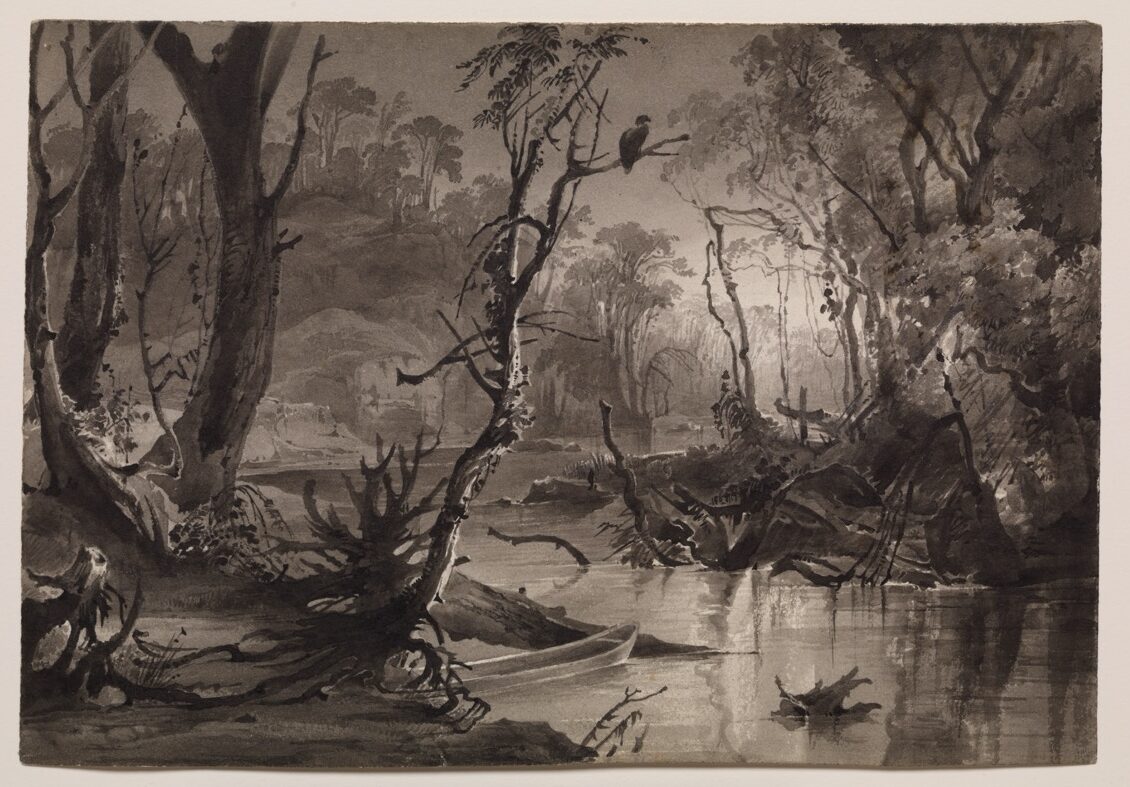
After rowing for one-half or three-quarters of an hour, we got out on the right bank and fastened our boat behind some thick fallen trunks. Then we climbed up the steep bank, which was already slippery because of the sun, and on top entered the tall forest, which has an undercover of wintergreen cane eight to ten feet tall (with delicately feathered leaves, Miegia macrocarpa). This shoots upward in a dense mass but here is grazed off by the cattle, which browse all around here day and night; [the mass] is penetrated by little paths. From the bank where we got out, it is several hundred paces straight across the island (called Fox Island), and then one immediately finds oneself beside a stream with a strong current and a deep bed, called Fox River, which flows nearly parallel to the Wabash for some distance and then empties into it below Fox Island (see Mr. Bodmer’s sketches). 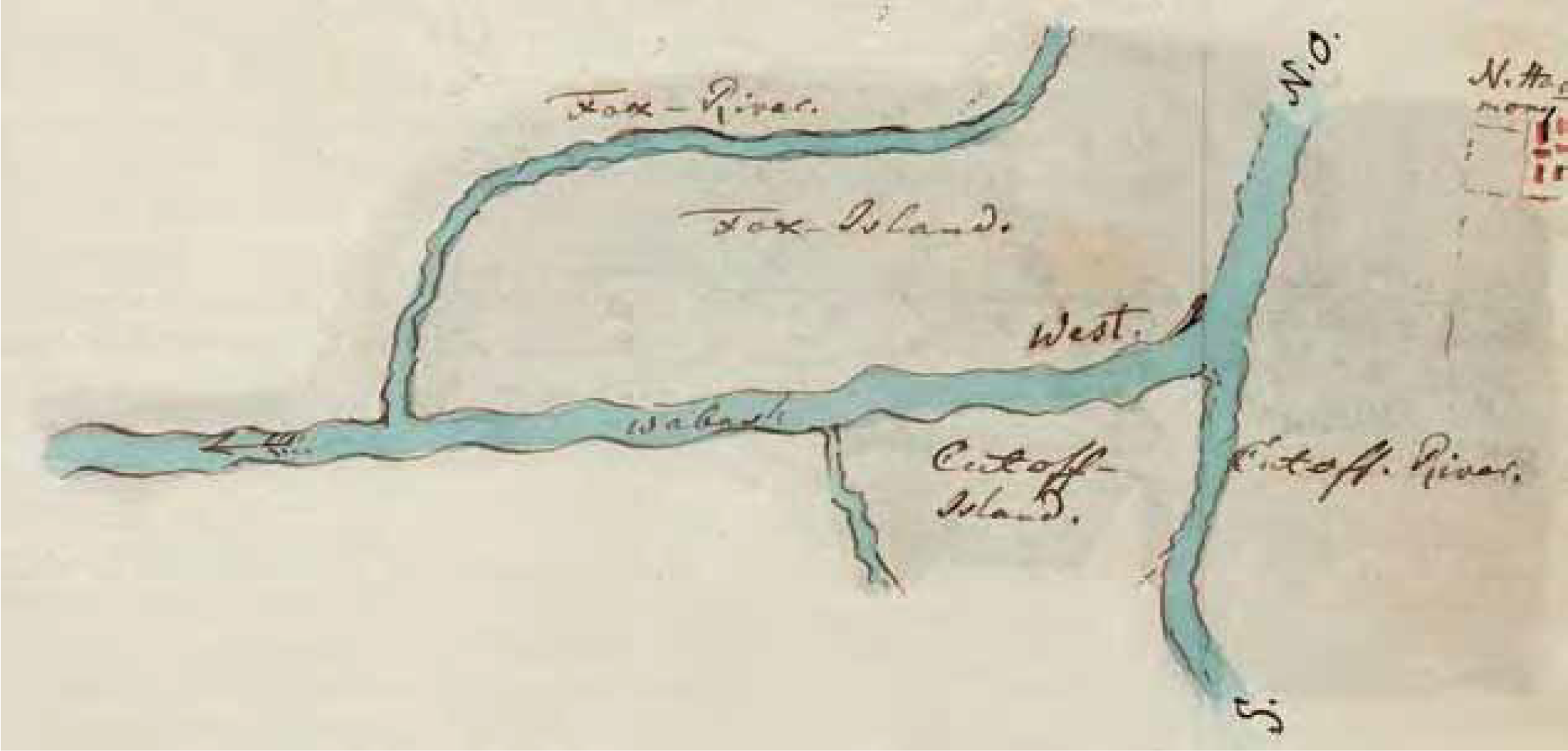 This stream is most scenic, with romantic banks, wildly toppled tall trunks, huge Platanus with white bark, splendid oaks, hickory, shellbark, etc. The Gymnocladus, with its large thick pods, grows here. Beautiful catalpas, with their long, narrow, legume[-like pods], Bignonia radicans and crucigera, as well as enormous grapevines, Rhus, Hedera quinquefolia, and Smilax species entwine the forest giants. In the water itself lie whole piles of fallen timber, some of which, because of the present rather low water level, form what are almost crossings or bridges at several places. Here the huge Platanus trunks, which six to seven men often cannot span at their base, are remarkable. Often they are hollow, and many people could find protection from the weather inside their trunks. At a height of 20 to 30 feet, the trunks usually fork into many extremely huge branches, which rise to a great height and, covered with an almost dazzlingly white bark, shine forth in large number in the brownish gray forest stripped of its leaves by winter.
During the entire day this calmly quiet, solitary brook is visited by numerous ducks. Each time we carefully crept through the tall cane and over the large dry leaves lying on the ground, which rustle loudly, we could immediately shoot at ducks. Unfortunately, we did not have any dogs and therefore lost many of the ducks we hit. After we had fired several times and frightened the ducks from the Fox River, Mr. Bodmer searched for the location, already discovered earlier, where he had begun a beautiful view of the stream.
On the island, I crept farther upward along the Fox River, finally found a beautiful ash-blue kingfisher (Alcedo alcyon), a species that we had not yet shot, and stole up on it. I shot it, and it fell into the brook, but I could not reach it; therefore I fetched Mr. Bodmer and together we tried our luck. When we again came to the spot where the bird lay, the air was filled with turkey buzzards, which are there in a second if one shoots even a single bird. They hovered over us and sat in groups of five or six on the tall, dry Platanus branches. I fired across the stream at them with my rifle, whereupon they scattered. A crow had also turned up. The kingfisher had actually already been carried to land by these assembled guests. Mr. Bodmer sought and found a crossing over the brook, and with wet feet he returned and brought the bird with him.
In this romantic wilderness, forcing my way through dense cane beneath the tall trunks and climbing over countless fallen trees, I scoured the tall, wild forest almost until evening. Here I found especially many woodpeckers and brown creepers (Certhia familiaris), Sitta carolinensis, as well as titmice, cardinals (Loxia carolinensis), several finches, and winter wrens (Troglodytes hyemalis), and shot several of these. The urubus often hovered above me, something one immediately notices from their passing shadows. There were numerous woodpeckers of all kinds here, in particular Picus auratus, carolinus, and pubescens, but especially the large, beautiful Picus pileatus, which is very large [and] black as a crow, with several beautifully white markings and a blood-red crest, which one readily recognizes at a distance. I shot three of these beautiful birds since they are not very shy. When the sun had set, we got into our boat again and, with no little difficulty, rowed up the Wabash against the current toward New Harmony. We did not arrive home until it was dark. During the evening we had a visit from Mr. Say, whom we always find pleasant and interesting, since we can then have a fruitful discussion about American natural history to our heart’s content over a cigar by the fireplace.