September 15, 1833
Early in the morning we continued on. During the night so much water had leaked into our boat that it was half full. We had not expected this and had not taken any precautionary measures—something that caused much damage. We decided to navigate somewhat farther and to halt and examine our baggage as soon as the sun was up. The morning was cold and unpleasant and windy. For several hours we bailed water out of the boat. The sun was just rising above the entrance of the striking passage into the Stone Walls. Right and left on the hills we saw bighorn and antelope in large number [and] entire herds. They calmly observed us, and we would gladly have hunted these animals, if we had not had to hurry to determine the whole extent of our water damage. Some white gulls appeared on the river.
When the sun was somewhat higher in the sky, we put in at the right bank and made a good fire, for which we took some wood from an old Indian hut in the tall cottonwood forest. We took our wet buffalo robes and blankets (bedding) ashore to dry them a little. [At this time] we also noticed that our pretty, tame, striped squirrel, which I had brought along in a cage, had drowned during the high water in the boat. Our helmsman went out for a moment with his rifle [but], without firing a shot, killed a skunk, the hide of which we took along. It did not differ from the animals of this kind that we had obtained in Pennsylvania. We warmed up with good coffee, ate our meat, and set out again an hour later.
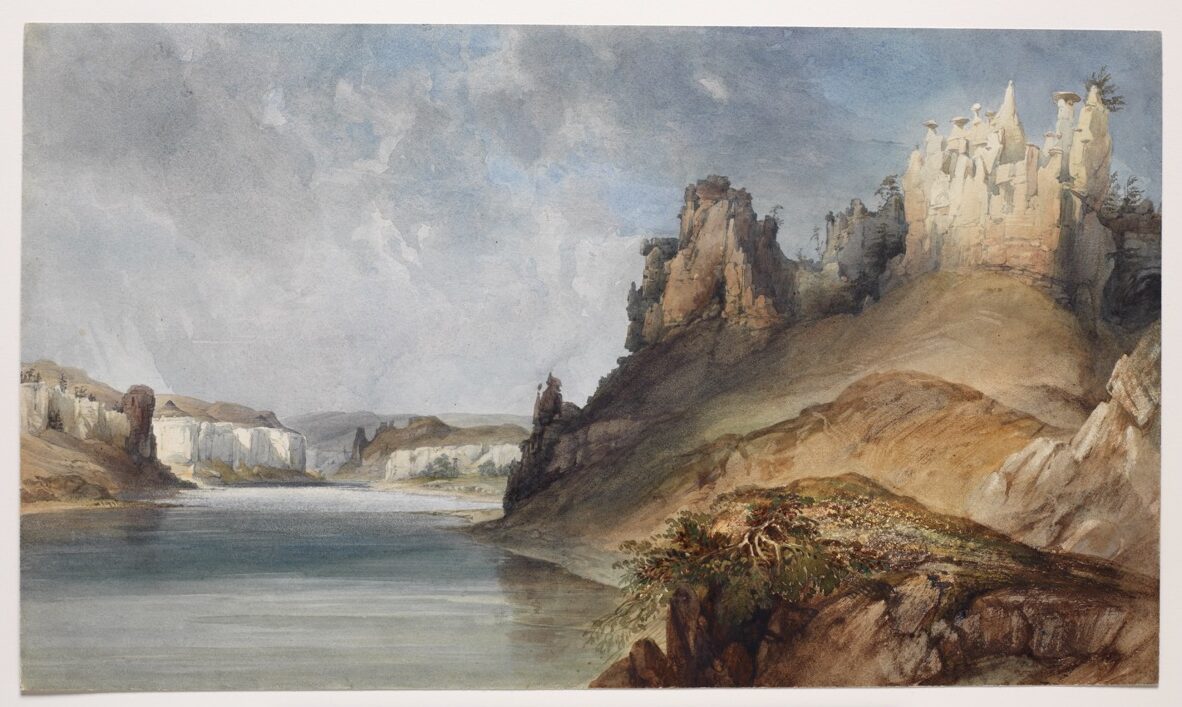
At 9:30 we reached the beginning of the Stone Walls, the last blackish tower-rock of which first appeared on the left bank. The view of the strange white sandstone walls, which here closely approach each other along both banks, surprised us anew [and] to the utmost degree. Large troops of bighorn stood crowded together [on] the grotesque formations of the domes of the hills [with their] towers, jagged points, and often isolated stones shaped like heads or tables. The swallows’ nests on these rock clusters had already been deserted by their inhabitants. On the right bank stood two big bull elk, which did not tolerate us, however, and our hunters pursued them [in] vain. They shot at a bighorn out of range. In the white sandstone rocks, there were magpies in large numbers (Corvus pica amer.).
At 11:30 we navigated past the mouth of Stonewall Creek, which remained to our left, and a few hundred paces above it, we put in at the left bank in order to examine our baggage, since the sun was warm now and favorable for this task. We took all the crates and trunks on shore, but how horrible! Not one of all our things was dry: all the Indian and natural history collections, articles of clothing, mathematical instruments, books. In short, everything was completely soaked and drenched; one trunk was completely open at every joint and had become useless; but what grieved me most of all was that my entire botanical collection, which I had assembled with effort and persistence during a journey of five to six months on the Missouri, now seemed completely lost. We opened all crates and packages, spread the contents out on the bank—they covered a sizeable stretch—and entrusted [them] to the hot sun to rescue at least part of them for us. My extensive herbarium I placed in dry paper in the wind in a small gully on the bank as well as I could, but soon it had to be packed again, and all the plants turned black and were covered with mold: a most distressing loss for me.
While we were drying the baggage, Mr. Bodmer went up one of the nearby hills and began an interesting view of the Stone Walls above the place where we lay at anchor. Morrin seized his rifle and shot a two-year-old black-tailed doe quite close to us. It already had its ash-gray autumn coat. We left the baggage to dry all day long and, in the meantime, posted our men on the heights as a guard, so we would not be surprised by Indians. Toward evening [we] cooked our meal, whereupon the fire was extinguished. At twilight a buck came close to us in the river, but to avoid any noise no one fired. The night was warm and very pleasant, [with] a little moonlight now and then. We maintained a double watch, and my number matched me with Thiebault from nine until eleven o’clock.