July 5, 1833
Early in the morning, beautiful weather, slightly overcast sky, and intermittent sunshine; on the prairie, somewhat pleasant wind. Our keelboat is being loaded today so that we can leave tomorrow. I went through the prairie to shoot ground squirrels; [I] saw none but later found many interesting new plants in the beautiful dense forest along [the] shore above the fort. The forest had tall, old cottonwoods and willows as well as a dense understory of roses, which had a pleasant aroma; Cornus sericea; Prunus padus (called la cerise), whose fruits are eaten and preserved; ashes; Negundo maples; elms; and, especially closer to the water, willows. Here a tall species of grass flourished [along with] several other plants unfamiliar to me; also [here was] the beautiful, tall, bushy Linum, the flax of which, nonetheless, is said to be like that in Europe. The fox-colored thrush (Turdus rufus) was singing in the old cottonwoods. Blackbirds, the kingbird, and Muscicapa ruticilla, with its delicately sibilant call, [all were] very numerous. Fringilla grammaca Say and others were numerous. Large amounts of wood had been felled in this forest. Much split wood [was] piled up, and several carts continually conveyed it to the fort.
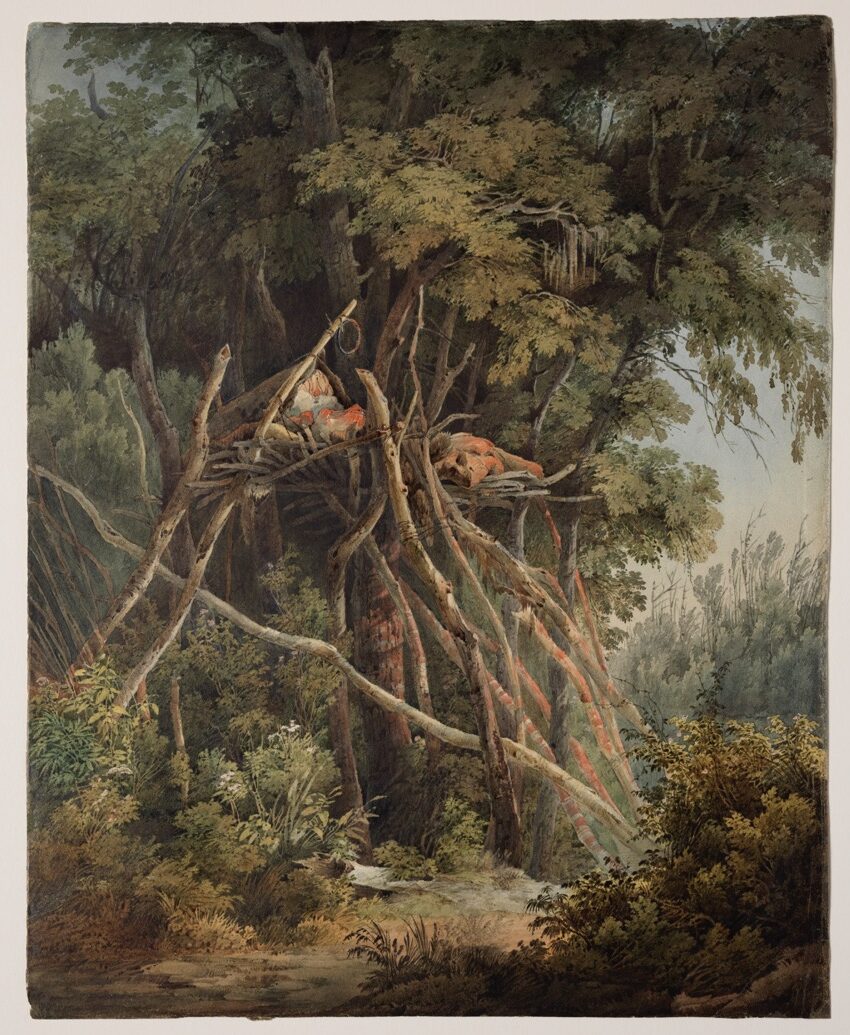
This morning the Assiniboines’ interpreter told me a large number of words of this language and then provided me [with] considerable information about this nation. These people, as well as the Crees, believe that thunder is created by a big bird, which some claim to have seen. Lightning they attribute to the Great Spirit; and whenever there is intense lightning, they believe he is angry. They say the dead go to Heaven and south. Outstanding warriors—individuals who during this life have made themselves popular among their people and have been brave—are not placed after death on trees but rather [are all] wrapped up on the bare ground. They will take care of themselves. Usually the wolves devour the corpse. Other dead persons, wrapped up, are placed on trees. They believe in an evil spirit who torments people with various diseases, against which their doctors and magicians employ the drum, the chichikué, and other remedies. In this respect the Crees are said to have the same ideas as the Assiniboines. The former are not numerous; the latter, on the other hand, are. They formerly killed whites, but no longer. Whenever their war parties encounter [whites], they beat them, [but only] lightly; on the other hand, [they] usually kill Indians.
On 4 July Mr. Bodmer drew one of the trees in the forest near Fort Union on which several dead bodies lay. The trunk and branches were partly painted red. Toward noon our keelboat was completely loaded; only our baggage was missing. A strong wind had arisen; wherever it was not blowing, [the day] was very hot. At twelve o’clock, 73°F [22.8°C] in the corridor of Mr. McKenzie’s house. We worked all afternoon arranging our baggage. Windy and rather cool in the afternoon. Just today Mr. Culbertson received instructions to accompany us to Fort Piegan, so that next spring he can take over the management of business there if Mr. Mitchell should travel with us to St. Louis. This young man speaks the Dacota language, because he [was] at the St. Peter’s [Minnesota River] a long time. He is goodnatured and obliging, though a little negligent. In the evening when it was dark, Mr. McKenzie prepared an entertainment with a few firecrackers and rockets for the entire crew assembled in front of the fort. The former were aimed into the most closely packed crowds of engagés and other people, who were completely unfamiliar with these things, and one can readily imagine the panicky fear and laughter that resulted from this. At nine o’clock the returning bison hunters fired shots on the other side of the river as a signal that we should fetch them. They had [— —].