Journey from Fort Pierre on the Teton River to Fort Union on the Yellowstone River
Stay at Fort Pierre – The Dacotas (Yanktons and Tetons) – The Yellow Stone returns; we travel on the Assiniboine – Difficult voyage – Cheyenne River – Cheyenne Indians – Antelope and elk – Little Cheyenne – Good day of hunting – Moreau’s River – Rivière du Rampart – Two Arikara villages – The Arikara Indians – Cannonball River – Old Mandan village – Heart River – Storms and bad weather delay us – Meeting with the Yanktonais (Dacotas) – Arrival at Fort Clark – The Mandan, Hidatsa, and Crow Indians – Five villages of the Mandans and Minitaris (Gros Ventres) [Hidatsas] – Meeting with the Hidatsas – Little Missouri – Difficult navigation around a promontory – Fire aboard ship – View of the first bears – Two Blackfoot Indians – Meeting with the Assiniboines – First glimpse of the bighorn – Muddy River – Second meeting with the Assiniboines – Yellowstone River – Fort Union
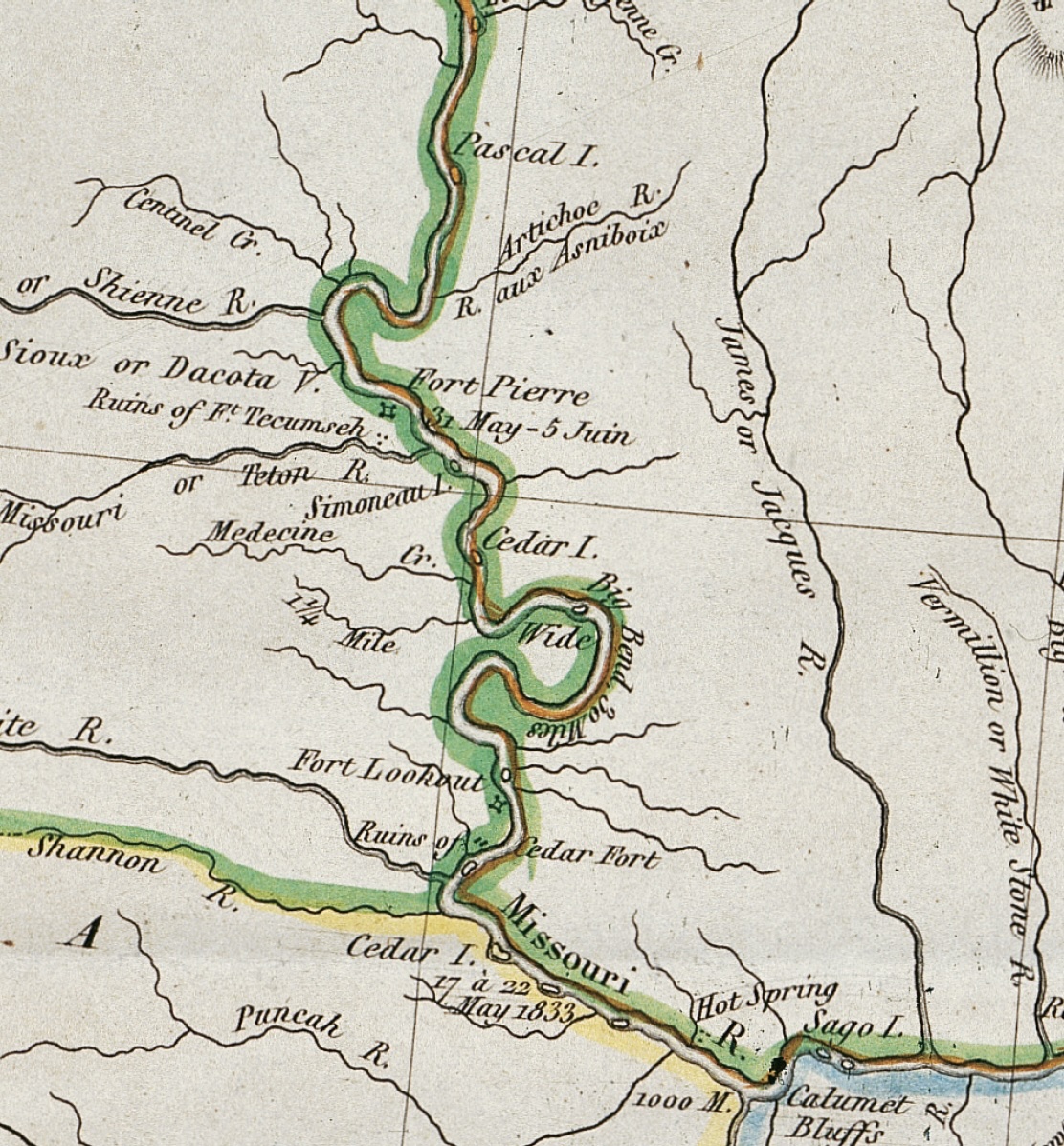
June 9, 1833
Early in the morning, beautiful, bright, pleasant weather. At 5:30, Cheyenne Island before us. To the right along the bank [were] five or six trees felled by the beavers, though not recently. They were not thick. Cheyenne Island is covered with cottonwoods and willows. After breakfast we saw the green region of the Cheyenne River before us. On the very bare hills to the left, noteworthy conical points.  The region around the mouth of the Cheyenne is wide and the hill chains low, merely ravines and few outstanding elevations, grayish and pale grayish green. To the left along the bank, gray sand bluffs; to the right, sandbars along the bank. The swallows are few and fly in individual pairs, as they do in all these prairie hills; undoubtedly they are of the species Hirundo fulva Vieill. Previously we saw individual kingbirds (Muscicapa tyrannus) on the tops of the bushes: [the bird’s] white abdomen gleams in the sun; in flight, the white border of its tail also.
Here at the mouth of the Cheyenne and farther upstream on both sides of the Missouri, the Arikaras, or Riccaras, once lived. [They] were driven away, however, by their enemies, the Dacotas. They now live somewhat farther upstream, but we will not see them, because they have a guilty conscience. They had villages on both sides of the mouth of the Cheyenne and beyond the Missouri. All the lowlands around this mouth are forest; we reached it at 6:30. Willow and cottonwood thickets. This river is now low, its banks flat at the outlet; it soon turns to the right before the chain of mountains or hills that form its right bank.
Several hundred miles upstream in the Black Hills live the Cheyenne nation, of whom little is known. They are tall, slender men, with very long, narrow faces; their language is said to differ from all others, and it is said that no one knows it.
| Language Samples of the Cheyennes | |
|---|---|
| WORDS | |
| Sun | Ischä́ |
| Moon | |
| Star | |
| God | Okúhme (‘e’ half [=ə]) |
| Fire | Hoísta (‘o’ and ‘í’ somewhat separate, ‘ta’ short) |
| Water | Má-pe (‘Má’ nasal, ‘pe’ short, ‘e’ full quality, both syllables short) |
| Earth | |
| Man | Itann |
| Woman | Hi-íh-u (together) |
| Child | Kaichkúnn (‘ich’ velar) |
| Head | Mihk (‘k’ with strong aspiration) |
| Arm | |
| Hand | |
| Hair | |
| Eye | |
| Mouth | |
| Bow | Máh-tachk |
| Arrow | Mah-hóss |
| Pipe (Tobacco) | Hióchko (‘och’ velar, ‘ko’ almost like ‘ke’—‘e’ half [=ə]) |
| Tomahawk | |
Behind the thickets above the mouth of the Cheyenne and before the hills, there is a prairie that is colored completely whitish green by bushes of Artemisia. Poles stood here as remnants of Indian huts. To the right, green lowland with willow and cottonwood. 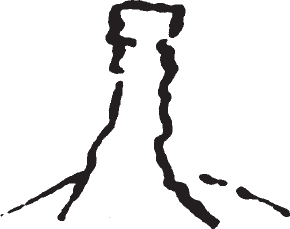 On the left bank, reddish gray sand bluffs on which there is little verdure. Argillite or sandstone layers form an angle of 25° or less, often horizontal. On the bare tops of a hill chain, cedars and Yucca angustifolia grow along the dry, scorched slopes. Along the small, eroded gullies [are] striking clay peaks and cones, [as well as] many curly, short, and withered cedars. Columba carolinensis are everywhere in the ravines. To the right, sandbars along the bank [and] conical peaks in the hill chain; otherwise, rather flat. Rosebushes bloom in the ravines to the left.
At 7:30, 70°F [21.1°C]. Now many totally dry gullies. Gentle lateral valleys with individual clay or sand elevations, conical hills, lone cedars, and scattered Artemisia; otherwise desolate and bare. Now a thicket appears on the bank with short ashes, cottonwoods, willows, roses, Prunus padus, Cornus sericea, and creeping Vitis, as well as Rhus. In a cave underneath the steep riverbank there is a Fulica americana (coot); she undoubtedly has her nest there. The river turns to the right; sandbars on the left bank force us to the other side. A brisk, pleasant breeze breaks the heat. We sail to the right along the sandbar, behind which is a dense cottonwood and willow forest.
This entire region is the territory of the Dacotas (Tetons). [The] Cheyennes lived in this region earlier; they came from the northeast, and the Dacotas drove them away. We will probably not see any more Dacotas upstream along the Missouri; therefore I shall now give some examples of the Teton language, so that they can be compared with those of the Yanktons (who are also Dacotas). From this we see that the language is quite the same as that of all the Dacotas, that only here and there is a different stress pattern, and several small deviations occur in the words.
| Language Samples of the Tetons (Dacotas) | |
|---|---|
| WORDS | |
| Sun | |
| Moon | |
| Star | |
| God | |
| Fire | |
| Water | |
| Earth | |
| Man | |
| Woman | |
| Child | |
| Head | |
| Arm | |
| Hand | |
| Hair | |
| Eye | |
| Mouth | |
| Bow | |
| Arrow | |
| Pipe | |
| Tomahawk | |
We soon passed Sentinel Creek on the left, with willow thickets at its mouth. On the right bank now appear earth bluffs similar [to those seen] previously on the left bank. Doves in pairs in the ravines. To the left the area is flat now; willow lowlands cover the bank. To the right, cedars and Artemisia, as well as buffalo berries. The hills to the right are greener now. To the left, a tall cottonwood forest; before it, willow thickets. Sandbars to the left leave us only a narrow channel along the right bank. Here we saw the first magpie (Corvus pica L.). [It] flew out of the cedars. The crew of the Yellow Stone had already noticed one earlier. Here we ran aground, turned around, and moved back to the left of the sandbars through the other channel. At twelve o’clock, 82°F [27.8°C]. From eleven to one o’clock, we were delayed by shallow water. We took soundings of the river in all directions for a long time, then continued a short distance [and] had the boat sent out to sound for the second time. But around two o’clock we were hard aground and lacked wood besides; we sent the boat to land to fetch some.
After a good half hour, we saw the boat returning. The men told us they had seen ten Indians, probably a war party, and they did not want to cut wood there. Now even our passengers, Messrs. Sanford, Mitchell, Bodmer, Dreidoppel, [and] a few company interpreters and clerks, as well as several other persons, armed themselves. Twenty-six men in two boats—twelve of them with guns and rifles, the others with axes—shoved off for land. The Indians, probably Arikaras, had taken flight, and the woodcutting proceeded smoothly.
After three-quarters of an hour, one of the boats returned loaded with wood; Mr. Sanford steered it. It brought back a hunter who had gone out this morning and an interpreter who had killed an antelope, which was also brought on board, unfortunately without the hide. It was female, and I obtained the fine head, which demonstrated that females here also have horns, even though I had been told the contrary; the horns, however, are usually short. Shooting this doe took it away from her fawn (which, however, was not with her); the udder was full of milk. The same rifleman had missed an elk; many elk tracks were found in the forest on the bank disturbed by Indians.
As soon as several boats full of split wood had arrived, we were able to sail to the forest where the woodcutters were, to pick up the crew there and the rest of the wood, and [then to] proceed for about one and a half to two hours to a place where we landed on the left bank. Nothing more had been seen or heard of the Indians. Dreidoppel brought a snake with [an] orange-colored streak on its back Coluber [— —] and a nice rush [— —]. He and Mr. Bodmer had found a prairie dog village and had shot at the animals. Extremely warm on the ship in the evening, wind strong.