July 22, 1833
Early in the morning, nice, clear weather. We navigated across the river and at six o’clock reached the hill chain on the left bank: high, rounded, almost blackish clay hills; a prairie extended before them, overgrown with Artemisia, where the hunters Deschamps and Dreidoppel joined us. Shortly before, we had left the hills on the right bank, which were rather flat and gently rounded but here and there also adorned with several small domes or angular figures. The hills on our side, which we still followed to some extent, were completely bare. In the gullies between them and in some of the furrows there was vegetation, otherwise not a blade of grass on them; their soil was blackish gray, crumbly clay. On them grows a thorny shrub with narrow, roundish, lancetlike, nearly linear, succulent leaves with woody stems ([— —]), which was not blooming now; also a nice plant ([— —]) resembling the Dianthus in color and shape; in addition, the beautiful yellow [— —] with petals turned back; and several others. The latter I found in willow thickets when I went ashore at 7:30. At 7:30, 70°F [21.1°C].
Everywhere in these hills, Dreidoppel had seen tracks of bears that dig here for roots. At this time of year, their claws are worn off short. (On a 6-foot-long bear, the longest front claw was 2 inches in length; when a bear is shot in spring after hibernation, its claws are extremely long, often [— —].) He had also seen a large band or herd of elk, probably forty head, which was roaming in a wooded point of land. A buffalo bull appeared on the hills before us.
We pushed the ship forward with poles in the middle of the river and, on the right bank, soon had completely barren clay hills, almost naked, covered only with individual small bushes: short plants distant from each other. On the bank [the hills] are either steeply cut off by the river or there is a prairie overgrown with Artemisia before them that has a perpendicular bank of 10, 15, or 20 feet in height at the river. When we had navigated around the river bend, we again put out the men on the cordelle and continued to pull [ourselves] along the left bank. Deschamps came in; [he] had shot a bison. About an hour later, we came to the edge of a cottonwood forest bordering on the prairie (three river bends above Big Dry River); here on an old, twisted cottonwood [we] fastened a bear skull that [will] be picked up again on the journey back. Before us, at the end of the river bend, we saw buffalo moving on the prairie.
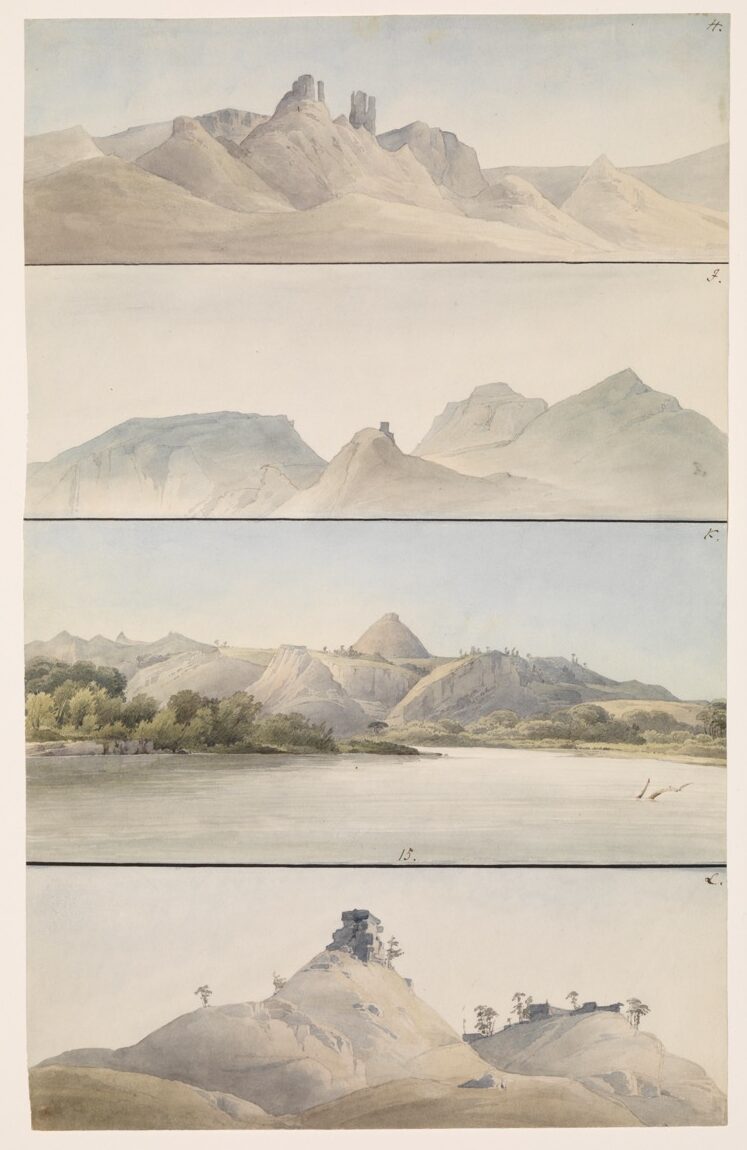
We now crossed to the right bank and found ourselves opposite the hills on which stand two clay peaks resembling the ruins of a mountain castle on the Rhine. Mr. Bodmer sketched this strange natural formation and noted that they resemble the two so-called brothers at Bornhofen (see sketch H.). The river here is broad and beautiful; along the right bank [there was a] powerful current, which we struggled against. A rather strong wind came up again. On the opposite bank, wild geese were calling and flew up in flocks; the goslings were fledged. The river made a big, wide, majestic bend here; its right bank was bare prairie, [and] in the background, gentle hills, several of which were formed like ramparts. Here [there] were buffalo. Mr. Mitchell and Culbertson had gone out after them earlier; now Deschamps also went out. At twelve o’clock, 82°F [27.8°C] in the cabin.
We continued on [and] sailed a good stretch until the river again changed direction. [We] then saw a big bison bull in the young willow thickets on the right bank. We sprang into the boat and landed: Mr. Mitchell (who wanted to let me shoot first), [me], and Deschamps. We crept to within 40 paces. The bison was wallowing in the sand so that the dust flew around our heads. I was somewhat overly eager and fired before [it] stood broadside to me. Both of my bullets hit it, and it stood wounded for a while, but then it ran away; it will perish, but we will not get it. I had just fired my two shots when another bull emerged from the willows and ran close past us; this one was not even fired upon. When we came onto the prairie, we saw three more big bulls moving [about].
We pulled on the cordelle to round a point and again got [a] sailing wind, which caused us to move swiftly. At a distant willow-point before us to the right, we again saw a bison bull walking. We sailed left along the forest and then past a prairie with whitish growth, behind which rose the very oddly shaped hills. Several of them had somewhat the shape of [a] lion’s head and lion’s trunk at the Cape of Good Hope. [The hills] here all consist of clay, and the riverbank likewise; it is steep besides, about 15 to 20 feet high. 68
I had received a quite small young specimen of Coluber proximus Say, the pattern of which did not differ from that of the old animal. [It is] strange that along the entire Missouri we have not seen one specimen from the family of the Sauri, or lizards. We found only very few frogs, [but] the toad (Bufo clamosus) [was] numerous. There is said to be only one small species of turtle along the middle Missouri; on the lower Missouri, there are several, but upstream I have not noticed anything similar. We saw a white wolf from the ship.
The hills, with their strange shapes, now approach close to the river. Their shapes mostly remain consistent; most conical domes were grayish brown, several [were] blackish gray, and several had reddish brown tops. Along the hills the sail had to be taken in, something that is unavoidable here, because of the many bends in the river. From the ship one saw shiny spots on all the clay hills; this I had found this morning to be a substance like isinglass stone, which occurs everywhere in layers in this clay and in the fragments, as I have already mentioned above. This morning we brought back large pieces of it. On all the hill chains we saw only one tree; [it] stood on the highest point of a hill and had a short trunk and an umbrella-like crown. We were there at twelve minutes before six o’clock. The river turned right; we landed for a moment at the point on the right, which was overgrown with cottonwoods. We continued sailing; the evening was very pleasant, the view of the bare, colorful hills on the left bank most singular. Before the high ridge of the hill to the right—on which a stag appeared, standing calmly and majestically against the bright evening sky—there was a lowland with willows far below along the river, where we saw numerous elk, several of which came to the river to drink.
We continued moving until dusk, when we anchored for the night at the sandbar to the right. Wherever the water had moistened the clay and it was half dry again, [there were] cracks and fissures running in all directions [in] a formation like shells or waves. Troughlike pieces about 1 to 2 inches thick [can] spring loose, [and] one can lift [them] off whole, in one piece. This clay could certainly be worked. On the sandbar we tracked bears, buffalo, elk, deer, and wolves, but all we got to see or feel were mosquitoes in swarms. With help from a favorable wind, we had made good progress today. During the night a quite strong wind seemed to prevail.