Journey from St. Louis to the Borders of Settlements along the Missouri,
Entry into the Missouri – St. Charles – Gasconade River – Portland – Osage River – Jefferson City – Marion – Franklin – Boonville – La Mine River – Pierre à [la] flèche – Grand River – Fox Prairie, where the Missourias were annihilated – Dangerous voyage – Bald eagle’s nest – Former Osage territories – We are stranded on a sandbar 9 miles from Fort Osage along Fishing Creek – Fort Osage – The Osages (Wassaschi) – Bluewater River – Violent thunderstorm – Liberty – Kansas River – The Kansa [Indians] – Indians recently settled here from the East – Dangerous situation – Little Platte River – The Iowas – Cantonment Leavenworth
April 19, 1833
In the morning, nice, clear weather but a murky atmosphere all around us, probably caused by prairie fires. At nine o’clock, 65°F [18.3°C]. The ship still lay on the sandbar but gradually moved a little. We wanted to try to bring it to the right bank, if possible, where there was more water, and then unload half of it into a flatboat, since we had no hope of making headway without this measure. We were [still] about 3 1/2 miles from Fort Osage. Messrs. Dougherty and Sanford had not returned. Our black snake had fully revived, and we kept it alive. A flatboat arrived and the goods were loaded onto it, brought ashore, and piled up in the forest. Full boatloads like these, one after the other, left the ship all day. Propelling the loaded flatboat over the sandbars and shallows required great effort. At twelve o’clock noon, 70 1/2°F [21.4°C].
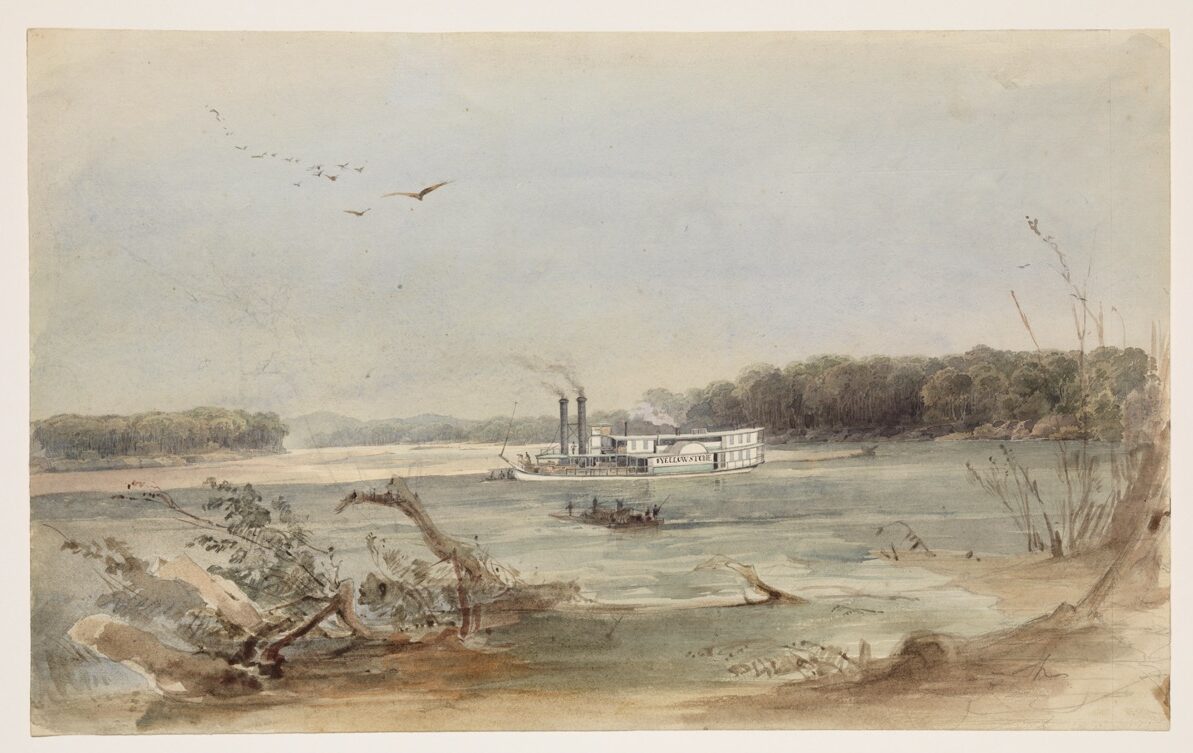
In the afternoon Mr. Bodmer went ashore with a gun. Doctor Fellowes, who was traveling with us as far as [Fort] Leavenworth, saw seven deer on land but was unable to shoot. One of the pilots shot two squirrels (Sciurus cinereus). Most of the animals had been frightened away by the noise caused by our large crew, for we had one hundred men on board and today all but a few of them were moving about. This morning from land, Mr. Bodmer made a nice sketch of the boat as it was being unloaded, but the wind was so unpleasant and carried so much sand that he could not paint. He returned but had not shot anything, nor did he find any plants in bloom except for a variety of viola.
At 3:30 the crew, through combined efforts, had succeeded in pushing and pulling the Yellow Stone free from the sandbar, whereupon we started the steam engine at this time and put in at the bank lying to our right. We lay at anchor somewhat below the mouth of Fishing Creek, a pretty stream with clear water some 10 feet deep at its mouth. Here we pulled in the anchor, boats, and other necessary things. The wares that lay on shore belonged partially to the Fur Company (but) were in part goods the government sends the Indians, intended for Dougherty’s agency. Three men were left there to guard them. A party of about thirty men returned the unloading barge to its owner on Fishing Creek. Somewhat farther on we took these people on board again, but the boat was filled to the point of sinking and only with great effort could it be brought to the ship. Some of the engagés waded into the water and pushed. One of these men had been drinking in the heat; [a] clerk gave him a strong dose of calomel.
We now steered to the other bank. Here, soon again, there were shallows and violent jolts, but we were able to get past. Behind us the Missouri formed a broad, imposing expanse but soon [became] narrow; it must be imposing at that place at high water. About a mile ahead we found several settlements to the right and left. The redbud was blooming very beautifully here. Somewhat farther on we put in at the left bank and took in wood. Red mulberry is said to be the best but is rare; ash is likewise very good. Here we obtained blossoms of cottonwood (Populus angulata?) and of two species of willow (Salix). Not very far from there, we had a view of the elevation on which Fort Osage had stood. [We] then violently struck the bottom but were immediately afloat again.
Before dusk we reached Fort Osage, which was located on a pretty, level ridge on the left (actually right) bank of the river. One can still see the old demolished ramparts close to the water. Even recently, inhabitants of the area have taken posts from there. The surface of the ridge is free of timber and cultivated now; the fort was allowed to fall into ruin.
Here the Osage Indian tribe had its chief habitation; they call themselves Wasaji in their language. They were still at Cote Sans Dessein just ten years ago, but they were forced farther back into the prairie toward the Arkansas River. They are said to be one of the handsomest Indian tribes, and here along the river, people were very much satisfied with their conduct. From the Osage River, the whole region through which we were now traveling was primarily their territory; many of them lived along the Osage River. Now they have been forced so far back that we have no hope of seeing any of them along the Missouri. Nevertheless, I should like to provide here a few words of their language as a sample. Say, Nuttall, Schoolcraft, and other travelers provide some information about this people, but no one provides us very detailed descriptions of them. Several were put on display in Germany for money; very good sketches were made of them, but on their return the poor Indians [did] not have much good to relate about their trip. They had to sing, dance, and display other skills, certainly solely for the benefit of their French guide and interpreter.
| Language Samples of the Wassaschi (Osages) (actually Wasaji, to be faintly pronounced) | |
|---|---|
| WORDS | |
| Sun | Uin (‘U’ and ‘i’ separate, ‘n’ as in French) |
| Moon | Míh or Mih-ómba (‘óm’ as in French) |
| Star | Uïtschachpe (‘ch’ as in German, velar) |
| God | Uakan-tanga (‘an’ as in French) or Uakoͣnda (as in German) |
| Fire | Pedje (‘j’ as in French, ‘e’ fully articulated) |
| Water | Nih |
| Earth | Makah or Maniga (velar, as in German) |
| Man | Niká (Nika-schiga, “several men, people”) |
| Woman | Uakó (‘Ua’ separate) |
| Child | Schinga-schinga |
| Head | Pah |
| Arm | Ischtó |
| Hand | Nompé (‘om’ as in French) |
| Hair | Pah-hah |
| Eye | Isch-tá |
| Mouth | I-há |
| Bow | Minn-dja (‘j’ as in French) |
| Arrow | Uan (‘an’ as in French) |
| Pipe | Nani-omba (together) |
| Tomahawk | Manhispä-naniomba (‘an’ as in French) |
Their actual place of habitation now is along the Arkansas River near the sources of the Osage River, and sometimes they roam down as far as the Red River.
Not far beyond Fort Osage, we put in on the left bank and spent the night there.