July 7, 1833
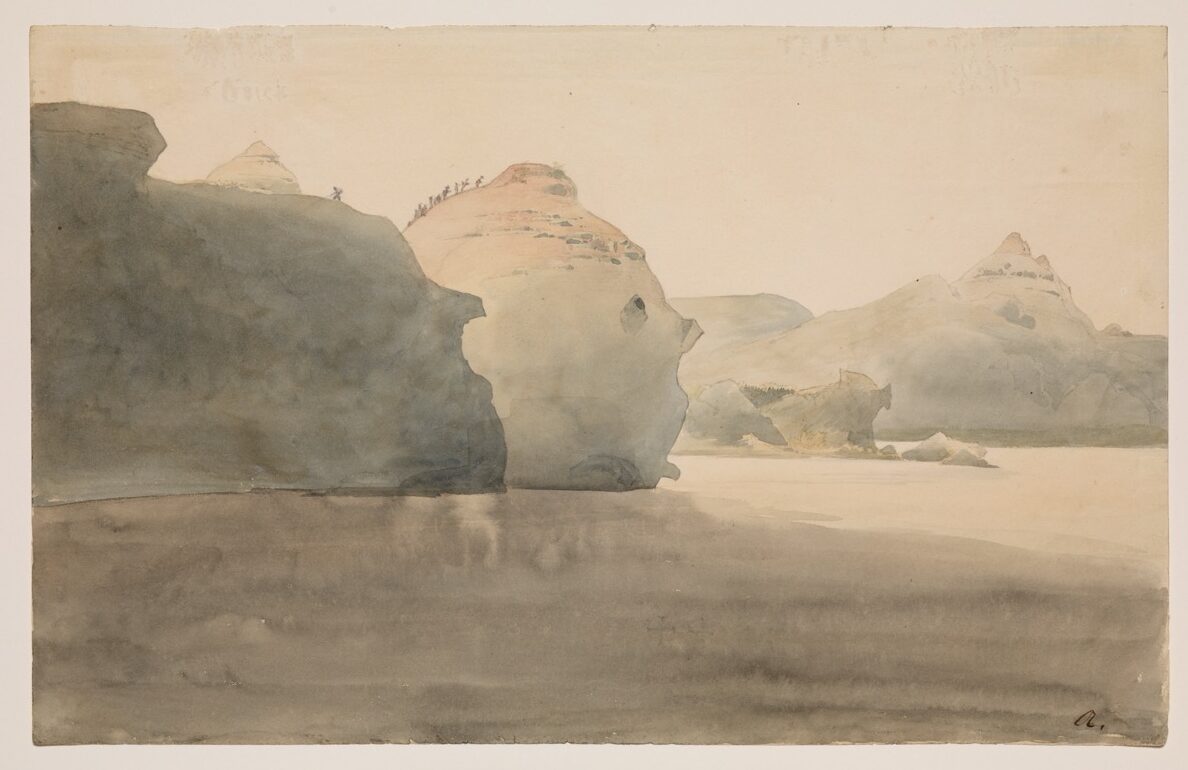
Beautiful, bright morning, calm with warm sunshine. We moved on early. Woods and willows on both banks, above which the strange chains of clay hills rose, some of them high. They have single, unusual small domes standing in isolation, [with] a whitish gray color like the hills in general. Very early on the left bank, we saw a deer; two hunters were put out on each side. No one had caught any fish, despite the many lines. Part of the crew was pulling [on] the cordelle; some of them were taken in, and they pushed the boat with long poles equipped with iron ferrules. We proceeded between the right bank and a small sandbar. On the left bank, we saw swans, which, together with wild geese, we had tracked in the mud on the banks. The bighorn (les grosses cornes), in particular, live in the bare clay elevations which the French call les Mauvaises Terres [the Badlands], although not yet in large numbers here.
We now had our little cabin, of about 8 paces in length, in better order. Guns hung on the ceiling and walls; the traveling bags and chests had been suitably distributed and moved to the side, [and] we had slept very well on our buffalo hides with blankets. The cabin contained two bedsteads: one for Mr. Mitchell and his Indian woman, who, like an automaton, sat or lay in bed all day and whom no one was concerned about; I slept in the other one. The three other cabin passengers slept on the floor.
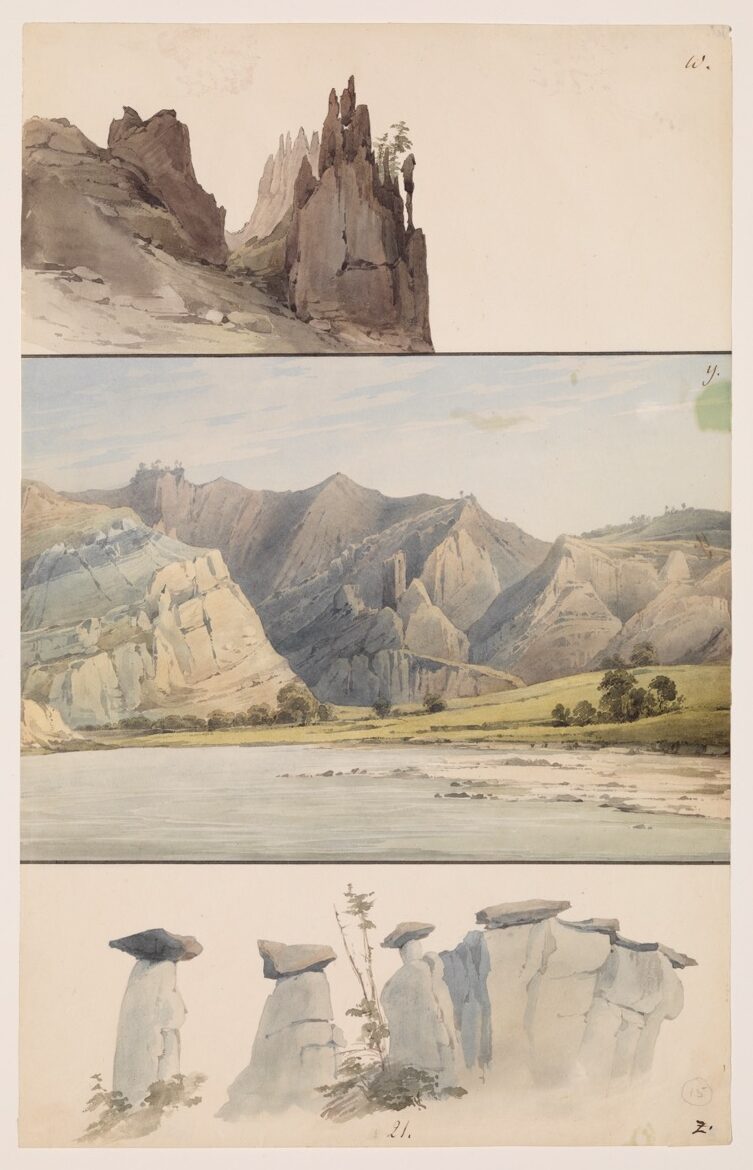
 At nine o’clock we stopped for a while on the right bank. One of our hunters returned but had not shot anything. A profusion of roses was blooming under the tall, lofty cottonwoods. Behind the trees was a narrow prairie; beyond [this] rose high, steep, whitish gray clay hills with nothing but vertical edges and small ravines between them. In the center and on the lower parts of these unusual walls there was brick-red clay in places. On the left bank, the same color now appeared on the walls. During the night the level of the river fell 4 inches. In the bushes on the bank to the right, we saw many leaves that had suffered from frost. Several interesting plants appeared new to us, including one like a violet Epilobium; the beautiful yellow plant with a large starlike flower from the family of Syngenesia ([— —]) bloomed commonly on the bank, as [did] clusters of roses. Artemisia grew everywhere but was not yet blooming. After one and a half or two hours, the forest comes to an end to the left, and the high, whitish gray bluffs, 150 to 200 or more feet high, precipitously adjoin the river. Many cedar thickets grow in their not-very-deep ravines. Before us on the left bank, we saw one of our hunters, who, however, did not seem to be carrying anything. The heat on deck was very intense now; one could not stay there long. On the bank flew pretty butterflies, including the big yellow Papilio turnus, which resembles our podalirius and machaon; it is common in Pennsylvania. A sandbar off the right bank, around which the boat was pushed with poles. Several ducks before us; one sees very few of them now, but many in fall and spring. Soaring urubus fly above the shady forest to the right. To the left, all the small level areas before the hills and their small ravines and slopes have a whitish cover of Artemisia; cedars (Juniperus virginiana), some of them tall and sturdy, [grow] on the higher walls and ravines, where they form blackish spots on the light gray and brownish or grayish green and whitish clay walls. To the right, a forest with tall, slender, stately, dense cottonwoods. To the left in the bluffs, a big, long, completely brick-red hill; all these red hills are said to have been affected by fire. It is said that one can find slaglike rocks on them. In the forest to the right, which is quite unusual for this region, there is [a] beautiful, thick underbrush of blooming roses. Here one often hears the melancholy call of the turtledove (Columba carolinensis), which is common here; [also] the call of the crows. On the cottonwoods with a diameter of 2 feet, one sees [that] the bark [has been] torn away by the ice, a good 15 feet above the river (the bank is 10 feet high).
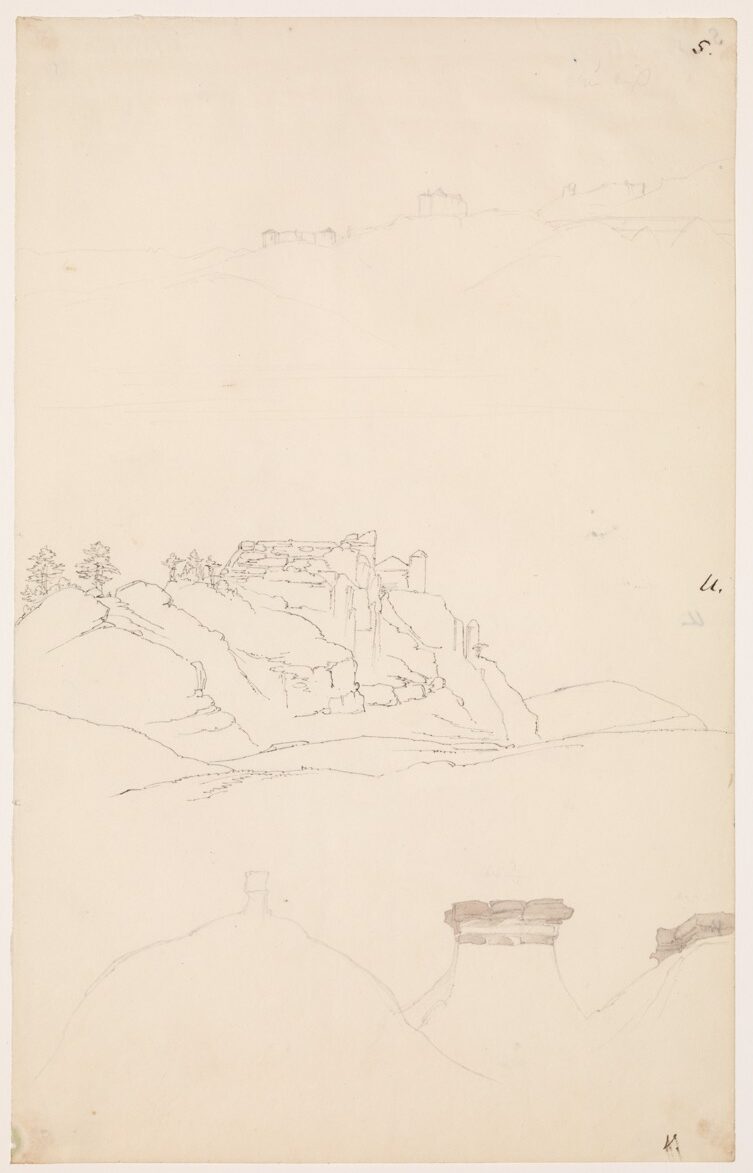
The forest now comes to an end. A whitish prairie overgrown with Artemisia joins it; behind it, the most unusual chain of high, whitish clay hills with brickred spots and several strata. One of our hunters had already returned; he had seen two deer and had shot [a] Falco borealis. David [Dreidoppel] and the carpenter appeared in the prairie; the former had shot a nice [bird], possibly Icterus. A young man caught a large specimen of Coluber eximus. The beautiful light vermilion [— —] formed completely red patches on the bank of the prairie. Dreidoppel brought some other nice plants. 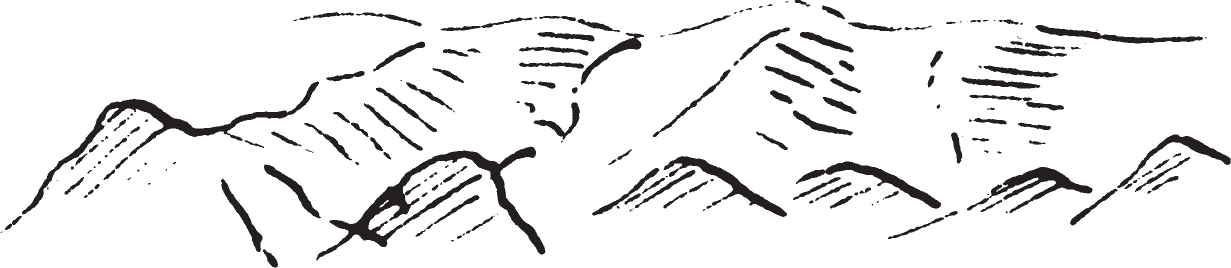 Rows of brick-red conical domes stood before the hills. When we reached this bluff, we [saw] the remarkable wall at close range: in the whitish argillite layers that lie between the clay, one can see hollow areas, archlike on top, [and] here and there like gates or windows of old castles.

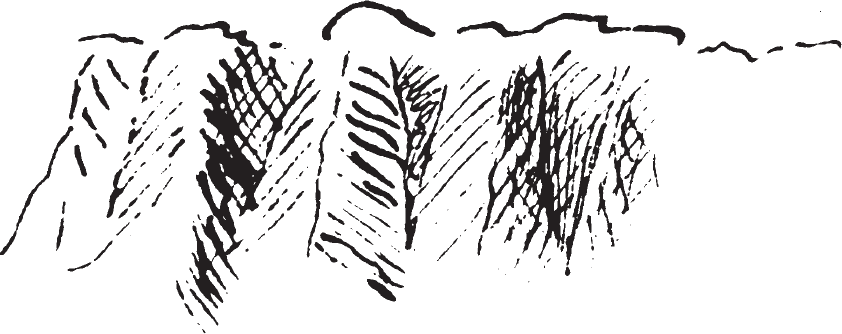
We crossed to the left bank and put in there; the men were put ashore to pull. Mr. Mitchell, Culbertson, and Bodmer entered the forest to hunt. The river turned left; forest on both banks. To the left among the willows, tall blooming roses. In the bluffs to the right, a narrow, coal-black stratum. To the left, tracks of wild geese in the sand. Here the forest soon came to an end, followed [by] a prairie covered with Artemisia. Dark storm clouds rose in the southwest (hora 5), [and] the river turned in this direction. Most unusual domes on the bluffs to the right. In the prairie our men found a large, approximately 3 1/2-foot-long rattlesnake (Crotalus tergeminus Say), the rattling of which we heard on ship; it was brought to me still alive. The hunters were driven back by rain, which soon stopped, however. The hunters had seen two deer; Deschamps had shot a deer and had seen four elk. On the left bank we now reached the high, striking clay walls with some red domes; swallows were nesting in some of these bluffs. On the peaks our men climbed like chamois; the current was very powerful, and one had to work strenuously. Mr. Bodmer sketched several hills (sketch A.). [A] Bufo clamosus was brought to me; I had heard [one] recently emitting its deep, short sounds in the prairie near Fort Union.
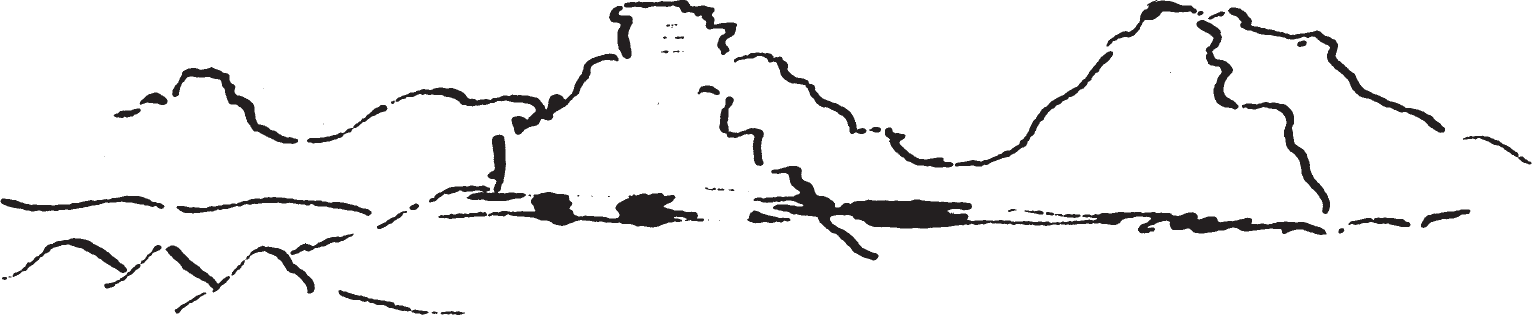
About evening we stopped at a forest to the left, where our hunters went out. We soon heard them shooting, and they sent us a variable hare (Lepus variabilis), which we had not yet seen. Since we heard several shots, we assumed they had killed game, and Mr. Mitchell sent a man to find out. On the right bank, [a] very interesting high hill chain with isolated red patches and domes, as well as a few disconnected, coal-black strata. At least four such strata extend at wide intervals along the cross section of the hills. This black matter seems to be formed from carbonized vegetable matter, but no one has discovered any use for it; therefore, it is not bituminous coal. The river now turned left again, away from this hill chain, and here there were again very unusual red cones standing before the higher walls.
Evening very pleasant; the sun sets. From the deck they shot at wild geese, which the Canadians call outarde. Low willow thicket to the right; to the left, cottonwood forest, in which trees always have to be cut down along the bank in order [for the men] to pass through with the cordelle. Our hunters came in and brought a fawn; this was their entire take. In the dense rosebush thicket, Bodmer had suddenly found himself quite close to a big rattlesnake and had caught it. On this occasion Mr. Mitchell related that he had seen an Indian boy die within an hour and a half from the bite of such a snake. The snake had struck him below the ankle. We soon stopped at the forest to the left. Evening very pleasant, few mosquitoes.